• Product
  • Suppliers
  • Manufacturers
  • Solutions
  • Free tools
  • Knowledges
  • Experts
  • Communities
Search


Free Expert Guides on Power Systems, Circuit Design & Electrical Troubleshooting

Access free engineering resources from IEE Business—covering power design, circuit layout, equipment selection, and troubleshooting. Expert-developed guides help engineers, procurement, and project teams make better decisions. Stay ahead on smart grids, renewables, efficiency, and AI tools. Improve reliability, reduce downtime, and enhance outcomes with real-world solutions. Explore our knowledge hub today.
Torsion bar spring operating mechanisms for circuit breaker
Enhanced Interrupting Capabilities and Mechanical Reliability in Gas-Insulated Circuit Breakers (GCBs)Mitsubishi Electric has developed a highly advanced torsion bar spring operating mechanism for Gas-Insulated Circuit Breakers (GCBs), which has enabled the development of higher interrupting capabilities, reaching up to 550/420 kV. This innovative mechanism offers several key benefits, including increased mechanical reliability and reduced maintenance requirements.Key Features of the Torsion Bar
12/19/2024
Consult
Tip
Consult
Tip
Disadvantage of overvoltage limitation methods in shunt reactor switching by circuit breakers according to IEEE
Overvoltage Protection Measures in SwitchgearIn high-voltage circuit breakers (CB), several protection methods are commonly used to address transient recovery voltage (TRV) and other overvoltage phenomena. Below are some typical protection methods along with their advantages and disadvantages:1.Opening Resistor Advantages: Provides additional damping during the opening of the circuit breaker, which helps in suppressing overvoltages. Disadvantages: Increased Mechanical Complexity: The opening r
12/18/2024
Consult
Tip
Consult
Tip
Short Line Fault interruption(SLF) principle in grid by circuit breakers
High-Frequency Transient Recovery Voltage (TRV) in Transmission LinesWhen a fault occurs on a transmission line at a distance ranging from 100 meters to several kilometers, a circuit breaker (CB) is required to clear the short-line fault (SLF). The process of clearing the fault by the circuit breaker can lead to the generation of a Transient Recovery Voltage (TRV) with a steep rate of rise, often resembling a sawtooth waveform. This phenomenon is caused by high-frequency oscillations generated b
12/17/2024
Consult
Tip
Consult
Tip
AC High voltage Air Break Disconnector Switch Routine Test According to IEC 62271-102 Standard
High Voltage Air-Break Disconnectors and Earthing Switches: Function, Types, and Routine TestingFunction of High Voltage Air-Break DisconnectorsHigh voltage air-break disconnectors play a critical role in high voltage power systems by providing electrical and visible isolation between different parts of the system. This isolation is essential for both normal day-to-day operations and maintenance or repair activities. The two primary forms of isolation are: Isolation for Normal Operation:During n
12/16/2024
Consult
Tip
Consult
Tip
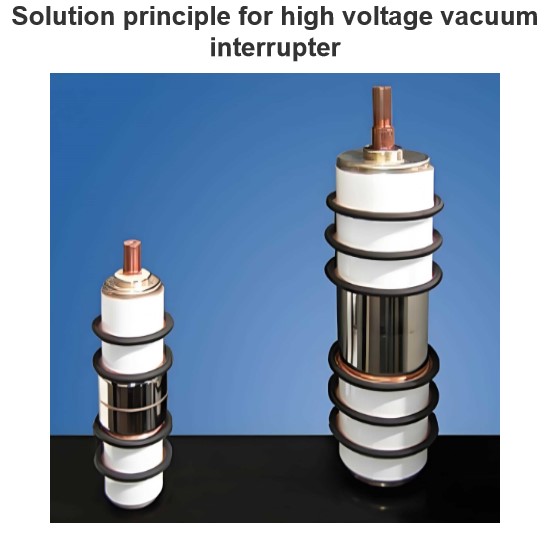
Solution principle for high voltage vacuum interrupter
Enhancing Dielectric Strength in Vacuum Gaps for High-Voltage InsulationThere are primarily two methods to increase the dielectric strength of a vacuum gap to meet the insulation requirements at high voltage (HV):Increase the Contact Distance in a Two-Contact Configuration: In a vacuum, breakdown is predominantly a surface effect, heavily influenced by the condition of the contact surfaces. Unlike in SF6 gas, where breakdown is primarily a volume effect that scales linearly with the gap length,
12/13/2024
Consult
Tip
Consult
Tip
Voltage Escalation in Shunt Reactor Switching in Circuit Breakers
Shunt-Reactor Switching: A Common Practice in Inductive-Load SwitchingShunt-reactor switching is one of the most common practices in inductive-load switching. Shunt reactors are installed to compensate for overhead-line capacitance and are switched in or out based on the momentary line load. Since a shunt reactor can be treated as a lumped circuit element with stray capacitance, the equivalent load circuit can be simplified to a straightforward LC (inductor-capacitor) circuit.Voltage Oscillation
12/12/2024
Consult
Tip
Consult
Tip
Transient Recovery Voltage(TRV) in Interruption of Small Inductive Currents by Circuit Breakers
Analyzing Transient Phenomena in Linear Systems Using the Principle of SuperpositionIn analyzing transient phenomena caused by switching operations in linear systems, the principle of superposition is a powerful tool. By combining the steady-state solution that existed before the open-circuit operation with the transient responses induced by short-circuit voltage sources and open-circuit current sources, and considering the current injected through the switch contacts, a comprehensive descriptio
12/11/2024
Consult
Tip
Consult
Tip
AC Circuit Breakers Routine Tests according to IEC 62271-100
To ensure the superior quality and performance of each AC circuit breaker in terms of materials, design, and assembly, manufacturers perform routine tests on every unit produced. These tests are essential for verifying the reliability and safety of the circuit breakers, confirming their ability to function correctly under specified conditions.For multi-phase circuit breakers consisting of multiple breaker units (such as V-type or T-type configurations), routine testing is conducted on the fully
12/10/2024
Consult
Tip
Consult
Tip
High voltage Incoming and outgoing feeders configuration in switch yards
The incoming and outgoing feeders of switchgear cabinets are typically equipped with circuit breakers, isolating switches, and earthing switches to ensure the safe operation of the power system. In high-voltage switch stations, each feeder is also fitted with current transformers (CTs) and potential transformers (PTs) to connect protection and measurement devices. CTs are positioned on the busbar side of the PTs to allow protection devices to detect short circuits in the PTs. For feeders without
12/09/2024
Consult
Tip
Consult
Tip
Out of phase current switching in High Voltage Circuit Breakers
When two parts of an electrical network with the same operating voltage are coupled, a phase displacement switching phenomenon occurs if their equivalent sources have different phase angles, with some or all phases being 180° out of phase. During the switching operation, the circuit breaker encounters source voltages with differing phase angles, leading to the presence of phase-displaced currents in the connection. These currents must be reliably interrupted by the circuit breakers on bo
12/07/2024
Consult
Tip
Consult
Tip
Send inquiry
+86
Click to upload file

IEE Business will not sell or share your personal information.

Download
Get the IEE Business Application
Use the IEE-Business app to find equipment, obtain solutions, connect with experts, and participate in industry collaboration anytime, anywhere—fully supporting the development of your power projects and business.