• Product
  • Suppliers
  • Manufacturers
  • Solutions
  • Free tools
  • Knowledges
  • Experts
  • Communities
Search


Free Expert Guides on Power Systems, Circuit Design & Electrical Troubleshooting

Access free engineering resources from IEE Business—covering power design, circuit layout, equipment selection, and troubleshooting. Expert-developed guides help engineers, procurement, and project teams make better decisions. Stay ahead on smart grids, renewables, efficiency, and AI tools. Improve reliability, reduce downtime, and enhance outcomes with real-world solutions. Explore our knowledge hub today.
What are four major hazards which may arise from the use of electrical equipment?
The four major dangers associated with the use of electrical equipment mainly include the following:Electric Shock:Electric shock is one of the most common electrical hazards. When a person comes into contact with a live electrical part, current passes through the body, potentially causing anything from minor tingling to fatal injuries. Electric shocks not only pose a threat to personal safety but can also lead to equipment damage and production interruptions.Fire:Electrical equipment failures,
11/15/2024
Consult
Tip
Consult
Tip
Is it safe to use a CO2 fire extinguisher on a high voltage transformer?
Using a carbon dioxide (CO₂) fire extinguisher on a high-voltage transformer is generally safe, but there are important considerations to keep in mind. Here are the key points regarding the safety and precautions:SafetyNon-Conductive: Carbon dioxide (CO₂) is an inert gas and does not conduct electricity. Therefore, using a CO₂ fire extinguisher to extinguish electrical fires does not increase the risk of electric shock, which is one of its main advantages.No Residue: CO₂ leaves no residue after
11/09/2024
Consult
Tip
Consult
Tip
What happens when there is an electric shock in a neutral wire?
Principles of electric shockIn a normal three-phase four-wire power supply system, the neutral wire (PEN wire or N wire) is grounded. Theoretically, the potential of the neutral wire is the same as that of the earth. When the three-phase load is balanced, there is almost no current flowing through the neutral wire. However, when a person touches the neutral wire and there is a fault in the neutral wire, an electric shock accident may occur.Electric shock mainly occurs because there is current fl
10/25/2024
Consult
Tip
Consult
Tip
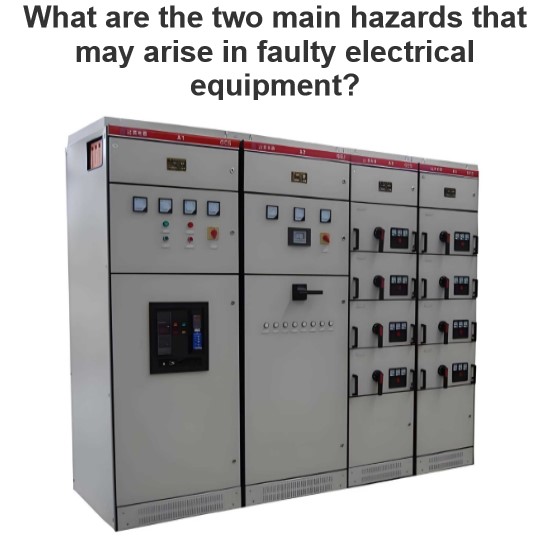
What are the two main hazards that may arise in faulty electrical equipment?
Electrical equipment failures may cause the following two main dangers:I. Danger of electric shockDirect contact electric shockWhen an electrical equipment fails, such as when insulation is damaged and wires are exposed, if a person accidentally touches the live part, direct contact electric shock will occur. For example, if the insulation of a motor is punctured and the motor casing is live, and an operator touches the casing, the current will flow through the human body into the ground, causin
10/22/2024
Consult
Tip
Consult
Tip
Is it more or less dangerous to touch high voltage wires in water?
Touching a high-voltage wire while in the water is indeed more dangerous.Here's an explanation Enhanced Conductivity: Water is an excellent conductor of electricity, especially when it contains impurities such as salt water or sewage. When a person is in the water, the conductivity of the body significantly increases, which means that current can more easily pass through the human body. Reduced Insulation: In water, the insulation provided by human skin and clothing is significantly diminished.
10/21/2024
Consult
Tip
Consult
Tip
What are some common causes of electrical outlet failure?
Some common causes of power socket failures are as follows:I. Overload usageConnecting too many electrical appliances Users may connect too many electrical appliances to one power socket. For example, in a family, multiple devices such as a television, computer, stereo, and charger are connected to an ordinary socket at the same time. When these devices are working simultaneously, the total current may exceed the rated current carrying capacity of the socket. The consequence is that the conducto
10/15/2024
Consult
Tip
Consult
Tip
How does electricity travel through our bodies?
1. The way electricity passes through the bodyDirect contact Conductive object contact: When the human body directly touches the charged conductor, the current will enter the human body through the contact point. For example, touching exposed wires, touching electrical equipment with leakage, etc. At this point, the current will enter the body from the contact point, and then through the various tissues and organs of the body, and finally flow to the earth or other grounded objects. Humid enviro
10/10/2024
Consult
Tip
Consult
Tip
What are the effects of having more than one kilo-volt of static electricity on our body?
Static electricity above 1000 volts may have the following effects on the body:1. Slight impactTingling sensationWhen the human body comes into contact with an object with more than 1,000 volts of static electricity, it may feel an instant sting. This is because the current generated by electrostatic discharge passes through sensitive parts of the human body, such as fingers, palms, etc., and stimulates nerve endings. For example, in the dry winter months, when you touch a metal door handle, you
10/10/2024
Consult
Tip
Consult
Tip
What factors contribute to some people being more prone to getting electrical shocks than others?
Human resistance differenceSkin conditionThe skin is an important part of the body's electrical resistance. When the skin is dry, the resistance is relatively large; When the skin is wet, the resistance decreases significantly. For example, in the case of heavy sweating or water stains on the skin surface (such as recently washed hands did not dry), the human resistance may be reduced from thousands of ohms when dry to hundreds of ohms or even lower. This is because moisture dissolves electrolyt
10/09/2024
Consult
Tip
Consult
Tip
How can we prevent current from flowing through people touching two hot wires in an ungrounded system?
Insulation protectionInsulation tools and equipmentIn an ungrounded system, the use of insulating tools and equipment is an important means to prevent the current from flowing through the person touching the two live wires. For example, when operating electrical equipment, electricians should use well-insulated electrical pliers, screwdrivers and other tools. The insulated handle of these tools prevents electrical current from being transmitted through the tool to the human body. For the electri
10/09/2024
Consult
Tip
Consult
Tip
Send inquiry
+86
Click to upload file

IEE Business will not sell or share your personal information.

Download
Get the IEE Business Application
Use the IEE-Business app to find equipment, obtain solutions, connect with experts, and participate in industry collaboration anytime, anywhere—fully supporting the development of your power projects and business.