• Product
  • Suppliers
  • Manufacturers
  • Solutions
  • Free tools
  • Knowledges
  • Experts
  • Communities
Search


Free Expert Guides on Power Systems, Circuit Design & Electrical Troubleshooting

Access free engineering resources from IEE Business—covering power design, circuit layout, equipment selection, and troubleshooting. Expert-developed guides help engineers, procurement, and project teams make better decisions. Stay ahead on smart grids, renewables, efficiency, and AI tools. Improve reliability, reduce downtime, and enhance outcomes with real-world solutions. Explore our knowledge hub today.
What is the classification of a transformer?
Classification of TransformersA transformer is a device that can change the alternating voltage and is widely used in power systems, industrial equipment, and household appliances. Transformers can be divided into various types according to different standards. The following are the main classification methods of transformers and their specific types:Classified by use Power Transformer: Used for stepping up and down voltage in power distribution systems. Instrument Transformers: Such as voltage
10/26/2024
Consult
Tip
Consult
Tip
What are the pros and cons of using a single-phase transformer compared to a three-phase transformer?
For a low-power transformer like 5kVA, compared with three-phase transformers, using single-phase transformers has the following advantages and disadvantages:I. Advantages of single-phase transformersLower costThe structure of single-phase transformers is relatively simple, and the manufacturing process and material costs are usually lower than those of three-phase transformers. For small power requirements such as a 5kVA transformer, the price of single-phase transformers may be more advantageo
10/21/2024
Consult
Tip
Consult
Tip
What is the purpose of using a 12 volt DC transformer in an AC circuit?
Using a 12-volt DC transformer (often called an adapter or power converter) in an AC circuit serves the purpose of converting alternating current (AC) to direct current (DC) and reducing the voltage to the desired level. Here are some common uses of a 12-volt DC transformer:1. Powering DC DevicesMany electronic devices and small appliances require DC power to function. A 12-volt DC transformer can provide a stable DC voltage for these devices. Examples include: Consumer Electronics: Such as phon
10/19/2024
Consult
Tip
Consult
Tip
What is a type of step-up transformer?
Step-up transformers (Step-up Transformers) are devices used to increase voltage levels and are widely applied in power transmission systems to reduce energy losses during transmission. Depending on various criteria, step-up transformers can be classified into different types. Here are the categories of step-up transformers according to different classification standards:1.By Number of Phases Single-phase Step-up Transformer: Suitable for residential or small commercial facilities. Three-phase S
10/16/2024
Consult
Tip
Consult
Tip
What are the effects of applying a negative DC input to the secondary of a transformer?
Applying a negative DC input to the secondary of a transformer can have the following effects:I. Effects on the transformer itselfCore saturationTransformers are usually designed to handle AC signals. When a DC input, especially a negative DC, is applied, it will generate a fixed magnetic field direction in the transformer core. This may lead to gradual saturation of the core.After the core is saturated, its permeability will drop sharply, and the inductance of the transformer will also be great
10/14/2024
Consult
Tip
Consult
Tip
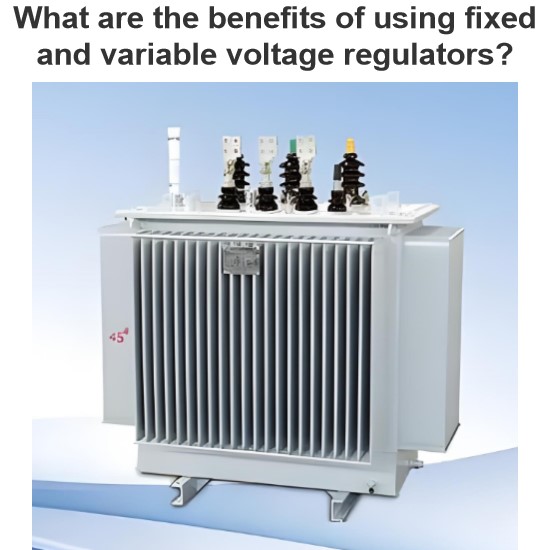
What are the benefits of using fixed and variable voltage regulators?
The benefits of using fixed and variable voltage regulators are as follows:I. Benefits of fixed voltage regulatorsStable output voltageFixed voltage regulators can provide a constant output voltage, unaffected by input voltage fluctuations and load changes. This is crucial for electronic devices that require a stable power supply. For example, microprocessors, digital circuits, and analog circuits have high requirements for power supply voltage stability. Fixed voltage regulators can ensure that
10/12/2024
Consult
Tip
Consult
Tip
What are some applications where an autotransformer is used instead of a normal transformer in substations?
In the substation, the autotransformer can replace the ordinary transformer in some cases, and its application mainly has the following aspects:First, power transmissionIncrease voltage levelIn long-distance power transmission, in order to reduce line losses, it is necessary to increase the voltage level. The autotransformer can easily increase or decrease the voltage to meet the power transmission needs of different voltage levels. For example, when transporting electrical energy from a power p
10/11/2024
Consult
Tip
Consult
Tip
What is the name of the insulating material used on a transformer's primary winding?
The insulation materials commonly used in transformer primary winding are as follows:Enamel wire insulating paintEnamelled wire is made by coating conductors such as copper wire with a layer of insulating paint. This insulating paint usually has good electrical insulation properties, heat resistance and chemical corrosion resistance. It can effectively isolate the conductor of the primary winding from other parts, preventing short circuit and leakage. For example, polyurethane wire insulating pa
10/10/2024
Consult
Tip
Consult
Tip
What are the methods for identifying whether a transformer has solid insulated windings or paper-oil insulated windings?
Identifying whether transformer windings use solid insulation or paper-in-oil insulation involves several methods, including physical inspection, electrical testing, and other analytical approaches. Here are some common methods to distinguish between the two types of insulation:Physical Inspection1. Visual Inspection Inspect Winding Materials: Solid insulation transformers typically use polymers (such as epoxy resin, polyester film, etc.) as insulating materials, whereas paper-in-oil insulation
10/10/2024
Consult
Tip
Consult
Tip
Can you explain how an electrical transformer works and its significance in the power grid?
The working principle and importance of power transformers in the power grid can be explained from several aspects:Working PrincipleThe basic working principle of an electric transformer is based on the law of electromagnetic induction. It mainly consists of two windings, one called the primary winding (or first winding) and the other called the secondary winding (or second winding). When the primary winding is connected to an alternating current power supply, the current produces a changing mag
10/10/2024
Consult
Tip
Consult
Tip
Send inquiry
+86
Click to upload file
Download
Get the IEE Business Application
Use the IEE-Business app to find equipment, obtain solutions, connect with experts, and participate in industry collaboration anytime, anywhere—fully supporting the development of your power projects and business.