• Product
  • Suppliers
  • Manufacturers
  • Solutions
  • Free tools
  • Knowledges
  • Experts
  • Communities
Search


Free Expert Guides on Power Systems, Circuit Design & Electrical Troubleshooting

Access free engineering resources from IEE Business—covering power design, circuit layout, equipment selection, and troubleshooting. Expert-developed guides help engineers, procurement, and project teams make better decisions. Stay ahead on smart grids, renewables, efficiency, and AI tools. Improve reliability, reduce downtime, and enhance outcomes with real-world solutions. Explore our knowledge hub today.
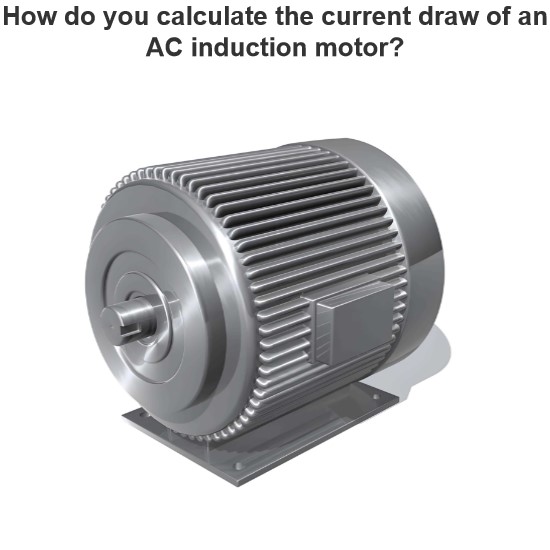
How do you calculate the current draw of an AC induction motor?
Calculating the current consumption of an AC induction motor involves multiple parameters. Below are the detailed steps and formulas to help you calculate the current consumption of an AC induction motor.Basic ParametersRated Power P (Unit: Watts, W or Kilowatts, kW)Rated Voltage V (Unit: Volts, V)Power Factor PF (Dimensionless, usually between 0 and 1)Efficiency η (Dimensionless, usually between 0 and 1)Number of Phases n (Single-phase or three-phase, typically 1 or 3)Calculation Formulas1. Sin
11/12/2024
Consult
Tip
Consult
Tip
What are the classifications of AC motors?
Types of AC MotorsAC motors (AC Motors) are a widely used class of motors that can be classified based on different working principles, structures, and applications. Below are the main categories of AC motors and their characteristics:1. Induction Motors1.1 Squirrel Cage Induction MotorStructure: The rotor is made of cast aluminum or copper bars, shaped like a squirrel cage, hence the name.Characteristics:Simple structure, low cost, and easy maintenance.High starting current but moderate startin
11/12/2024
Consult
Tip
Consult
Tip
How does torque, speed and power affect an electric motor?
1. Basic Definitions of Torque, Speed, and PowerBefore discussing the relationship between torque, speed, and power of an electric motor, it is necessary to clarify the basic definitions of these three concepts: Torque (Torque): Torque is the force that causes an object to rotate, and it is a measure of the amount of rotational force that an electric motor can provide. In physics, torque is equal to the product of force and the lever arm, with the international unit being newton meters (N·m). Sp
11/11/2024
Consult
Tip
Consult
Tip
Why does the outer frame of an induction motor have slots on its outer periphery?
The reason for the slots on the outer periphery of the frame of an induction motor.The outer periphery of the frame of an induction motor is designed with slots, primarily to accommodate and secure the stator winding. The following are the specific reasons and related details:The installation of the stator windingThe stator winding of an induction motor needs to be installed in the slots of the outer frame (stator core). These slots provide physical support, allowing the windings to be securely
11/11/2024
Consult
Tip
Consult
Tip
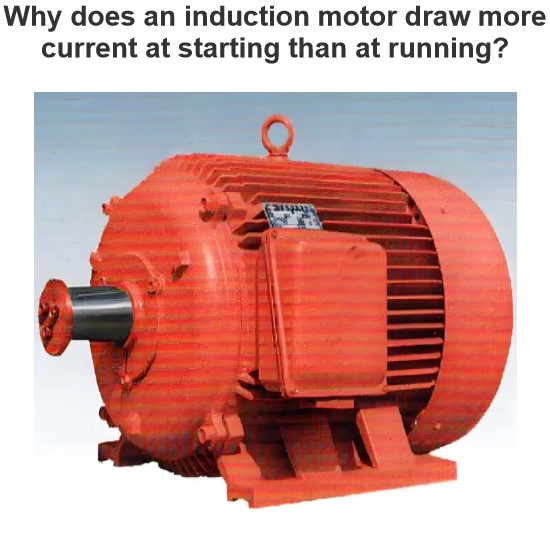
Why does an induction motor draw more current at starting than at running?
An induction motor (Induction Motor) draws more current during start-up than during operation due to the electromagnetic characteristics inside the motor at the start-up stage. Here is a detailed explanation:1. High Current Demand During Start-Up1.1 Initial Flux EstablishmentNo Initial Rotor Field: At start-up, the rotor is stationary and has no initial rotating magnetic field. The rotating magnetic field produced by the stator needs to establish a magnetic flux in the rotor.High Induced Current
11/09/2024
Consult
Tip
Consult
Tip
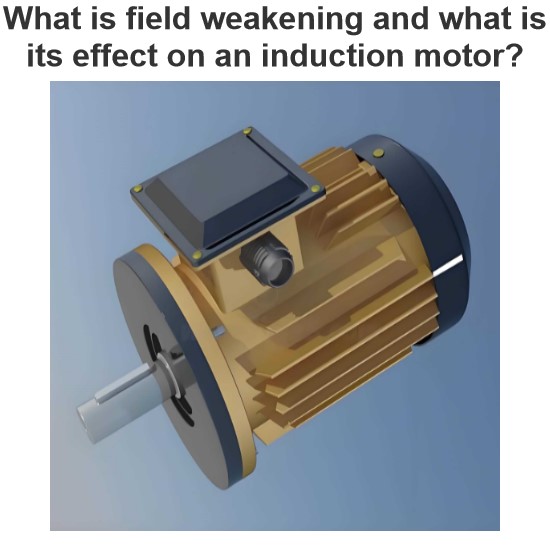
What is field weakening and what is its effect on an induction motor?
Field weakening refers to the process of adjusting the magnetic field strength of a motor during operation to modify its performance. In DC motors, field weakening is typically achieved by reducing the excitation current. In AC motors, particularly induction motors and permanent magnet synchronous motors, field weakening can be accomplished by changing the frequency of the power supply or controlling the output of the inverter.Effects of Field Weakening on Induction MotorsIn induction motors, fi
11/09/2024
Consult
Tip
Consult
Tip
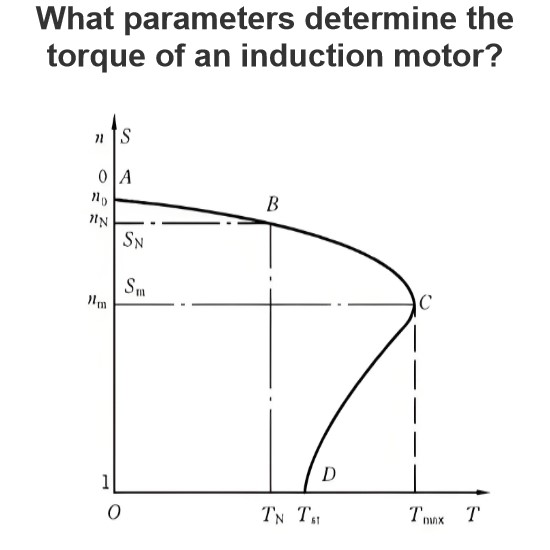
What parameters determine the torque of an induction motor?
The torque of an induction motor is influenced by various parameters, mainly including the following aspects:1. Power supply voltageThe power supply voltage has a significant impact on the torque of an induction motor. According to the operating principle of the motor, the electromagnetic torque is directly proportional to the magnetic flux per pole and the induced current in the rotor, both of which are directly proportional to the voltage. Therefore, a drop in the power supply voltage can sign
11/08/2024
Consult
Tip
Consult
Tip
What is the difference between armature winding and rotor winding?
The armature winding and the rotor winding play important but different roles in a motor. Here are the main differences between them:Armature windingDefinition: Armature winding refers to the winding in a motor that is used to generate induced electromotive force and current. It plays a crucial role in the energy conversion process of the motor.Location:In a DC motor, the armature winding is typically located on the rotating rotor.In AC motors (such as synchronous and induction motors), the arma
11/08/2024
Consult
Tip
Consult
Tip
What is the normal slip of an induction motor?
The slip (s) of an induction motor is an important parameter that measures the difference between the rotor speed and the synchronous speed of the rotating magnetic field. Slip is typically expressed as a percentage and is calculated using the following formula:Where:s is the slip (%)ns is the synchronous speed (rpm)nr is the actual rotor speed (rpm)Normal Slip RangeFor most induction motors, the normal slip range is typically between 0.5% and 5%, depending on the motor design and application. H
11/08/2024
Consult
Tip
Consult
Tip
On what principle induction motor works?
An induction motor is a widely used type of AC motor whose operating principle is based on the law of electromagnetic induction. Below is a detailed explanation of how an induction motor works:1. StructureAn induction motor mainly consists of two parts: the stator and the rotor.Stator: The stator is the stationary part, typically composed of laminated iron cores and three-phase windings embedded in the slots of the iron core. The three-phase windings are connected to a three-phase AC power sourc
11/08/2024
Consult
Tip
Consult
Tip
Send inquiry
+86
Click to upload file
Download
Get the IEE Business Application
Use the IEE-Business app to find equipment, obtain solutions, connect with experts, and participate in industry collaboration anytime, anywhere—fully supporting the development of your power projects and business.