• Product
  • Suppliers
  • Manufacturers
  • Solutions
  • Free tools
  • Knowledges
  • Experts
  • Communities
Search


Free Expert Guides on Power Systems, Circuit Design & Electrical Troubleshooting

Access free engineering resources from IEE Business—covering power design, circuit layout, equipment selection, and troubleshooting. Expert-developed guides help engineers, procurement, and project teams make better decisions. Stay ahead on smart grids, renewables, efficiency, and AI tools. Improve reliability, reduce downtime, and enhance outcomes with real-world solutions. Explore our knowledge hub today.
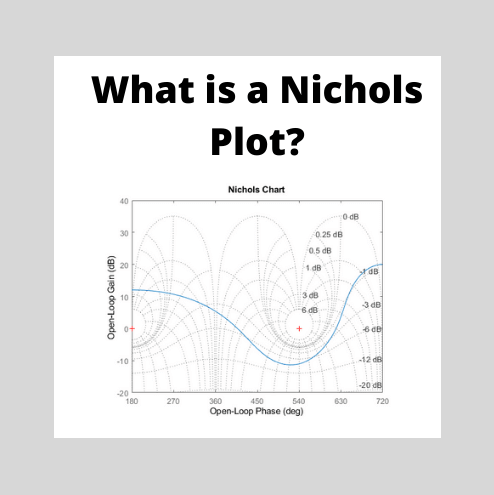
Nichols Chart: What is it?
What is a Nichols Chart?A Nichols Chart (also known as a Nichols Plot) is a plot used in signal processing and control system design to determine the stability and closed-loop frequency response of a feedback system. The Nichols chart is named after its founder, Nathaniel B. Nichols.How Does A Nichols Chart Work?Constant magnitude loci that are M-circles and constant phase angle loci that are N-circles are the fundamental components in designing the Nichols chart.The constant M and constant N ci
03/29/2024
Consult
Tip
Consult
Tip
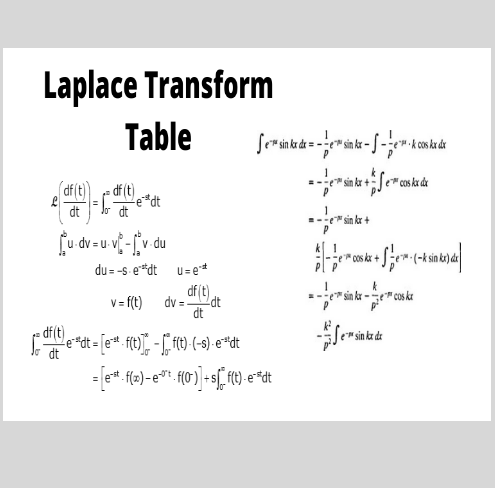
Laplace Transform Table, Formula, Examples & Properties
Laplace transformation is a technique for solving differential equations. Here differential equation of time domain form is first transformed to algebraic equation of frequency domain form. After solving the algebraic equation in frequency domain, the result then is finally transformed to time domain form to achieve the ultimate solution of the differential equation. In other words it can be said that the Laplace transformation is nothing but a shortcut method of solving differential equation.In
03/29/2024
Consult
Tip
Consult
Tip
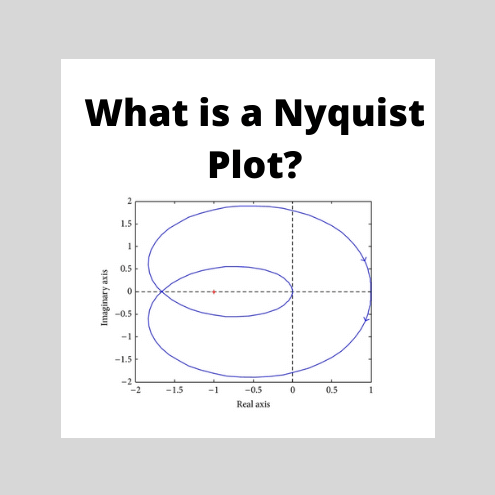
Nyquist Plot: What is it? (And How To Draw One)
What is a Nyquist Plot?A Nyquist plot (or Nyquist Diagram) is a frequency response plot used in control engineering and signal processing. Nyquist plots are commonly used to assess the stability of a control system with feedback. In Cartesian coordinates, the real part of the transfer function is plotted on the X-axis, and the imaginary part is plotted on the Y-axis.The frequency is swept as a parameter, resulting in a plot based on frequency. The same Nyquist plot can be described using polar c
03/29/2024
Consult
Tip
Consult
Tip
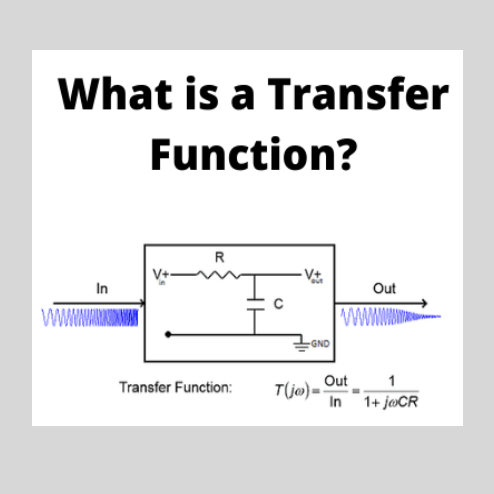
Transfer Function of Control System
A transfer functionrepresents the relationship between the output signal of a control system and the input signal, for all possible input values. A block diagram is a visualization of the control system which uses blocks to represent the transfer function, and arrows which represent the various input and output signals.For any control system, there exists a reference input known as excitation or cause which operates through a transfer operation (i.e. the transfer function) to produce an effect r
03/29/2024
Consult
Tip
Consult
Tip
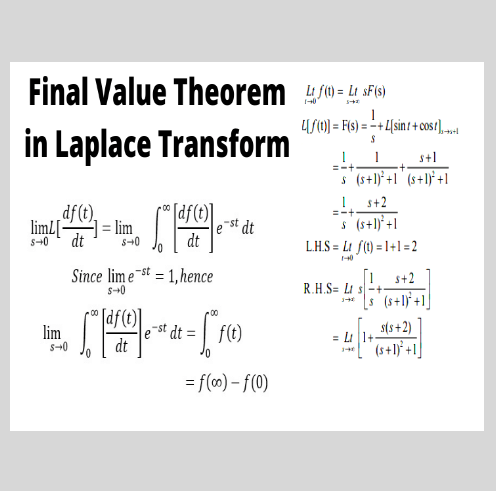
Final Value Theorem in Laplace Transform (Proof & Examples)
In the solution of Networks, Transient, and Systems sometimes we may not be interested in finding out the entire function of time f(t) from it’s Laplace Transform F(s), which is available for the solution. It is very interesting to find that we can find the first value or last value of f(t) or it’s derivatives without having to find out the entire function f(t). We will be interested in finding out final values and it’s derivatives in this article.For the sake of example:If F(s) is given, we wou
03/29/2024
Consult
Tip
Consult
Tip
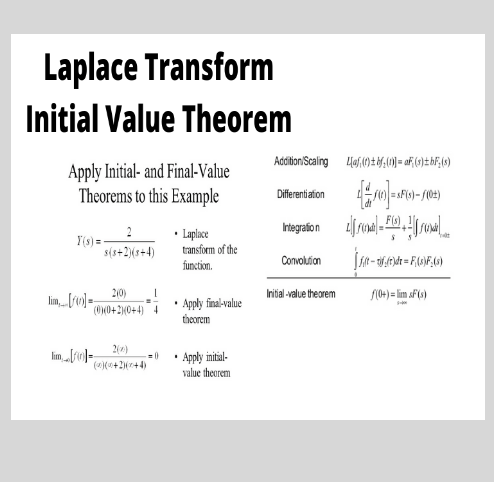
Initial Value Theorem of Laplace Transform
Initial Value Theorem is one of the basic properties of Laplace transform. It was given by prominent French Mathematical Physicist Pierre Simon Marquis De Laplace. He made crucial contributions in the area of planetary motion by applying Newton’s theory of Gravitation. His work regarding the theory of probability and statistics is considered pioneering and this influenced a whole new generation of Mathematician. Laplace is one among the 72 people to have their name engraved on the Eiffel Tower.I
03/29/2024
Consult
Tip
Consult
Tip
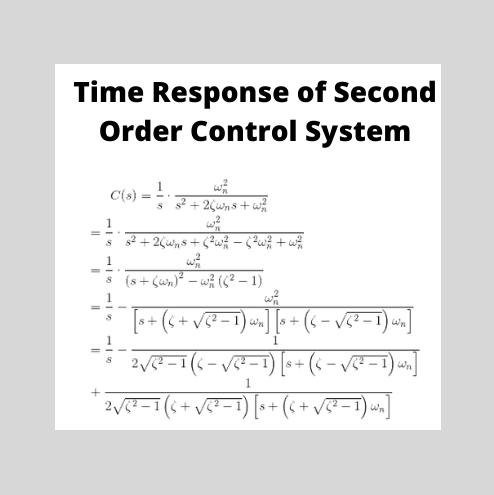
Time Response of Second Order Control System (Worked Example)
The order of a control system is determined by the power of ‘s’ in the denominator of its transfer function.If the power of s in the denominator of the transfer function of a control system is 2, then the system is said to be second order control system.The general expression of the transfer function of a second order control system is given asHere, ζ and ωn are the damping ratio and natural frequency of the system, respectively (we will learn about these two terms in detail later on).Rearrangin
03/29/2024
Consult
Tip
Consult
Tip
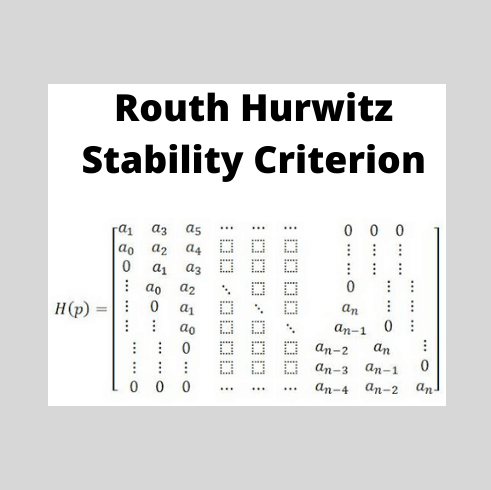
Routh Hurwitz Stability Criterion
After reading the theory of network synthesis, we can easily say that any pole of the system lies on the right hand side of the origin of the s plane, it makes the system unstable. On the basis of this condition A. Hurwitz and E.J.Routh started investigating the necessary and sufficient conditions of stability of a system. We will discuss two criteria for stability of the system. A first criterion is given by A. Hurwitz and this criterion is also known as Hurwitz Criterion for stability or Routh
03/29/2024
Consult
Tip
Consult
Tip
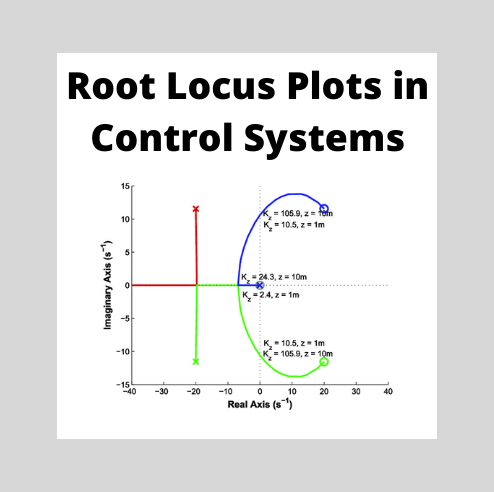
Root Locus Technique in Control System | Root Locus Plot
The root locus technique in control system was first introduced in the year 1948 by Evans. Any physical system is represented by a transfer function in the form ofWe can find poles and zeros from G(s). The location of poles and zeros are crucial keeping view stability, relative stability, transient response and error analysis. When the system is put to service stray inductance and capacitance get into the system, thus changes the location of poles and zeros. In root locus technique in control sy
03/29/2024
Consult
Tip
Consult
Tip
State Space Analysis of Control System
Before I introduce you about the concept of state space analysis of control system, it is very important to discuss here the differences between the conventional theory of control system and modern theory of control system. The conventional control theory is completely based on the frequency domain approach while the modern control system theory is based on time domain approach. In the conventional theory of control system we have linear and time invariant single input single output (SISO) syste
03/29/2024
Consult
Tip
Consult
Tip
Send inquiry
+86
Click to upload file

IEE Business will not sell or share your personal information.

Download
Get the IEE Business Application
Use the IEE-Business app to find equipment, obtain solutions, connect with experts, and participate in industry collaboration anytime, anywhere—fully supporting the development of your power projects and business.