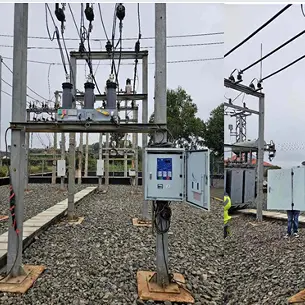
Positioning: An intelligent retrofit solution for existing equipment aimed at power grid companies, power supply bureaus, and EPC contractors—without replacing the fuse itself, simply by adding a snap-on smart monitoring device, ordinary drop-out fuses can achieve fault location within seconds.
Applicable to: 6kV–40.5kV overhead distribution lines (branch circuits, primary side of distribution transformers).
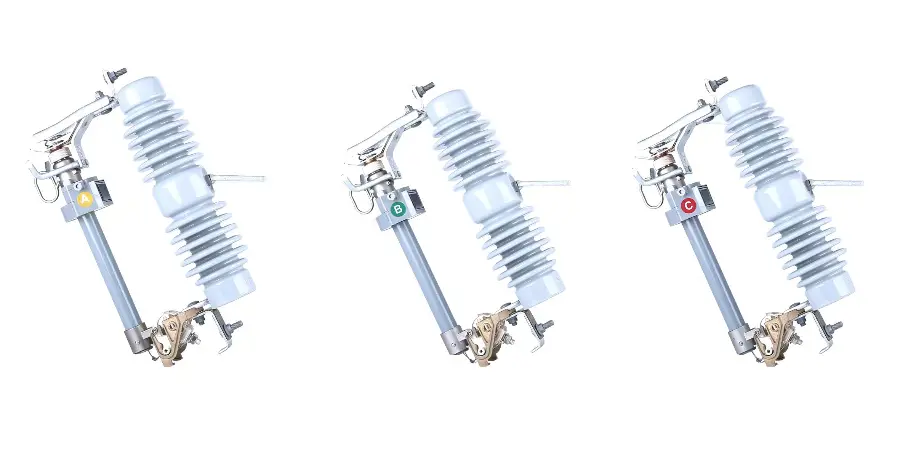
01 Transformation Background: Your power grid still “can’t see” faults.
A large number of conventional drop-out fuses currently in operation in distribution networks serve to protect line branches and distribution transformers. However, they all share a common issue: after tripping, there is no electrical indication whatsoever.
Fuse drop-out → No signal, no indication → Only manual line patrol and pole-by-pole inspection are possible → The time spent on fault location accounts for more than 60% of the total outage duration (industry experience).
As a result: The equipment isn't broken, yet the power outage lasts for a long time. The labor, vehicle, and time costs associated with line patrols continue to rise, putting pressure on power supply reliability metrics (SAIDI/SAIFI), and customer complaints keep piling up.
Try a different approach: Rather than replacing all the circuit breakers, why not let them “speak up”?
02 Renovation plan: Install a snap-on smart monitoring device.
2.1 Transformation logic (one sentence)
Retain all the original features of the fuse while adding a “sensing + communication” external module—transforming a conventional drop-out fuse into a smart drop-out fuse.
2.2 Complete the renovation in three steps.
| Steps |
Content |
Time |
| ① Buckle installation |
The open-and-close monitoring device clips onto the fuse body, allowing for monitoring without power interruption and eliminating the need to rewire. |
About 5 minutes/photo |
| ② Communication Configuration |
Interleaved 2.4G networking + collector RS485 aggregation, with 4G/SMS reporting. |
30 Minutes/Transformer District |
| ③ Platform Access |
Connect to the cloud platform, establish device profiles, set up alarm policies, and implement map-based positioning. |
Activated on the same day |
2.3 Comparison before and after renovation (same line)
| Project |
Before modification (ordinary fuse) |
After modification (+ SRW12-K) |
| Fuse positioning |
Manual line inspection: 2–8 hours |
Alert + Location: Delivered in about 5 minutes |
| Current/Temperature Monitoring |
✗ |
✓ (Automatic alarm upon exceeding threshold) |
| Device Location Archive |
Paper ledger |
Beidou positioning, platform traceability available. |
| Data assets |
None |
Accumulation of current/temperature data to support line loss and load analysis. |
| Original protection characteristics |
— |
Completely preserved, unaffected. |
| Power outage renovation |
— |
Zero power outages, zero line reconfigurations |
2.4 Technical Key Points (Basis for Modification and Selection)
- Rated voltage: 6kV–40.5kV; universally applicable to overhead distribution lines; one set of configuration covers all voltage levels.
- Four-channel communication (2.4G + RS485 + 4G + SMS fallback)—no alarm loss even in areas with weak signals;
- Solar-powered, requiring no wiring and no battery replacements, enabling long-term independent operation of remote poles and towers.
- Pre-warning for contact temperature monitoring to prevent fuse and distribution transformer burnout caused by overload or poor contact.
- Snap-fit opening and closing, with detachable replacement—device maintenance or relocation does not affect the primary equipment.
- Without altering the fuse’s physical structure, protective characteristics, or installation method, safety is ensured by the original equipment, while intelligence is provided by the additional device.
03 Transformation benefits: Low investment, quick returns.
3.1 Direct Benefits (Illustrative Calculation, Single Feeder/Year)
| Benefit item |
Improve content |
Annualized Value (Illustrative) |
| Fewer power outage losses |
Single power outage duration shortened by approximately 3.5 hours. |
≈$516 (× 6 times per year) |
| Line inspection cost savings |
No need for manual line patrols (human labor + vehicles) |
Approximately $900 |
| Avoidance of fire damage |
Temperature warning pre-positioned |
Hundreds of dollars per session |
| Reliability Assessment |
SAIDI improvement, bonus points for performance evaluation |
Qualitative, significant impact |
| Total |
|
Approximately $1,400–$2,000 per feeder per year |
3.2 Renovation vs. Replacement (Investment Comparison)
| Route |
Single-point cost magnitude |
Power outage request |
Implementation cycle |
| Renovation (installation of monitoring devices) |
Low (device price) |
No power outage |
Tier-1 (Batch) |
| Replace the smart switch/smart circuit breaker |
High (equipment + installation + power outage) |
Power outage required |
Monthly (by feeder) |
Conclusion: The investment required for retrofitting the existing lines is only a fraction of what it would cost to replace them entirely, and the retrofit does not require any power outage windows—making it an ideal solution for grid companies that have large-scale existing equipment, limited renovation budgets, and tight power outage windows.
3.3 Strategic value
- Revitalizing Existing Assets: Continue using the existing circuit breakers and upgrade them to intelligent systems within their lifespan, thereby avoiding the wasteful practice of "removing and replacing with new ones."
- Phased investment: Gradually upgrade by feeder and according to priority levels, piloting and rolling out simultaneously, ensuring controllable risks.
- Laying the foundation for distribution network automation: The transformed monitoring data can be directly integrated into the SCADA/distribution network automation master station, serving as the foundational data source for future self-healing capabilities and line loss analysis.
04 Implementation Path
- Pilot Program (1 feeder, 10–20 sets): Validate alarm accuracy, communication stability, and on-site operation and maintenance adaptability.
- Verification and Promotion (by feeder batch): Calculate the return on investment based on pilot data and replicate it to more feeders.
- Framework Collaboration: Network-wide planning + platform deployment + O&M training—long-term cooperation.
Delivery contents: Monitoring device + Collector/Gateway + Cloud platform (SaaS) + Installation training + Multi-language manual (Chinese/English/French); 4G module configured according to the target country’s frequency bands; Warranty + Remote technical support.

 Login