• Product
  • Suppliers
  • Manufacturers
  • Solutions
  • Free tools
  • Knowledges
  • Experts
  • Communities
Search


Monitor For Surge Arrester

  • Monitor For Surge Arrester
  • Monitor For Surge Arrester

Key attributes

Brand Wone
Model NO. Monitor For Surge Arrester
Upper-limit operating current 10kA
Lower-limit operating current 50A
Series Arrester Auxiliary Equipment

Product descriptions from the supplier

Description

Description:

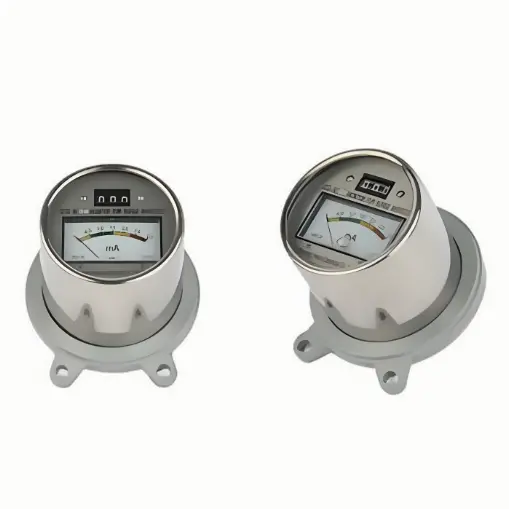
JCQ-3E Lightning arrester monitor is connected in series with the arrester below, can be used to record the number of times a lightning arrester action, but also by a leakage current monitoring device milliammeter arrester at operating voltage. Lightning arrester for 220KV and below grade, site environmental conditions with the same lightning arrester is connected, it is not suitable for a serious pollution and severe shock place; the zinc oxide valve sheet, electrical properties are greatly enhanced.

Test procedure:

First charge the condenser by turning the megger. Cut off the charge circuit when it charges steadily on the condition that you keep the megger turning. Then make the condenser which has been charged well discharge the two terminals of the coil of the counter once, so the counter counts once. You should continue to make the experiment for ten times. The counter is good if it can operate normally and reliably every time. If not, it is possible that the counter can't work or its sensitivity is lower, it needs checking or repairing.
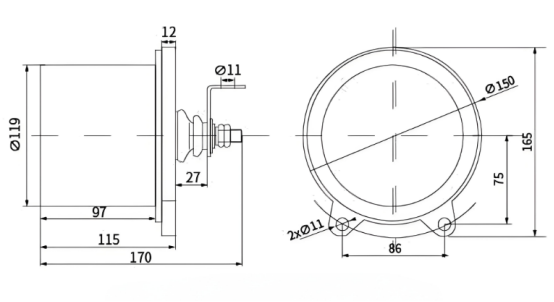
企业微信截图_17339733931130.png

Structure and installation diagram

Conditions of using:

  • Suitable for indoor or outdoor.

  •  Environmental temperature ( -40 - +40) ℃ 

  • The attitude does not exceed 2000m.

  • The power frequency (48 - 62) Hz.

  • No severe vibration place.

Structure and properties:

 Electrical principle:

  • Lightning arrester monitor such as sampling valve plate, silicon bridge rectifier, a high-voltage capacitor, electromagnetic counter,milliammeter components. It is the use of the discharge current of the arrester, the valve plate (nonlinear resistor) the voltage generated by the silicon bridge rectifier, the charge on the capacitor, the discharge to the electromagnetic counter, every one record at a time, to achieve record lightning arrester action times.

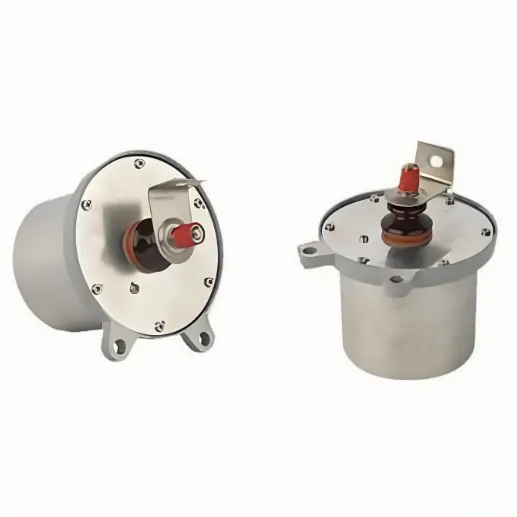
  • This product uses the high quality stainless steel shell casing, has a good corrosion protection; the sealing performance is good, is not affected by the external environment. Internal element has good anti-aging properties, can be applicable to power system operation. JCQ-3E type lightning arrester monitor uses 2 bit digital display, the display is clear, easy to observe; is conducive to the short-term frequency by lightning arrester complete record.

The main technical performance:
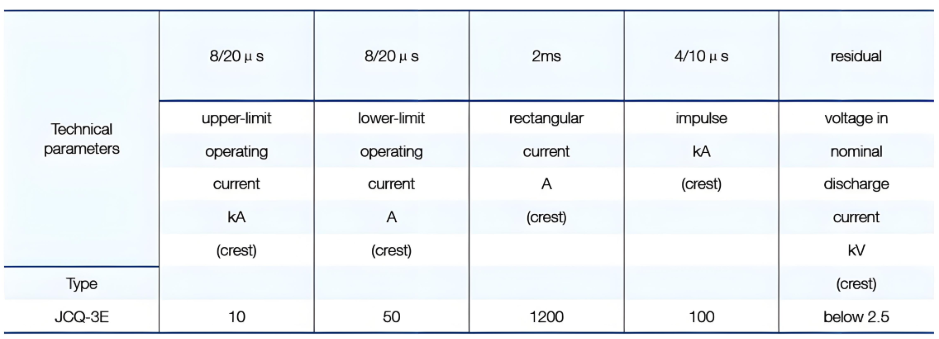
image.png

Installation:

Install a counter with reference to its overall figure. The counter should be connected in series between the arrester and ground, in other words, it is connected in parallel with the flanges on the two terminals of insulating pedestal of an arrester. When you install a counter, you should scrape off the paint on the two fixture hole surface (4>11) which is on the flange of the counter first in order to en sure them being connected very well. And then fix the counter near the pedestal of an arrester by bolt of M10x40, which is a place where it is easy to be watched levelly It is also as an earthed terminal. Then connect the end of HV lead wire to the bus bar on the upper flange of insulation pedestal of an arrester by bolt of MI0x30. Check the counter after finishing installation and it mustn't be a clear incline. You must adjust it well with reference to the clause User should know that:, if the indicator of a counter does not point to “0”. Then it may be putted into operation. You shouldn't loose the M10 nut which is painted red and those six bolts of M6x20 on the pedestal in order to avoid destroying seal. The overall dimension and installation position of a counter are pointed in the following.

User should know that:

  •  User should make a simple spot experiment in one counter before its being operated and after its operating for one or two years.

  •  A simple way of testing the operation characteristic of a counter; You need one megger for 500V and one condenser for 600V 10 g F.

How does a surge arrester monitor work?

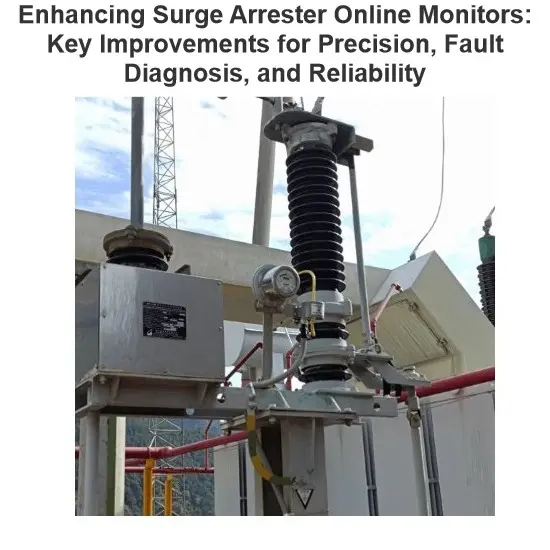
When the surge arrester is operating normally, the monitor continuously tracks its leakage current using a through-core sensor and displays the data on the corresponding interface. If an overvoltage event occurs in the system, the arrester activates to divert the resulting surge current into the ground. At this point, the current sensor in the monitor detects this change in current, triggering the counting unit to increment the operation count. The monitor then continues to track the leakage current after the arrester has operated, to determine whether the arrester has been damaged as a result of the operation.

Know your supplier
Online store
On-time delivery rate
Response time
100.0%
≤4h
Company overview
Workplace: 65666m²m² Total staff: 300+ Highest Annual Export(usD): 50000000
Workplace: 65666m²m²
Total staff: 300+
Highest Annual Export(usD): 50000000
Services
Business Type: Design/Manufacture/Sales
Main Categories: Wire cable/High Voltage Electrical Apparatus/Low Voltage Electrical Apparatus/Instrument meters/New energy/Tester/Integrated Electrical Equipment/Production equipment/Generator/Electrical fittings
Whole life care manager
Whole-life care management services for equipment procurement, use, maintenance, and after-sales, ensuring safe operation of electrical equipment, continuous control, and worry-free electricity consumption.
The equipment supplier has passed platform qualification certification and technical evaluation, ensuring compliance, professionalism, and reliability from the source.

Related Products

Related Knowledges

  • Impact of DC Bias in Transformers at Renewable Energy Stations Near UHVDC Grounding Electrodes
    Impact of DC Bias in Transformers at Renewable Energy Stations Near UHVDC Grounding ElectrodesWhen the grounding electrode of an Ultra-High-Voltage Direct Current (UHVDC) transmission system is located close to a renewable energy power station, the return current flowing through the earth can cause a rise in ground potential around the electrode area. This ground potential rise leads to a shift in the neutral-point potential of nearby power transformers, inducing DC bias (or DC offset) in their
    01/15/2026
  • HECI GCB for Generators – Fast SF6 Circuit Breaker
    1.Definition and Function1.1 Role of the Generator Circuit BreakerThe Generator Circuit Breaker (GCB) is a controllable disconnect point located between the generator and the step-up transformer, serving as an interface between the generator and the power grid. Its primary functions include isolating generator-side faults and enabling operational control during generator synchronization and grid connection. The operating principle of a GCB is not significantly different from that of a standard c
    01/06/2026
  • Distribution Equipment Transformer Testing, Inspection, and Maintenance
    1.Transformer Maintenance and Inspection Open the low-voltage (LV) circuit breaker of the transformer under maintenance, remove the control power fuse, and hang a “Do Not Close” warning sign on the switch handle. Open the high-voltage (HV) circuit breaker of the transformer under maintenance, close the grounding switch, fully discharge the transformer, lock the HV switchgear, and hang a “Do Not Close” warning sign on the switch handle. For dry-type transformer maintenance: first clean the porcel
    12/25/2025
  • How to Test Insulation Resistance of Distribution Transformers
    In practical work, insulation resistance of distribution transformers is generally measured twice: the insulation resistance between thehigh-voltage (HV) windingand thelow-voltage (LV) winding plus the transformer tank, and the insulation resistance between theLV windingand theHV winding plus the transformer tank.If both measurements yield acceptable values, it indicates that the insulation among the HV winding, LV winding, and transformer tank is qualified. If either measurement fails, pairwise
    12/25/2025
  • Design Principles for Pole-Mounted Distribution Transformers
    Design Principles for Pole-Mounted Distribution Transformers(1) Location and Layout PrinciplesPole-mounted transformer platforms should be located near the load center or close to critical loads, following the principle of “small capacity, multiple locations” to facilitate equipment replacement and maintenance. For residential power supply, three-phase transformers may be installed nearby based on current demand and future growth projections.(2) Capacity Selection for Three-Phase Pole-Mounted Tr
    12/25/2025
  • Transformer Noise Control Solutions for Different Installations
    1.Noise Mitigation for Ground-Level Independent Transformer RoomsMitigation Strategy:First, conduct a power-off inspection and maintenance of the transformer, including replacing aged insulating oil, checking and tightening all fasteners, and cleaning dust from the unit.Second, reinforce the transformer foundation or install vibration isolation devices—such as rubber pads or spring isolators—selected based on the severity of vibration.Finally, strengthen sound insulation at weak points of the ro
    12/25/2025
Haven't found the right supplier yet? Let matching verified suppliers find you. Get Quotation Now
Haven't found the right supplier yet? Let matching verified suppliers find you.
Get Quotation Now
Send inquiry
+86
Click to upload file

IEE Business will not sell or share your personal information.

Download
Get the IEE Business Application
Use the IEE-Business app to find equipment, obtain solutions, connect with experts, and participate in industry collaboration anytime, anywhere—fully supporting the development of your power projects and business.