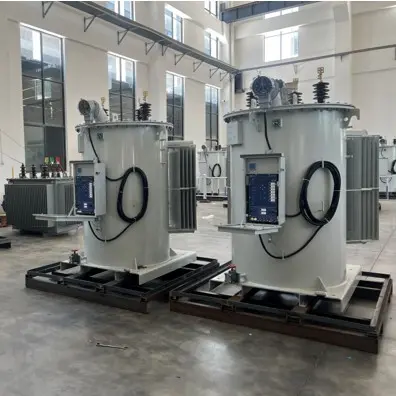
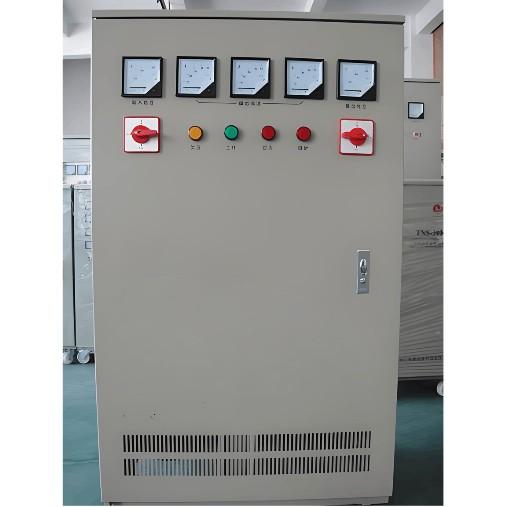
I. Why do small and medium-capacity regulators use "rectangular wound cores"?
For small and medium-capacity voltage regulators, where the physical size and weight are relatively modest, the rectangular wound core offers overwhelming comprehensive advantages:
- Optimal magnetic performance (lowest losses): A wound core is formed by continuously winding cold-rolled grain-oriented silicon steel strip. The magnetic flux flows entirely along the optimal grain-oriented direction (rolling direction) of the steel throughout the closed magnetic circuit, with little to no magnetic flux distortion. Moreover, it has no joints (or only minimal air gaps), resulting in the lowest possible no-load losses, no-load current, and operating noise.
- Extremely high material utilization: Since the wound core is continuously wound from strip material, it eliminates the need for complex corner shearing required in stacked cores. This essentially produces no scrap edges or waste, achieving a material utilization rate close to 100%—offering excellent economic efficiency.
- High-efficiency automated manufacturing: In the small and medium-capacity range, existing wound-core machines and specialized winding equipment (for directly winding coils onto the closed core) are highly mature. This enables a high degree of automated production, significantly reducing labor costs.
- Limitations at large capacities: As the capacity increases substantially, the core weight (often ranging from several tons to tens of tons) and cross-sectional area grow dramatically. At this scale, winding such massive steel strips becomes extremely difficult, and during high-temperature annealing, the formed core is highly prone to gravitational sagging and deformation. Furthermore, directly winding heavy-duty conductor coils onto a large, closed core is mechanically and practically infeasible.
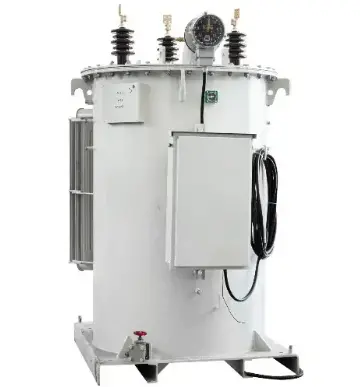
Physical Photo of Single Phase Automatic Voltage Regulator
II. Why do large-capacity regulators use "stepped-lap fully mitered stacked cores"?
For large-capacity voltage regulators, where wound-core construction is impractical, the stacked core design is adopted—where the bulky coils are wound separately, and then precisely cut silicon steel laminations are interleaved and assembled piece by piece. Among stacked-core techniques, the "stepped-lap fully mitered" configuration represents the optimal solution to minimize the inherent drawbacks of laminated construction:
- Enables large-capacity manufacturing and assembly: Large-capacity coils weigh several tons and have stringent insulation requirements. They must be wound, dried, and compressed on dedicated winding mandrels. The stacked-core process allows operators to remove the upper yoke (top section) of the core, lower the pre-wound coil into place, and then re-insert the upper yoke laminations—making this the only feasible assembly method for large equipment.
- Fully mitered joints prevent magnetic flux deviation:
- Early core designs used right-angle (90°) butt joints at the corners, which caused magnetic flux to cross the silicon steel transversely. Since grain-oriented steel has extremely poor magnetic properties in the transverse direction, this resulted in significant losses and localized overheating.
- Fully mitered joints (45° angle cuts) ensure that the magnetic flux, when transitioning through the corners, still travels predominantly along the grain-oriented (high-permeability) direction of the steel. This effectively eliminates transverse flux and substantially reduces no-load losses.
- Stepped-lap construction addresses localized magnetoresistance and noise:
- Traditional staggered overlap (with joints alternating left and right in successive layers) still exhibits considerable magnetoresistance at the joint gaps. This causes localized magnetic flux crowding, increased leakage flux, and enhanced magnetostriction (leading to vibration and high noise levels) under alternating magnetic fields.
- The stepped-lap technique staggers the joints of adjacent layers in a "step-like" pattern with a few millimeters of offset. This design enables the magnetic flux in the joint region to transition smoothly and evenly to adjacent laminations, significantly alleviating local magnetic saturation. It can further reduce no-load losses by 5%–15% and effectively lower noise by 2–5 decibels—which is critical for large-capacity equipment where noise levels can easily exceed permissible limits.
- Facilitates heat dissipation and enhances mechanical strength: Large-capacity cores generate considerable heat. The stacked design conveniently allows for the insertion of spacing blocks between laminations to create cooling oil ducts (or air ducts). At the same time, robust clamping structures and through-bolts (or binding bands) compress the stacked core firmly, providing exceptionally high resistance to short-circuit electromagnetic forces.
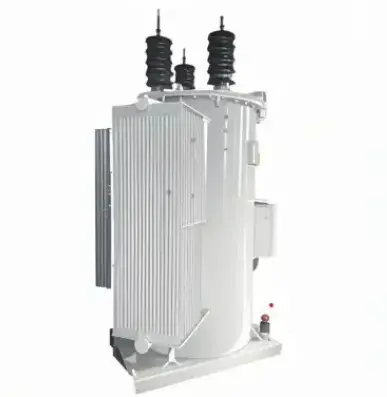
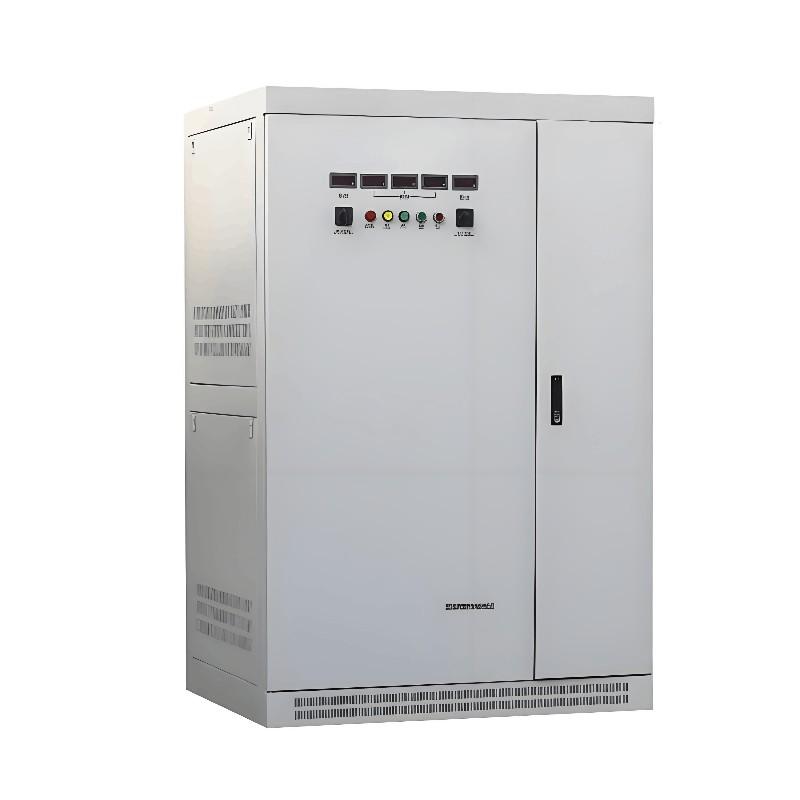
Physical Photo of Maintenance-free 32 step voltage regulator
III. Summary
For small and medium-capacity regulators, Vziman adopts rectangular wound cores to achieve the lowest possible losses, zero material waste, and highly efficient automated production—all within the bounds of feasible manufacturing processes. For large-capacity regulators, Vziman employs stepped-lap fully mitered stacked cores to accommodate the assembly requirements imposed by their bulky dimensions, while leveraging state-of-the-art cutting and lapping techniques to minimize, to the greatest extent possible, the losses, heating, and noise caused by air gaps and magnetic reluctance. By comprehensively taking into account standard specifications, installation environments, and life-cycle costs, Vziman delivers the most appropriate core solutions tailored to each customer's needs.
Edited From:Echo

 Login