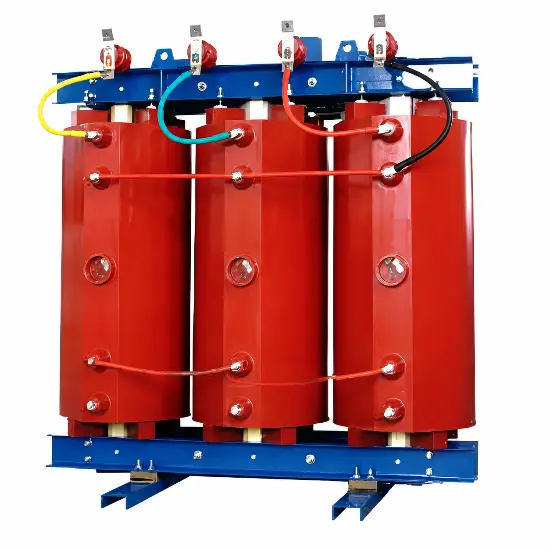
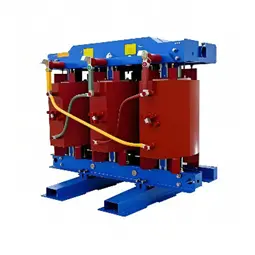
Dry-type grounding transformers are widely designed with Zig-Zag connection, because this winding structure offers high excitation impedance to positive- and negative-sequence currents during normal operation, while providing low impedance to zero-sequence currents during single-phase earth faults.
This makes it possible to create an artificial neutral point and offer a reliable path for zero-sequence current in medium-voltage distribution networks.
Compared with ordinary star or delta-connected transformers, Zig-Zag grounding transformers are better suited for earthing applications in MV networks, wind and solar power plants, industrial distribution systems, and data centers.
1. What Does a Grounding Transformer Do?
In many medium-voltage networks, the main transformer secondary side is connected in delta, or the neutral point cannot be directly accessed. In such cases, there is no natural neutral point for connecting an arc suppression coil, neutral grounding resistor, or zero-sequence protection equipment.
A grounding transformer is used to:
- Create an artificial neutral point N;
- Connect an arc suppression coil, neutral grounding resistor, or reactor;
- Provide a return path for zero-sequence current during earth faults;
- Limit arc-induced overvoltages and improve zero-sequence protection sensitivity;
- Optionally supply auxiliary power through a secondary winding.
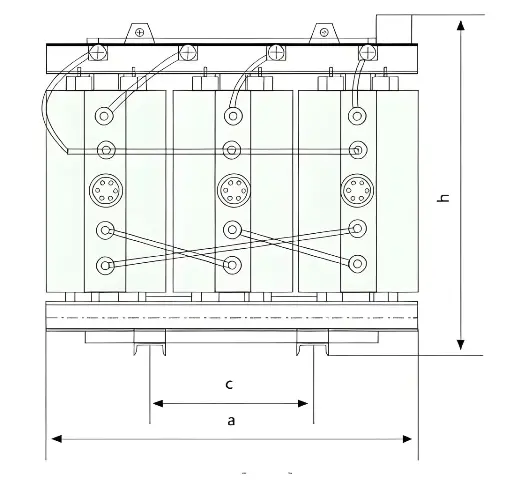
Dry-type grounding transformers usually adopt cast resin or impregnated insulation. They are oil-free, fire-resistant, and suitable for indoor substations, switch rooms, and renewable energy plants.
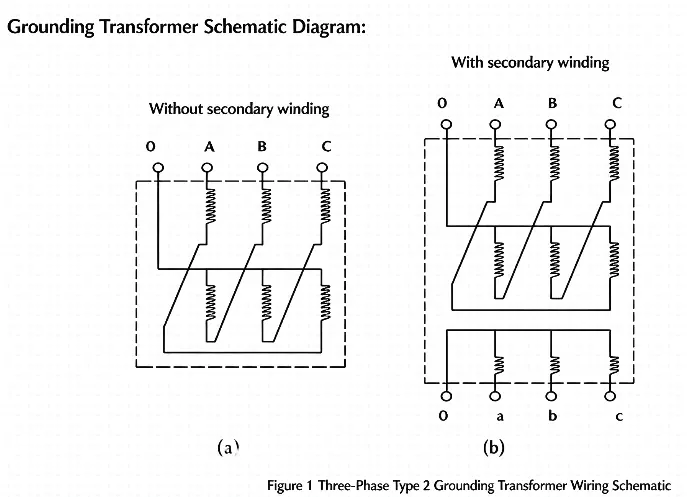
2. Structure of the Zig-Zag Winding
The Zig-Zag winding, also called a Zig-Zag or曲折形 winding, is formed by dividing each phase winding into two equal parts. These two parts are wound on different core limbs and connected in opposite polarity.
Key features:
- Each phase has two winding sections with equal turns;
- The two sections are placed on different core limbs;
- The windings are cross-connected with opposite polarity;
- The ends of the three-phase windings are joined to form the neutral point N;
- The line ends are connected to phases A, B, and C.
In this way, the voltage of each phase is not supported by a single winding on one core limb, but by two windings located on different limbs. This creates the typical “zig-zag” phasor relationship.
3. Operating Principle
Normal operation
Under balanced three-phase voltage, only positive- and negative-sequence currents flow through the grounding transformer. Due to the cross-connected winding structure, the transformer presents high excitation impedance.
Therefore, during normal operation:
- Only excitation current and small losses flow;
- The transformer operates nearly at no-load;
- The impact on normal three-phase operation is minimal;
- Additional network losses are very low.
Single-phase earth fault
When a single-phase earth fault occurs, zero-sequence voltage and zero-sequence current appear. Zero-sequence current returns through the earth and flows into the grounding transformer neutral point.
In a Zig-Zag winding, the zero-sequence currents in the three phases are in phase. Due to cross-connection, the zero-sequence ampere-turns on the same core limb cancel each other. As a result, the zero-sequence excitation flux is very small, and the zero-sequence impedance is mainly determined by leakage reactance.
This gives the grounding transformer a relatively low zero-sequence impedance, allowing zero-sequence current to flow reliably through the neutral point and the earthing device.
It should be noted that the zero-sequence impedance is not zero. A Zig-Zag grounding transformer is mainly used to provide an artificial neutral point and carry zero-sequence current, not to transmit active power.
4. Why Zig-Zag Connection Is Preferred
Low zero-sequence impedance
Zig-Zag grounding transformers provide a stable path for earth fault current. When used with neutral grounding resistors, they help zero-sequence protection operate quickly and selectively. When used with arc suppression coils, they support capacitive current compensation and arc extinction.
Low normal losses
Because the transformer operates nearly at no-load under normal conditions, excitation current and core losses remain low. This makes long-term connection to the network technically reasonable.
Better utilization of arc suppression coil capacity
Ordinary transformers may be limited by zero-sequence impedance, additional losses, and temperature rise when used for earthing purposes. A Zig-Zag grounding transformer, if designed in accordance with applicable standards and verified for temperature rise and fault duration, can carry a load matching the rating of the connected arc suppression coil or grounding resistor.
Optional auxiliary winding
Many dry-type Zig-Zag grounding transformers are designed with ZNyn or ZNyn11 connections. The high-voltage side uses Zig-Zag connection to create the neutral point, while the low-voltage side provides a star-connected secondary winding for auxiliary supply. The exact connection group should follow product design and applicable standards.
Suitable for indoor and renewable energy applications
Dry-type construction avoids insulating oil, reduces fire risk, and simplifies installation and maintenance. This makes it suitable for indoor substations, distribution rooms, wind farms, PV plants, and industrial facilities.
5. Comparison with Ordinary Transformers
| Item |
Zig-Zag Grounding Transformer |
Ordinary Y/Δ Transformer |
| Main function |
Create artificial neutral point, carry zero-sequence current |
Transform voltage, transmit power |
| Normal operation |
Nearly no-load |
Usually loaded |
| Zero-sequence impedance |
Relatively low |
Depends on core structure and connection |
| Arc suppression coil application |
Suitable under rated conditions |
Often limited |
| Neutral point availability |
Yes |
Depends on system connection |
Ordinary three-limb transformers without a delta-connected stabilizing winding or dedicated zero-sequence flux path usually have limited zero-sequence current capability and should not be simply replaced by a Zig-Zag grounding transformer without detailed verification.
6. Summary
A Zig-Zag dry-type grounding transformer provides an artificial neutral point for medium-voltage systems. It operates nearly at no-load under normal conditions and offers low zero-sequence impedance during earth faults, supporting arc suppression coils, neutral grounding resistors, and zero-sequence protection. Typical connections include ZNyn and ZNyn11, with optional auxiliary windings.
For international projects, the following terms are commonly used:
- Zig-Zag Connection / Zig-Zag Winding
- Grounding Transformer / Earthing Transformer
- Zero-Sequence Impedance
- Artificial Neutral Point
- Arc Suppression Coil / Petersen Coil
- Neutral Grounding Resistor
It should be noted that a Zig-Zag grounding transformer is not a conventional power transformer. Its capacity should be determined based on system capacitive current, arc suppression coil rating, neutral grounding resistor value, fault duration, temperature rise limits, and whether a secondary load is required.
If you are sourcing equipment or reviewing technical proposals, a professional Neutral Grounding Transformer Factory China can support detailed design verification, factory testing, and customization for MV and HV earthing systems.

 Login
Login