Among the technical pathways for replacing traditional SF6 gas in eco-friendly ring main units, the current mainstream approach is "vacuum interruption + eco-friendly gas insulation" (using dry air, nitrogen, or C4/C5 gas mixtures). Although the "all-solid-insulation" route emerged earlier, it has not become the dominant choice due to inherent physical limitations and manufacturing challenges.
The core technical reasons are as follows:
1. Self-Restoration of the Insulating Medium (a Critical Physical Difference)
-
Eco-friendly gas route: Gaseous insulation has self-restoring properties. If an instantaneous breakdown flashover occurs inside the equipment due to lightning or switching overvoltages, the dielectric strength of the gas recovers immediately after the arc extinguishes, allowing the equipment to continue operating.
-
All-solid route: Breakdown in solid insulating materials such as epoxy resin is irreversible. Once internal treeing discharges or breakdown occurs, the insulation structure suffers permanent carbonization damage, rendering the entire module scrap. The fault tolerance is extremely low.
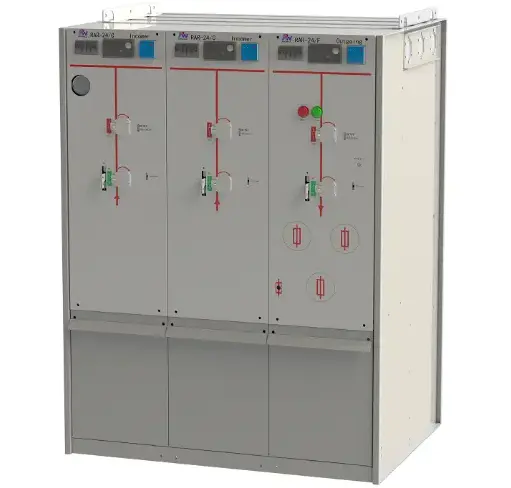
Rockwill RAR Series SF6-free gas-insulated switchgear/RMU
2. Challenges in Thermal Stress and Partial Discharge (PD) Control
This is the most intractable issue for all-solid insulation (particularly relevant to your research on soft-packing processes and thermal stress control).
-
All-solid route: The vacuum interrupter, conductive copper busbars, and disconnecting switches must be completely embedded in epoxy resin. Given the significant differences in coefficients of linear expansion among copper (16.5×10⁻⁶/°C), ceramic (the vacuum interrupter envelope), and epoxy resin (approximately 30–40×10⁻⁶/°C), long-term thermal cycling under varying loads induces enormous mechanical thermal stress at the encapsulated interfaces. This stress readily causes material delamination and the formation of micro-gaps, which in turn trigger severe partial discharge and eventual insulation degradation.
-
Eco-friendly gas route: As a fluid, the gas accommodates the thermal expansion and contraction of conductors, eliminating interfacial thermal stress issues between dissimilar materials. The insulation components are only required to provide mechanical support, and electric-field distortion and PD risks are more easily managed through equalizing shields inside the gas tank.
3. Thermal Dissipation Bottleneck Limits Capacity Scaling
-
All-solid route: Epoxy resin is a poor thermal conductor. At high current ratings (e.g., 1250 A and above) under full load, the heat generated by the vacuum interrupter contacts and busbars is difficult to dissipate, readily causing excessive internal temperature rise and accelerating insulation aging. This restricts the scalability of solid-insulated switchgear to higher capacities or voltage levels.
-
Eco-friendly gas route: The gas inside the tank enables natural convection heat exchange, and the large stainless-steel tank surface provides effective cooling, resulting in far superior temperature-rise control compared to solid encapsulation.
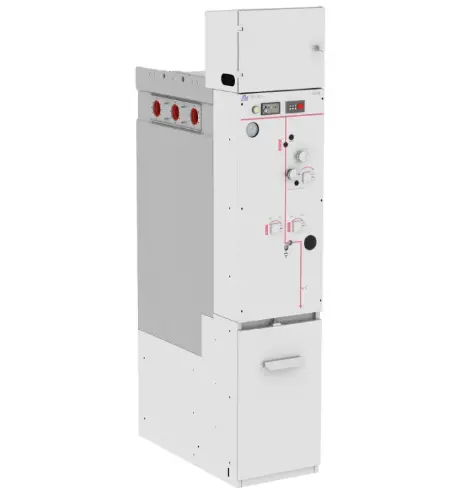
Rockwill REC Series SF6-free gas-insulated switchgear/RMU
4. Manufacturing Yield and Voltage-Grade Scalability
-
At the 12 kV level, solid-insulated switchgear can maintain acceptable yields using APG (Automatic Pressure Gelation) processes. However, as the voltage level rises to 24 kV or even 40.5 kV, the required insulation thickness increases sharply, and the castings become significantly larger. Shrinkage stresses, internal voids, and micro-cracks during the curing process become almost unavoidable, causing manufacturing yields to deteriorate substantially and costs to rise exponentially.
-
In contrast, eco-friendly gas-insulated switchgear only requires a modest increase in phase spacing or filling pressure, and the fabrication complexity of the metal-enclosed tank does not undergo a fundamental change.
5. Lifecycle Carbon Footprint (LCA) and Recycling Challenges
Against the backdrop of the "dual carbon" goals, environmental friendliness encompasses not only zero greenhouse-gas emissions during operation but also end-of-life treatment.
-
Eco-friendly gas route: At decommissioning, dry air or nitrogen can be released directly (and even C4/C5 gas mixtures are readily recoverable). The external stainless-steel tank, internal copper busbars, and vacuum interrupters can be 100% disassembled and recycled as scrap metal, offering an excellent LCA profile.
-
All-solid route: The copper busbars and resin are tightly encapsulated together, making it nearly impossible to economically separate and recycle the cast poles and insulation components after decommissioning. The recycling cost far exceeds the material scrap value, presenting a clear conflict between economic viability and environmental sustainability. Consequently, the full-lifecycle carbon footprint of solid insulation is difficult to make superior to that of the fully recyclable gas-insulation solution under current technologies.
In summary: All-solid insulation has irreplaceable advantages in extremely harsh environments and compact-footprint applications. However, for the vast majority of standard medium-voltage grid nodes, the "vacuum interruption + eco-friendly gas" approach perfectly balances high reliability, excellent heat dissipation, and full-lifecycle environmental sustainability—making it the preferred evolutionary path for leading manufacturers.
The Rockwill RAR Series is a practical embodiment of this philosophy. This series employs dry air (GWP = 0) as the insulating medium, with a core technology featuring a rotating limit mechanism and a linear-drive pressure-assisted arc-quenching design. During contact separation, it actively compresses air to force arc extinction, achieving SF₆-comparable interrupting performance with a zero-GWP medium, thereby providing a reliable, drop-in alternative for the green upgrade of distribution networks.
Edited From:Garca

 Login