• Product
  • Suppliers
  • Manufacturers
  • Solutions
  • Free tools
  • Knowledges
  • Experts
  • Communities
Search


Domestic ±800kV OLTC Achieves Full IP & Global Lead

Baker
Field: News
Engineer
4-6Year
Canada

Recently, Chinese on-load tap changer (OLTC) manufacturers announced a major breakthrough: China’s first ±800 kV ultra-high-voltage (UHV) converter transformer vacuum OLTC with fully independent intellectual property rights has successfully completed all type tests. Its key technical specifications have reached internationally leading levels, marking a critical step toward full domestic control over the entire UHV converter transformer supply chain.

As one of the core components in UHV DC transmission projects, the reliable and smooth operation of the OLTC is essential for the effective functioning of the entire system. This reliability hinges critically on the performance of the vacuum interrupter used within the OLTC. Serving as the “heart” of the device, the vacuum interrupter is responsible for switching high currents and must endure an electrical life of 360,000 operations and a mechanical life of 1.5 million cycles. Historically, both the OLTCs for converter transformers and their associated vacuum interrupters—high-precision mechatronic products—have been heavily reliant on imports, making the urgent development of more reliable, domestically produced OLTCs a national priority.
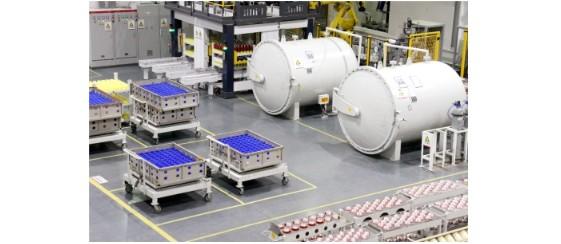
±800kV OLTC.jpg

To address this challenge, Chinese OLTC manufacturers launched a dedicated R&D initiative focused on the localization of high-reliability vacuum interrupters. Adopting an innovative collaborative model—"project-driven, integrating industry-academia-research-application, and multi-disciplinary coordination"—the project team conducted comprehensive research and development across performance enhancement, prototype fabrication, testing validation, engineering deployment, and standardization. Leveraging deep expertise in vacuum interrupter technology, the team overcame critical hurdles in design, manufacturing, testing, reliable application, and electromechanical integration—particularly in synchronizing contact bounce behavior with mechanism actuation speed—significantly improving arc-quenching reliability.

The project outcomes have now officially passed the milestone review under the Ministry of Industry and Information Technology’s (MIIT) "Military Order" (Junlingzhuang) accountability program, signifying that China’s domestically developed OLTC has successfully cleared authoritative pre-deployment verification.

The successful completion of these type tests once again demonstrates the stability and reliability of vacuum interrupters produced by Chinese OLTC manufacturers. Moving forward, the company will accelerate the scaling of industrial manufacturing capabilities and expedite the engineering demonstration and deployment of domestically made OLTCs for UHV converter transformers, providing strong support for China’s high-end power equipment industry.
Give a tip and encourage the author!
Recommended
Impact of DC Bias in Transformers at Renewable Energy Stations Near UHVDC Grounding Electrodes
Impact of DC Bias in Transformers at Renewable Energy Stations Near UHVDC Grounding ElectrodesWhen the grounding electrode of an Ultra-High-Voltage Direct Current (UHVDC) transmission system is located close to a renewable energy power station, the return current flowing through the earth can cause a rise in ground potential around the electrode area. This ground potential rise leads to a shift in the neutral-point potential of nearby power transformers, inducing DC bias (or DC offset) in their
01/15/2026
HECI GCB for Generators – Fast SF6 Circuit Breaker
1.Definition and Function1.1 Role of the Generator Circuit BreakerThe Generator Circuit Breaker (GCB) is a controllable disconnect point located between the generator and the step-up transformer, serving as an interface between the generator and the power grid. Its primary functions include isolating generator-side faults and enabling operational control during generator synchronization and grid connection. The operating principle of a GCB is not significantly different from that of a standard c
01/06/2026
Distribution Equipment Transformer Testing, Inspection, and Maintenance
1.Transformer Maintenance and Inspection Open the low-voltage (LV) circuit breaker of the transformer under maintenance, remove the control power fuse, and hang a “Do Not Close” warning sign on the switch handle. Open the high-voltage (HV) circuit breaker of the transformer under maintenance, close the grounding switch, fully discharge the transformer, lock the HV switchgear, and hang a “Do Not Close” warning sign on the switch handle. For dry-type transformer maintenance: first clean the porcel
12/25/2025
How to Test Insulation Resistance of Distribution Transformers
In practical work, insulation resistance of distribution transformers is generally measured twice: the insulation resistance between thehigh-voltage (HV) windingand thelow-voltage (LV) winding plus the transformer tank, and the insulation resistance between theLV windingand theHV winding plus the transformer tank.If both measurements yield acceptable values, it indicates that the insulation among the HV winding, LV winding, and transformer tank is qualified. If either measurement fails, pairwise
12/25/2025
Send inquiry
+86
Click to upload file

IEE Business will not sell or share your personal information.

Download
Get the IEE Business Application
Use the IEE-Business app to find equipment, obtain solutions, connect with experts, and participate in industry collaboration anytime, anywhere—fully supporting the development of your power projects and business.