• Product
  • Suppliers
  • Manufacturers
  • Solutions
  • Free tools
  • Knowledges
  • Experts
  • Communities
Search


China has successfully developed the world's first ±408 kV DC transfer switch.

Baker
Baker
Field: News
Engineer
4-6Year
Canada

Recently, China’s switchgear manufacturer independently developed the world’s first ±408 kV DC transfer switch, which has successfully passed the full set of type tests. This marks the official successful development of the product and represents the first breakthrough in DC transfer switches applied on the 400 kV pole line side.

The Jinshang–Hubei UHV project is currently the world’s highest-altitude ±800 kV ultra-high-voltage (UHV) DC transmission project. It adopts China’s independently developed multi-terminal cascaded UHV DC technology and was the first to propose the application requirement for a 408 kV DC transfer switch. Facing the stringent demands imposed by the complex environment of the Sichuan-Tibet region—characterized by high altitude and high seismic intensity—the manufacturer’s project team remained undaunted, focusing on core technology breakthroughs and innovative structural design. 

Through coupled analysis of the DC arc electromagnetic field, flow field, temperature field, and external auxiliary circuits, the team achieved rapid self-excited oscillation of DC current, enabling a maximum transfer current of 6,400 amperes. Additionally, research on corona prevention at high altitudes led to the design of a complete shielding system for the equipment, achieving a DC withstand voltage of 975 kV, meeting requirements for operation at 4,000-meter altitude.
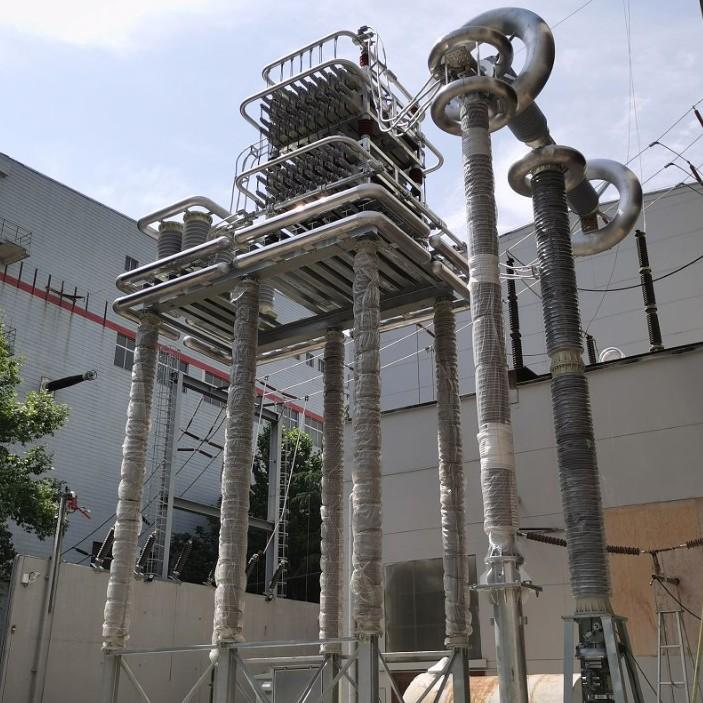
±408 kV DC Converter Switch.jpg

This product features high current-carrying capacity, with an overload current rating of 8,000 A; strong DC current transfer capability, supporting a DC transfer current of 6,400 A; high insulation withstand strength, satisfying insulation performance requirements at 4,000-meter altitude; and robust seismic resistance, rated at AG5 seismic level. The successful development of this product fills a global gap in the switchgear industry for 408 kV-class DC transfer switches and meets the special requirements of the Jinshang–Hubei ±800 kV UHV DC transmission project for geographically separated cascaded configurations.

 It can be applied to large-scale, long-distance transmission of renewable energy under the “West-to-East Power Transmission” initiative and is suitable for high-altitude, high-seismic-intensity, and heavily polluted regions, effectively enhancing the efficiency and reliability of DC transmission systems. Its development holds significant importance for ensuring safe and reliable power supply, accelerating the clean and low-carbon energy transition, supporting the planning and construction of a new-type energy system, and expediting the formation of a new development paradigm.

In recent years, China’s switchgear manufacturer has aimed to build a world-class enterprise-level scientific and technological innovation platform, adhering to an innovation-driven development strategy, firmly grasping the lifeline of key power grid equipment technologies, strengthening its scientific and technological innovation system, promoting high-level self-reliance and self-strengthening in science and technology, and gradually establishing a leading core competitive advantage in the industry.
Give a tip and encourage the author!
Recommended
Can the secondary neutral of a control transformer be grounded?
Grounding the secondary neutral of a control transformer is a complex topic involving multiple aspects such as electrical safety, system design, and maintenance.Reasons for Grounding the Secondary Neutral of a Control Transformer Safety considerations: Grounding provides a safe path for current to flow to earth in the event of a fault—such as insulation failure or overload—instead of passing through the human body or other conductive paths, thereby reducing the risk of electric shock. System sta
Echo
12/05/2025
Wiring Methods and Parameters of Grounding Transformers
Grounding Transformer Winding ConfigurationsGrounding transformers are classified by winding connection into two types: ZNyn (zigzag) or YNd. Their neutral points can be connected to an arc suppression coil or a grounding resistor. Currently, the zigzag (Z-type) grounding transformer connected via an arc suppression coil or a low-value resistor is more commonly used.1. Z-Type Grounding TransformerZ-type grounding transformers come in both oil-immersed and dry-type insulation versions. Among them
James
12/05/2025
Why Do We Need a Grounding Transformer and Where Is It Used?
Why Do We Need a Grounding Transformer?The grounding transformer is one of the most important devices in power systems, primarily used to connect or isolate the system neutral point to ground, thereby ensuring the safety and reliability of the power system. Below are several reasons why we need grounding transformers: Prevent Electrical Accidents:During the operation of a power system, abnormal conditions such as voltage leakage may occur in equipment or lines due to various reasons. If the neut
Echo
12/05/2025
How to Implement Transformer Gap Protection & Standard Shutdown Steps
How to Implement Transformer Neutral Grounding Gap Protection Measures?In a certain power grid, when a single-phase ground fault occurs on a power supply line, both the transformer neutral grounding gap protection and the power supply line protection operate simultaneously, causing an outage of an otherwise healthy transformer. The main reason is that during a system single-phase ground fault, the zero-sequence overvoltage causes the transformer neutral grounding gap to break down. The resulting
Noah
12/05/2025
Send inquiry
Download
Get the IEE Business Application
Use the IEE-Business app to find equipment, obtain solutions, connect with experts, and participate in industry collaboration anytime, anywhere—fully supporting the development of your power projects and business.