I. The "Voltage Threshold": When Do We Start Using Them?
The configuration of grading rings for Metal Oxide Arresters (MOA) follows strict engineering standards based on voltage level and physical height:
- ≤35kV≤35kV: Rarely Used. The physical height of the arrester is small (usually <1m<1m), and the impact of stray capacitance on potential distribution is negligible.
- 66kV66kV: Transition Level. Not standard for all applications, but may be used in high-altitude or heavily polluted areas to suppress corona.
- 110kV110kV: Critical Threshold. This is the engineering watershed. The height of the arrester increases significantly, and the axial potential distribution becomes uneven. Grading rings are mandatory from 110kV onwards.
- 220kV220kV to 1000kV1000kV (UHV): Standard Mandatory Configuration. As voltage climbs, grading rings evolve into complex structures (dual rings, elliptical rings, or cage-type) to handle extreme electric field distortion.
II. The Three Pillars of Functionality
1. Optimization of Axial Potential Distribution
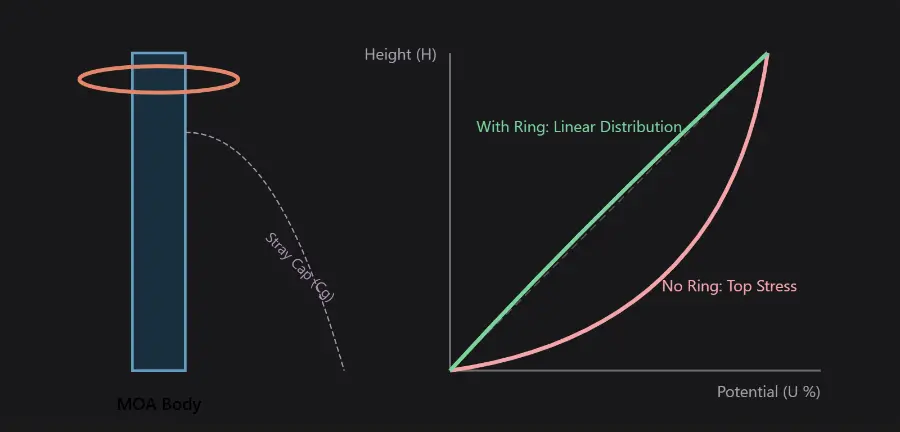
A surge arrester consists of a stack of hundreds of Zinc Oxide (ZnO) varistors. Ideally, each varistor should share the voltage equally. However, at high voltages, stray capacitance (CgCg) between the top fittings and the ground causes "current leakage" to the air.
- The Problem: Without a ring, the top 20% of the varistors bear nearly 50% of the total voltage, leading to localized overheating and premature aging.
- The Solution: The grading ring provides a compensation capacitance that counteracts the stray capacitance, forcing the voltage to distribute linearly across the stack.
2. Corona Suppression
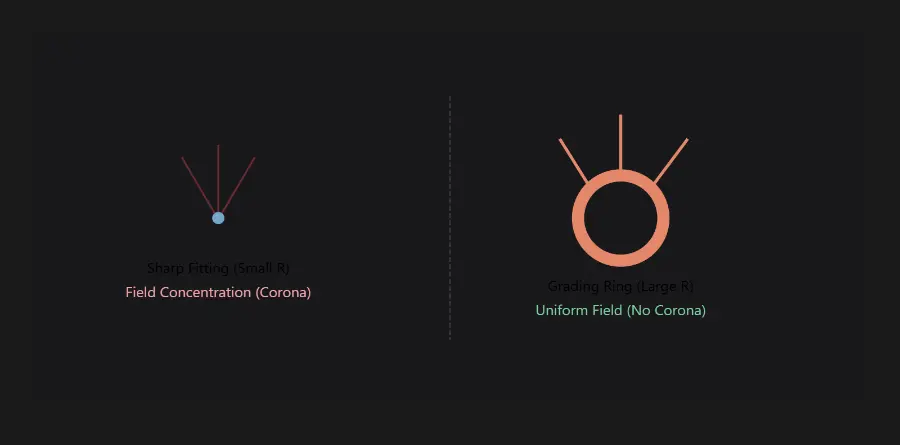
Sharp metallic parts (bolts, flange edges) at the top of the arrester have a very small curvature radius (RR). According to the formula E=V/RE=V/R, a small radius leads to extremely high electric field intensity (EE).
- The Problem: When EE exceeds 30kV/cm30kV/cm, the air ionizes, causing corona discharge, which generates ozone that corrodes seals and causes EMI (Electromagnetic Interference).
- The Solution: The grading ring, with its large tube diameter, increases the curvature radius at the high-voltage end, pushing the high-intensity field away from the metallic surface and effectively "smoothing" the field.
3. Structural Evolution Across Voltage Levels
As the system voltage increases, the grading ring evolves from a simple metallic hoop to complex multi-stage systems:
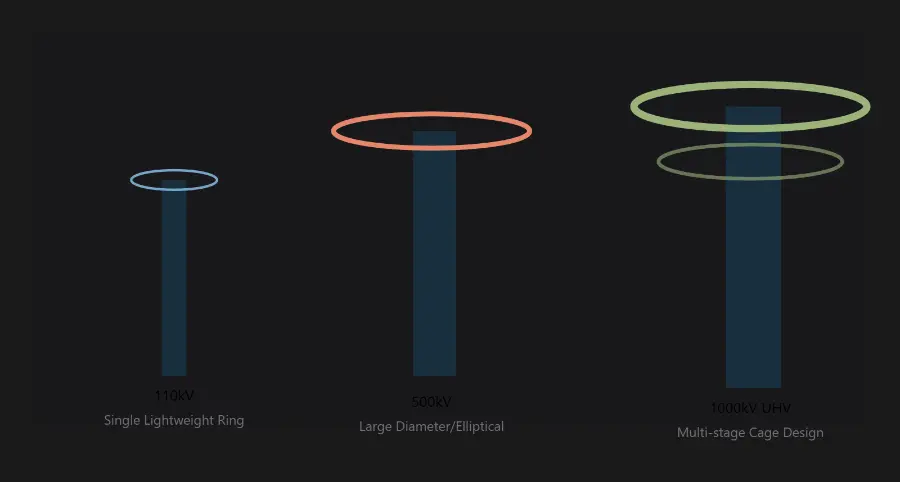
- 110kV−220kV110kV−220kV (Single Ring): Primarily for potential distribution. Tube diameter is typically 40mm−60mm40mm−60mm.
- 500kV500kV (Large/Elliptical Ring): Arresters can be over 5 meters tall. Large diameter or elliptical rings are used to ensure coverage while maintaining phase clearance.
- 750kV−1000kV750kV−1000kV (Multi-stage/Cage Ring): UHV systems use "Double Rings" or "Cage Rings." These precisely tune the potential for every section of the varistor stack to prevent thermal breakdown in extreme electric fields.
Engineering Checklist for Maintenance
When performing on-site inspections, keep these Expert Tips in mind:
- Verification of 110kV: If you encounter a 110kV110kV arrester without a grading ring, or if the ring is severely tilted, it must be rectified immediately. The top varistors will likely degrade within 2−32−3 years.
- Mounting Height Precision: The center plane of the ring should align with the center of the first varistor section. A vertical error >50mm>50mm reduces grading efficiency by over 15%15%.
- Foreign Objects: Never allow bird nests or loose wires to hang on the ring. These objects break the "curvature radius" balance and can lead directly to phase-to-phase short circuits.
ROCKWILL Engineering Note: For EHV/UHV projects, always use grading rings that have been verified through precise Electric Field Simulation (FEA) to ensure the 50-year50-year lifecycle stability of the equipment.
Contact us:
Edited From:Dyson

 Login