The Inherent Shortcomings of Two Classic Interruption Principles
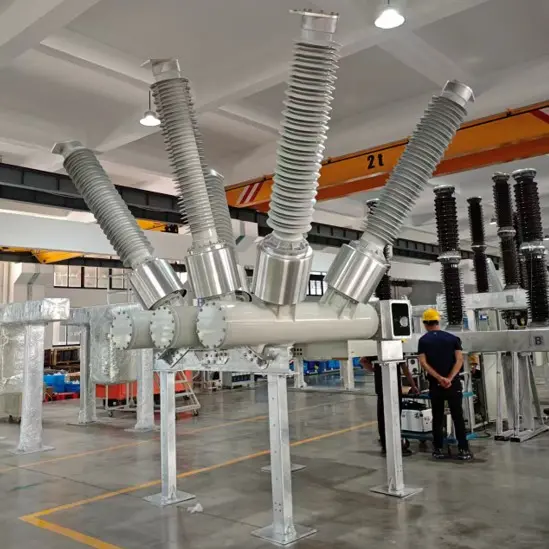
In the technological evolution of SF6 circuit breakers, the puffer-type and self-blast-type represent two landmark technical routes, each with distinct characteristics and unavoidable limitations.
The core logic of the puffer-type is "mechanical forcing"—the operating mechanism compresses SF6 gas with significant mechanical force, forming a high-pressure gas blast at the moment of contact separation to extinguish the arc. Its advantages lie in "rapid pressure build-up and stable, controllable interruption of small currents," with relatively mild contact erosion.
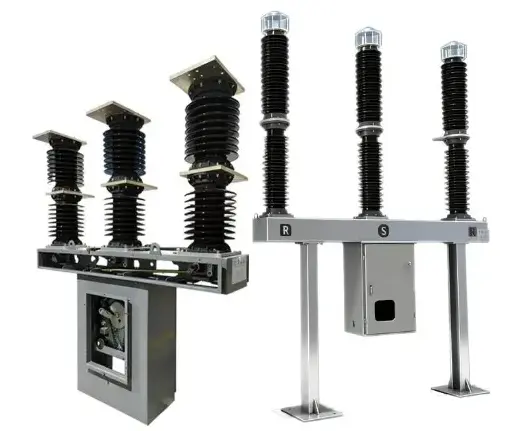
Rockwill RHB series Live tank SF6 gas circuit breaker
However, the trade-off is equally significant: when interrupting large currents, the substantial thermal energy released by the arc "competes" with the mechanically compressed gas flow. To overcome the opposing forces, the operating mechanism must deliver far more operating energy than theoretically required, resulting in bulky equipment and high energy consumption.
The self-blast type, by contrast, embodies the wisdom of "using force against itself." It harnesses the arc's own thermal energy to heat the SF6 gas, causing a sharp pressure rise in the expansion chamber and generating a strong gas blast at current zero. When interrupting large currents, the greater the arc energy, the stronger the gas-blast pressure—creating an adaptive "positive feedback loop" that significantly reduces the burden on the operating mechanism. However, when facing small-current interruptions, the arc energy is too weak to establish an effective gas blast, leaving the self-blast type in a difficult position where its reliability becomes questionable.
Optimized Self-Blast Interruption Technology: "Strategic Synergy" of Two Forces
The industry's technological breakthrough lies in recognizing that large-current and small-current interruptions are fundamentally two distinct physical challenges that require differentiated quenching strategies. Consequently, optimized self-blast technology—which uses the self-blast principle as the mainstay while incorporating puffer-type "assisted blowing" or "collaborative pressurization" functions—has emerged and become the mainstream technical foundation for today's medium- and high-voltage circuit breakers.
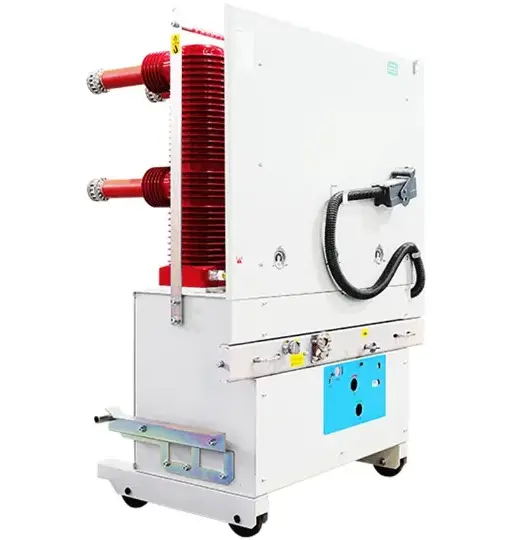
Rockwill HM4 series Indoor SF6 Circuit Breaker
For large-current interruption, the self-blast principle takes the leading role. The arc, serving as an extremely high-energy heat source, heats the SF6 gas and rapidly builds up pressure within the expansion chamber. The greater the arc energy, the stronger the gas blast.
This "self-adaptive" mechanism minimizes the burden on the operating mechanism, making the equipment lighter and more efficient. Currently mature self-blast interrupter designs (such as the domestic LW30-252 type) have demonstrated more than 20 full-capacity interruption operations at 50 kA, fully validating the reliability of this approach.
For small-current interruption, the puffer-type "assisted blowing" or "collaborative pressurization" mechanism plays a critical role. The challenge here is not excessive energy, but rather the risk of current chopping before the SF6 arc reaches current zero—where forced extinction can induce dangerous overvoltages or even restrikes.
At this point, relying solely on weak arc thermal energy cannot establish an effective gas blast. Instead, an initial, controllable auxiliary gas blast provided by the operating mechanism is essential to ensure that the arc is extinguished smoothly and controllably at current zero, effectively mitigating chopping and restrike risks. Although this increases the transient reaction force on the mechanism, it delivers precision and reliability in small-current interruption.
It is worth noting that in professional circles, "hybrid interruption" sometimes specifically refers to a technical configuration where puffer and thermal expansion occur simultaneously within the same chamber, mutually reinforcing each other—conceptually distinct from the "self-blast dominant, puffer-assisted" structure described above. Nevertheless, both belong to the same technical lineage of evolving from a single principle to multi-mechanism synergy.
Rockwill's Technical Practice: From Principle Integration to Product Platformization
Rockwill's SF6 circuit breaker technology is a representative example of the above philosophy. Rather than relying on a single interruption principle, its arc-quenching system creatively integrates the self-blast main mechanism with puffer-type auxiliary support, targeting the fundamentally different interruption physics of large and small currents to achieve excellent interruption performance across the full current range.
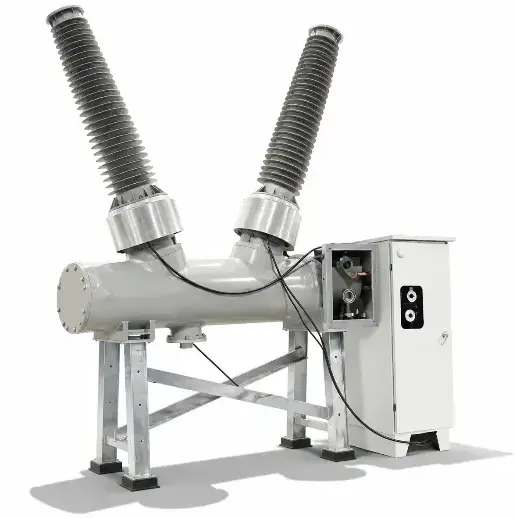
Rockwill RHD series Dead tank SF6 Gas Circuit Breaker
Representative products cover the HD4, HM4, RHB, RHD, and LW series, with interruption capabilities reaching 40–63 kA. In terms of technical details: during large-current interruption, the interrupter chamber utilizes arc thermal energy to establish high pressure and achieve efficient hot-gas flow guidance; during small-current interruption, the operating mechanism provides controllable auxiliary gas blowing to ensure that chopping and restrike risks are effectively suppressed.
This technical approach enables a single interrupter chamber to maintain superior performance across different fault current levels, and achieves platform-based sharing of interruption units among primary distribution equipment (HD4/HM4), ring main units (RHB/RHD), and LW outdoor pole-mounted switches.
The HM4 series, in particular, introduces high-voltage-proven self-blast/puffer hybrid technology into the medium-voltage domain, with its technical description explicitly emphasizing "optimal performance at all operating current values based on compression and self-blast technologies"—a precise reflection of the value offered by optimized self-blast interruption technology.
Trend Outlook: Optimized Self-Blast Interruption Is Becoming the Technical Backbone of Medium- and High-Voltage Circuit Breakers
From the perspective of industry technology evolution, traditional high-operating-energy puffer-type breakers—which require complex hydraulic or pneumatic mechanisms—are gradually being phased out. Replacing them are self-blast-type and optimized variants (including various hybrid interruption technologies) equipped with all-spring mechanisms, whose share in the medium- and high-voltage sector is steadily increasing.
This trend marks a better balance between "performance" and "economy" in interruption technology—in some high-voltage applications, operating energy can be reduced to approximately 12% of that of traditional puffer types, with significantly improved equipment reliability.
Rockwill, through its platform-based portfolio of HD4, HM4, RHB, RHD, and LW product series, extends this technological capability across multiple application scenarios—including primary distribution, ring main units, and outdoor pole-mounted installations—offering users with varying voltage levels and installation requirements a diverse selection under a unified technical foundation, aligning with the industry's broader movement toward higher efficiency and lower energy consumption.
Edited From:Garca

 Login