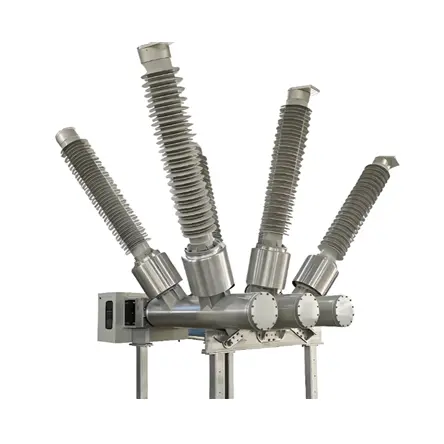
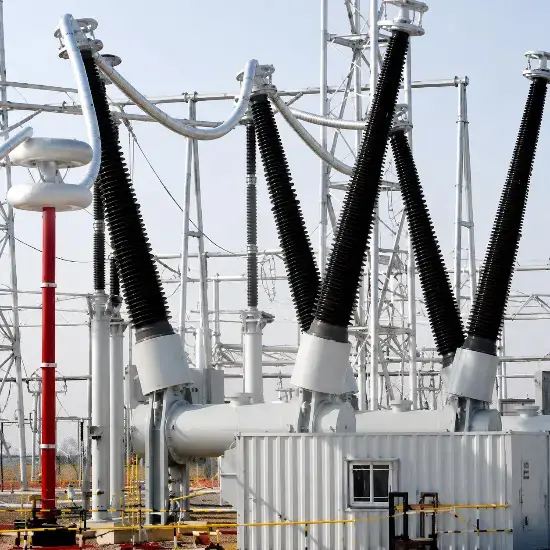
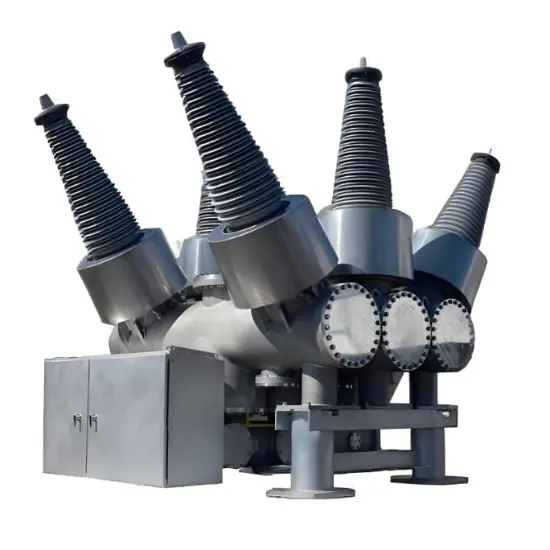
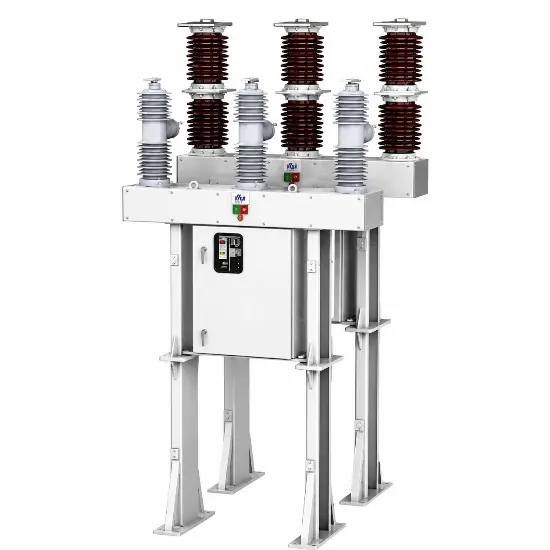
In ROCKWILL high-voltage and extra-high-voltage dead tank circuit breakers (RHD/RHB series, 72.5kV-800kV), the external insulation bushings can be configured with either traditional high-strength porcelain bushings or silicone rubber composite bushings. There are significant differences between the two in mechanical performance, pollution resistance, seismic performance, transportation, installation, and full lifecycle cost. A systematic comparison analysis is provided below.
I. Structural Differences
| Item |
Porcelain Bushing |
Silicone Rubber Composite Bushing |
| Material Structure |
High-temperature sintered electrical porcelain + capacitive core/conductive rod, glazed surface |
FRP epoxy fiberglass core rod + high-temperature vulcanized (HTV) silicone rubber sheds |
| Characteristics |
Hard wear-resistant surface, mature technology, long operating history, heavy weight |
Lightweight (~20%-40% the weight of porcelain), flexible structure, natural hydrophobicity, high impact resistance |
ROCKWILL standard configuration is typically porcelain bushings, with composite bushing options available per project requirements.
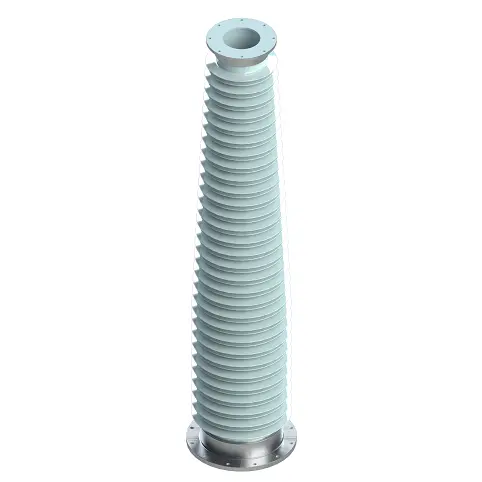
Silicone Rubber Composite Bushing
II. Electrical Performance Comparison
| Item |
Porcelain Bushing |
Silicone Rubber Bushing |
| Power frequency / Lightning impulse withstand voltage |
Excellent, compliant with IEC 62271-100 |
Excellent, equally compliant with IEC 62271-100 |
| Electric field distribution |
Stable |
Stable (through proper shed design) |
| Insulation life |
≥30 years |
25-30+ years (high-quality formulation) |
| Aging performance |
Excellent, minimal degradation |
Good, UV exposure requires long-term hydrophobicity monitoring |
Conclusion
: Both types offer equivalent primary insulation electrical performance, meeting ROCKWILL dead tank product design standards. The differences mainly lie in environmental adaptability of external insulation rather than the insulation level itself.
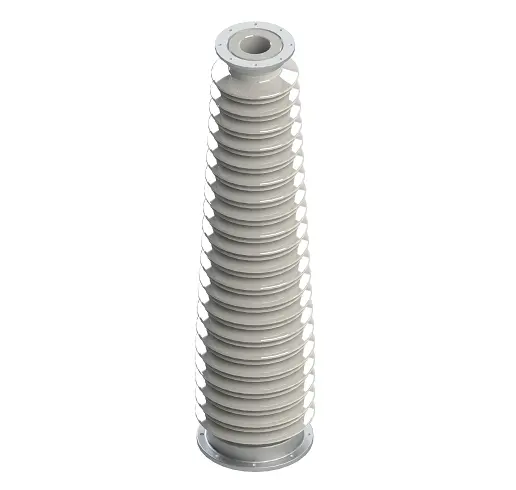
Porcelain Bushing
III. Anti-Pollution Flashover Performance
- Glazed surface is hydrophilic, easily attracting salt fog and industrial dust
- Forms a continuous conductive water film under humid conditions → increased leakage current
- Requires periodic cleaning or RTV anti-pollution coating in Class III and above pollution areas
Silicone Rubber Composite Bushing
- Possesses hydrophobicity and hydrophobicity transfer — the contamination layer also remains water-repellent
- Surface water beads into droplets, not a continuous film, resulting in extremely low leakage current
- Pollution flashover voltage is typically 30%-50% higher than equivalent porcelain bushings, suitable for coastal salt fog, heavy industrial pollution, and high-humidity areas
ROCKWILL Recommendation: For salt fog/heavy pollution areas (coastal regions, chemical industrial parks) → prioritize composite bushings.
IV. Mechanical and Seismic Performance
| Item |
Porcelain Bushing |
Silicone Rubber Composite Bushing |
| Material Properties |
Brittle inorganic material, good compression but poor bending/impact resistance |
FRP core rod bending strength 120-150kN, good toughness |
| Seismic Performance |
Risk of porcelain fracture in high-seismic zones |
Flexible structure, can withstand higher seismic acceleration (≥0.4g) |
| Weight Impact |
Increases tank top load |
Significantly reduces top load, improving overall seismic performance of the dead tank breaker |
ROCKWILL dead tank breakers themselves feature a low-center-of-gravity design for excellent seismic performance. Pairing with composite bushings further reduces the risk of external insulation failure in high-seismic zones.
V. Safety and Explosion-Proof Performance
- Porcelain Bushing: Internal faults causing sudden pressure rise may lead to porcelain explosion, with ceramic fragments posing secondary injury risk to nearby equipment and personnel.
- Silicone Rubber Composite Bushing: No large-area brittle fragmentation; failure mode is primarily deformation/cracking with minimal fragments, providing higher safety for personnel and adjacent equipment.
Recommendation: For dense urban substations, underground substations, and scenarios with explosion-proof requirements, composite bushings are recommended.
VI. Transportation and Installation
| Item |
Porcelain Bushing |
Silicone Rubber Composite Bushing |
| Unit Weight |
Heavy, requires special lifting equipment |
Light, can be handled manually or with small lifting equipment |
| Lifting Difficulty |
High, strict collision prevention required |
Low |
| Transport Damage Rate |
Relatively high (risk of micro-cracks) |
Low |
| Installation Efficiency |
Average |
High, suitable for remote/export projects |
For export projects (South America, Middle East, Africa, etc.) and areas with difficult mountain transportation, composite bushings can significantly reduce logistics costs and cargo damage rates.
VII. Lifecycle and Maintenance
- Porcelain Bushing: The body itself undergoes minimal aging, but heavy pollution areas require periodic cleaning/anti-pollution coating application — high maintenance workload.
- Silicone Rubber Composite Bushing: Essentially maintenance-free for cleaning; hydrophobicity can be maintained for many years, requiring only periodic hydrophobicity class (HC rating) spot checks. After long-term UV exposure, sheds may experience chalking, typically evaluated for replacement after 15-20 years of service.
From a full lifecycle cost (LCC) perspective, composite bushings have slightly higher initial investment in high-pollution areas but significantly lower O&M costs.
VIII. ROCKWILL Engineering Selection Recommendations
ROCKWILL RHD/RMR series dead tank SF6 circuit breakers can be flexibly configured with either bushing type depending on operating conditions:
| Application Scenario |
Recommended Configuration |
| Conventional inland substations, pollution Class I-II, cost-sensitive projects |
Porcelain bushing (standard configuration) |
| Coastal salt fog, heavy industrial pollution areas, high-humidity/high-temperature regions (pollution Class III-IV) |
Silicone rubber composite bushing |
| High seismic zones (Intensity VIII and above), dense urban areas |
Silicone rubber composite bushing (explosion-proof + seismic) |
| 245kV and above EHV, long-distance export transportation projects |
Prioritize silicone rubber composite bushing |
| When full lifecycle O&M cost minimization is the priority |
Silicone rubber composite bushing — clear comprehensive advantage |
IX. Industry Trends
Currently, international mainstream manufacturers (Hitachi Energy, Siemens Energy, GE Vernova, Mitsubishi, etc.) are increasingly adopting silicone rubber composite bushings for external insulation on 145kV and above dead tank / GIS equipment. ROCKWILL can also provide type test certification reports for either porcelain or composite bushing options per user technical specifications to meet the differentiated requirements of various grid companies.
Edited From:Garca

 Login