Search


Rockwill Tank-Type SF6 Self-Blast Arc-Quenching Chamber: Dual-Mode Operating Mechanism and Reliability Design Boundaries

Rockwill tank-type SF6 self-blast arc-quenching chamber: dual-mode operating mechanism, reliability design boundaries, and performance analysis.

Rockwill
Field: Manufacturing
10Year<
China
Add us on Google

I. Core Mechanism: Dual-Mode Intelligent Arc-Quenching for High and Low Currents

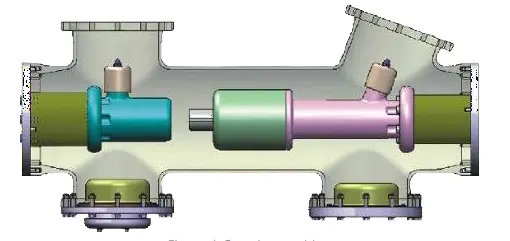
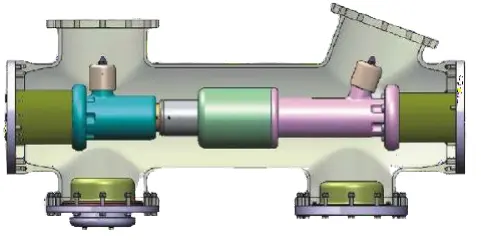
The Rockwill RHD arc-quenching chamber adopts an integrated structure combining a "thermal expansion chamber + pressure chamber + one-way check valve." This design eliminates complex mechanical switching devices, relying entirely on the cavity pressure differential generated by the arc's own energy and mechanical compression to automatically achieve seamless switching between arc-quenching modes:

iee-business

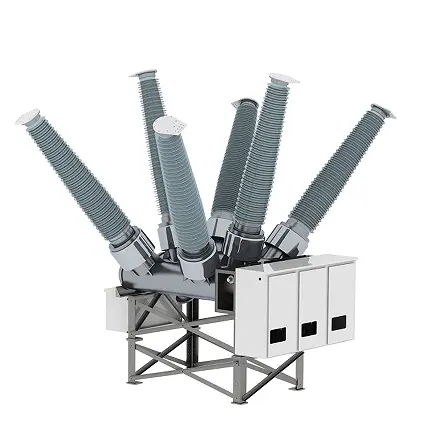
High Reliability Dead tank SF6 gas Circuit Breaker 40.5kV - 550kV

High Short-Circuit Current Condition (Self-Blast Thermal Expansion Arc-Quenching):

During opening, the moving contact drives the piston to pre-compress the SF6 gas. Upon contact separation, a high-energy arc is generated, causing the gas in the arc zone to heat and pressurize rapidly. The hot gas flows into the thermal expansion chamber, causing its internal pressure to quickly surpass that of the pressure chamber. The one-way check valve automatically closes under the combined action of pressure differential and spring preload. At current zero, the high-pressure SF6 accumulated in the thermal expansion chamber forcefully sweeps across the contact gap. This mode ingeniously utilizes the arc's own thermal energy to achieve powerful arc-quenching, significantly reducing the output work required of the operating mechanism.

Low Load Current Condition (Mechanical Pressure Arc-Quenching):

When interrupting load, capacitive, or small inductive currents, the arc energy is weak, and the thermal expansion chamber cannot establish effective high pressure. In this case, the mechanical compression pressure in the pressure chamber exceeds that of the expansion chamber, and the check valve automatically opens. The SF6 flow generated by the pressure cylinder smoothly enters the arc zone, forming axial or radial forced arc-quenching, relying solely on mechanical compression energy to complete forced arc extinction, perfectly compensating for the insufficient self-blast energy under low-current conditions.

iee-business

Opening position

iee-business

Closing position 

II. Reliability Assurance: Design Boundaries for Both Operating Conditions

To ensure absolute reliability of the dual-mode operation across all conditions, ROCKWILL has established strict technical boundaries in the arc-quenching chamber design:

iee-business

(A) High Short-Circuit Current (Self-Blast Mode) Boundary Conditions

  • Volume Matching Boundary: The volume ratio between the thermal expansion chamber and the pressure chamber is precisely calculated to ensure sufficient high-pressure gas accumulation under high currents, balancing nozzle flow velocity and gas reserve.
  • Gas Pressure Boundary: The rated SF6 gas pressure of the tank serves as the design baseline. If the pressure drops below the lower limit, the expansion chamber's pressure-building capability is directly weakened, creating a risk of arc-quenching failure.
  • Nozzle Flow Boundary: The throat diameter and choke section length of the PTFE arc-resistant nozzle are strictly limited to precisely balance the backflow of arc energy and the release rate of gas flow.
  • Check Valve Operating Threshold: The spring preload of the valve disc is precisely calibrated to ensure reliable closure under high currents, completely isolating the pressure chamber's pressure relief path.

(B) Low Load Current (Pressure Mode) Boundary Conditions

  • Piston Stroke and Compression Ratio: A fixed lower limit for the effective pressure stroke during opening is established to ensure that, even under low currents, the minimum gas pressure required for arc-quenching can still be delivered.
  • Pressure Differential Conduction Boundary: The check valve's opening pressure differential is matched to the pressure range of low-current conditions, ensuring that the compressed gas flow enters the arc zone smoothly without throttling.
  • Gas Flow Path Boundary: The flow cross-section of the hollow stationary arcing contact reserves a lower limit to prevent insufficient cooling caused by gas flow throttling under low currents.
  • Mechanism Output Work Boundary: The minimum output work of the spring mechanism must satisfy the compression requirements of the pressure cylinder, avoiding insufficient gas pressure due to low opening speed.

(C) General Collaborative Design Boundaries

  • Temperature Range Boundary: The equipment is designed to operate in ambient temperatures from -30°C to +40°C. To account for SF6 density variations under high and low temperatures, the pressure and self-blast efficiency are adjusted accordingly. Under extreme low-temperature conditions, the system must ensure that SF6 does not liquefy, or the design must incorporate a pressure compensation/heating mechanism to maintain the minimum gas density required for arc-quenching.
  • Current Switching Threshold: The critical current threshold for switching between self-blast and pressure modes is clearly defined, ensuring full coverage of the rated interrupting current range and eliminating performance blind spots.
  • Gas Tightness Boundary: The leakage rate of the tank and arc-quenching chamber seals is strictly controlled to maintain the pressure baseline for dual-mode operation through long-term pressure retention. This is required not only to maintain insulation strength but also to meet stringent environmental leakage prevention requirements.
  • Transient Recovery Voltage Withstand: The insulation recovery speed of the SF6 medium after arc-quenching must match the system's transient recovery voltage (TRV). The nozzle design of the arc-quenching chamber must be capable of adapting to demanding TRV conditions to fundamentally prevent arc re-ignition.

III. Conclusion

The core advantage of the ROCKWILL tank-type SF6 self-blast arc-quenching chamber lies in its "purely physical, self-adaptive" minimalist design. Through the ingenious "pressure-differential-controlled check valve" structure, the equipment requires no additional mechanical or electronic intervention — under extreme short-circuit conditions it "redirects the arc's energy" (self-blast arc-quenching) to significantly reduce mechanism load, while under routine load conditions it "strikes proactively" (pressure arc-quenching) to guarantee arc-quenching reliability. At the same time, relying on rigorous design boundaries covering volume matching, nozzle flow, and environmental adaptation, this arc-quenching chamber successfully bridges the technical gaps across different current, temperature, and insulation recovery conditions, ensuring high efficiency and absolute safety of the high-voltage circuit breaker throughout its full lifecycle. Furthermore, this dual-mode self-adaptive mechanism offers excellent technical scalability, reserving ample room for future transition to eco-friendly gas mixtures.

Edited From:Garca

Give a tip and encourage the author!

Comments

Share your question or perspective
WhatsApp
Send inquiry
+86
Click to upload file
Download
Get the IEE Business Application
Use the IEE-Business app to find equipment, obtain solutions, connect with experts, and participate in industry collaboration anytime, anywhere—fully supporting the development of your power projects and business.
Login
or continue with
New here?
Register