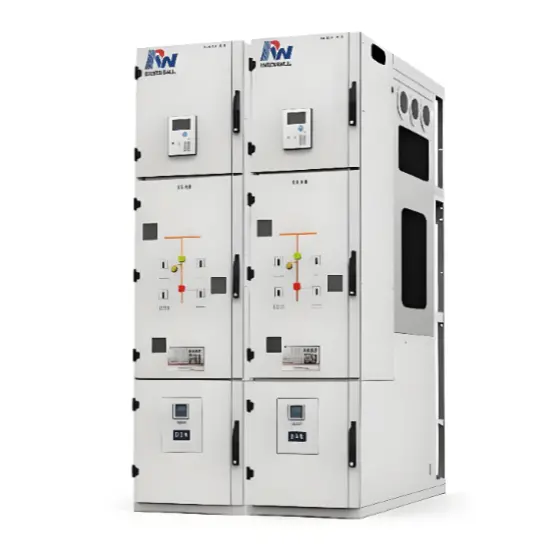
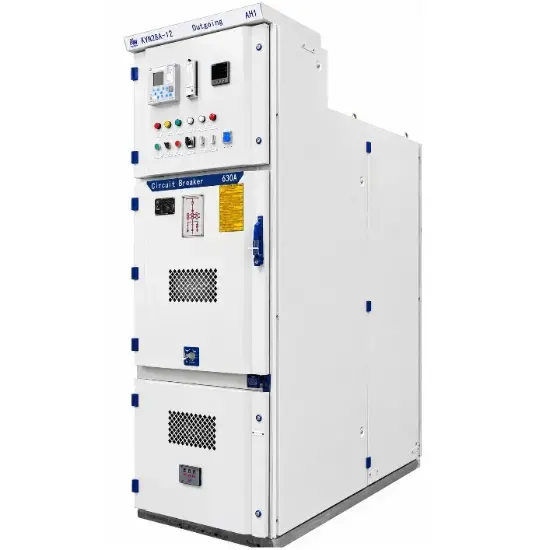
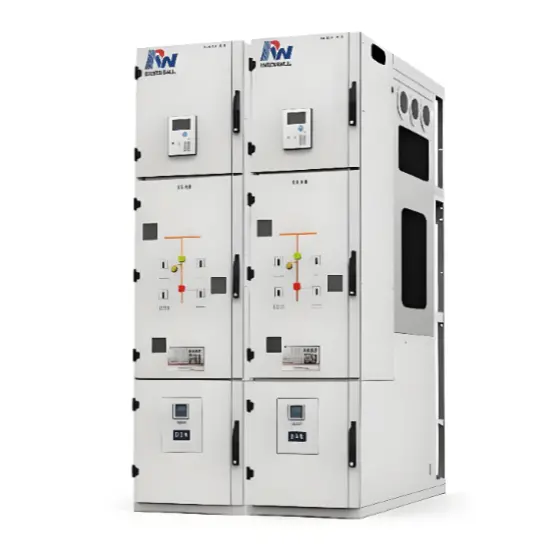
In medium-voltage SF6-free gas-insulated switchgear, the adoption of a “dual-gas-chamber structure” — typically comprising an independent main-busbar and three-position disconnector chamber, and a separate vacuum circuit-breaker chamber — represents a key design trend in premium eco-friendly switchgear. Rockwill has embodied this philosophy in its RGIS-12 / 24 gas-insulated metal-enclosed switchgear.
Compared with conventional “single-chamber” designs, this configuration offers notable engineering advantages in the context of SF6-free technology, primarily in the following five aspects:
1. Perfectly Matched to the Higher Pressure Requirements of Eco-Friendly Gases (Structural Mechanics Advantage)
-
Background: The dielectric strength of eco-friendly gases such as dry air or nitrogen is generally lower than that of SF6. To achieve equivalent insulation performance, SF6-free equipment often requires a higher filling pressure (e.g., raised from around 0.03 MPa (gauge) for SF6 to 0.13 MPa (gauge) or even higher).
-
Advantage: Under elevated pressure, a large-volume single-chamber stainless-steel tank is prone to bulging and deformation. The dual-chamber structure uses a partition to physically split the large tank into two smaller independent cavities, significantly enhancing the overall mechanical rigidity and pressure-withstanding capability of the enclosure. This allows the tank to safely withstand the higher operating pressures of eco-friendly gases without requiring a substantial increase in steel plate thickness.
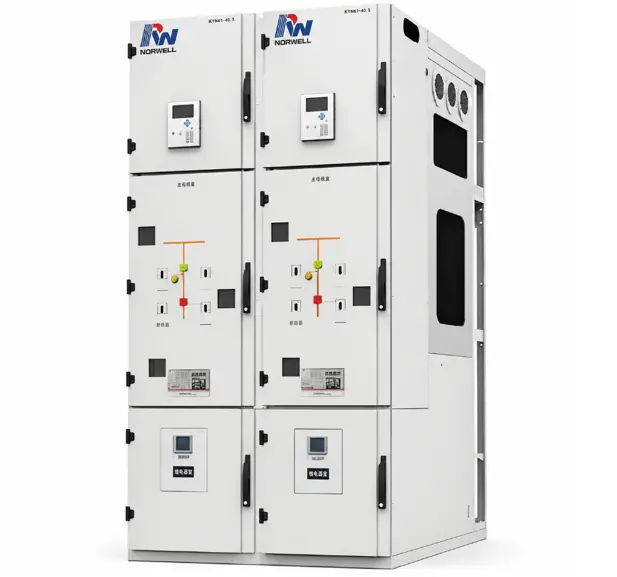
Physical Photos of Rockwill RGIS Series SF6-Free C-GIS
2. Isolation of Metallic Contaminants to Ensure Insulation Stability (Electric Field Optimization)
-
Background: Eco-friendly insulating gases have lower molecular weight and dielectric strength than SF6, leaving a narrower margin of tolerance for local electric-field distortions and free metallic particles in the gas space. The presence of such particles can readily induce partial discharge (PD).
-
Advantage: During frequent operation of the vacuum circuit breaker, the contact bounce of the moving contact generates minute metallic ablation products, while mechanical operation produces wear debris — both are significant sources of metallic particles within the gas chamber. The dual-chamber design physically isolates this dynamic contamination source from the main-busbar chamber, which remains under a static electric field for long periods. This design not only prevents metallic particles from migrating along the chamber floor toward the busbar area, thereby avoiding electric-field distortion caused by suspended or adhered particles, but also confines potential PD risks within the breaker unit itself. Consequently, the core busbar system maintains exceptionally high insulation cleanliness and reliability throughout its long service life.
3. Superior Fault Containment Capability (Prevention of Fault Escalation)
-
Advantage: Should an internal fault occur inside the circuit-breaker chamber — such as vacuum interrupter leakage, dielectric breakdown, or internal arcing — the independent pressure-relief valve of that chamber will operate separately to release pressure. Since the busbar chamber is isolated, the fault does not propagate to the main busbar system. This means that a severe fault in a single feeder branch will not paralyze the entire busbar section, substantially narrowing the outage scope and enhancing the power supply reliability of the distribution network.
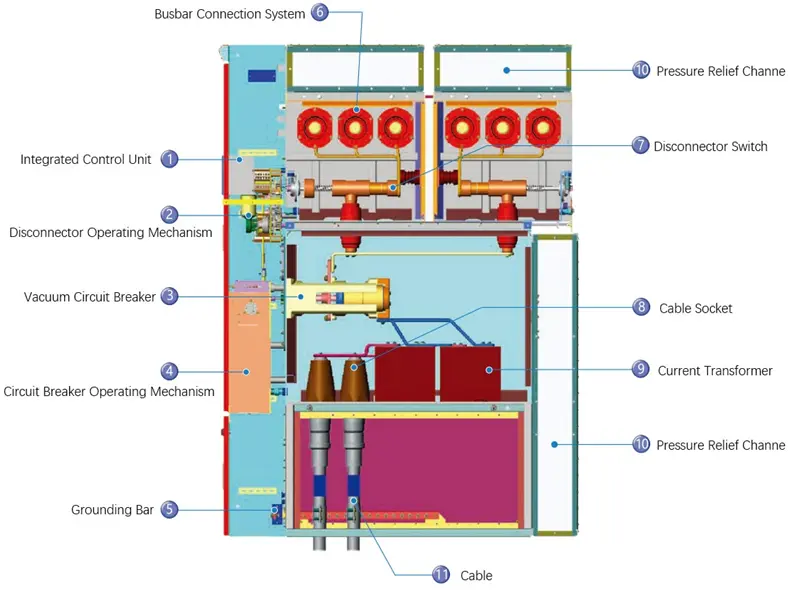
RGIS Cabinet Cross-Sectional View
4. Enhanced Flexibility in Operation, Maintenance, and Replacement
-
Advantage: Vacuum circuit breakers, which are tasked with interrupting short-circuit currents, typically exhaust their electrical and mechanical service lives earlier than the static main busbar, making them more likely to require inspection or replacement. With the dual-chamber structure, if the breaker chamber develops a leak or needs replacement of the vacuum interrupter, gas recovery, evacuation, refilling, and leak-checking operations can be performed solely on the breaker chamber, while the main-busbar chamber remains in its original factory-sealed state. This not only reduces the complexity of on-site work but also prevents the busbar system from being exposed to external moisture or dust contamination.
5. Independent Management of Gas Pressure and Temperature Rise
-
Background: The conductive connections in the breaker circuit — such as terminal connections, flexible connections, and contact joints — constitute the main concentrated heating points within the switchgear. The dynamic temperature rise at these points causes corresponding pressure fluctuations in the breaker chamber.
-
Advantage: The dual-chamber structure fully decouples the pressure monitoring and design parameters of the breaker chamber from those of the busbar chamber. Each chamber is equipped with its own independent gas-density monitoring unit. The busbar chamber, being free of heat sources and having stable pressure, can serve as a reference chamber. The breaker chamber’s pressure varies with load fluctuations. By comparing the pressure-temperature derived density curves of the two chambers, the maintenance system can precisely identify the leak location: a simultaneous density drop in both chambers indicates an external total leak, while a drop solely in the breaker chamber points to a leak in that specific unit — overcoming the difficulty of locating leaks in a single-chamber design. Furthermore, the two chambers can be set to independent pressure levels; for instance, the breaker chamber may adopt a higher pressure to meet interrupting requirements, while the busbar chamber uses a lower pressure to reduce enclosure stress, achieving an optimized balance between design and cost.
Summary
In the development of SF6-free equipment, the dual-gas-chamber structure is not only a manifestation of modular design but also an effective compensation for the inherent “weaknesses” of eco-friendly gases — namely, sensitivity to higher pressure and to metallic particles.
By physically separating the high-failure-rate unit (the circuit breaker) from the core unit (the busbar), this configuration represents one of the optimal engineering solutions for balancing environmental friendliness with high reliability, and for meeting the demands of high-security-level power grids.
The Rockwill RGIS series C-GIS is a typical example of this approach; its 12 kV / 24 kV nitrogen-insulated models, through multi-chamber partitioned design, have successfully validated the engineering value of the dual-chamber structure in fault isolation, particle prevention, and differentiated pressure management.
Edited Form:Garca

 Login