

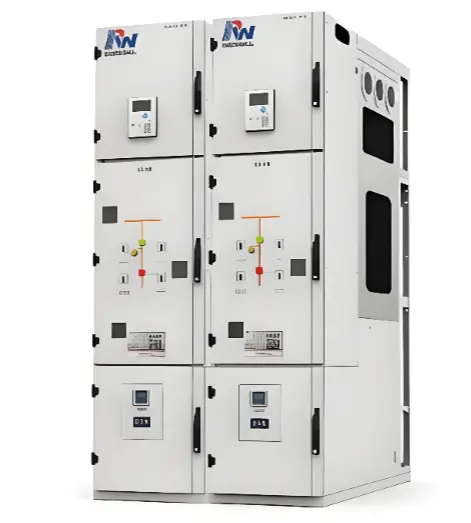
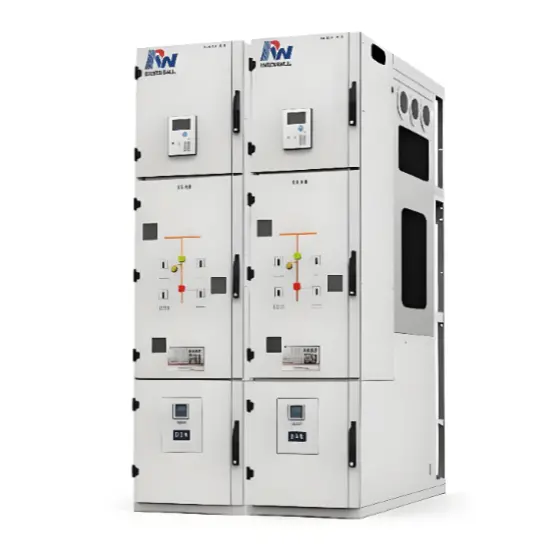
Rockwill RGIS three-position disconnector interlock design: how the five-prevention system is achieved in MV switchgear – technical analysis.
In power systems, the safe operation of high-voltage switchgear is critical. The ROCKWILL RGIS C-GIS switchgear converts complex international standards (IEC, IEEE, etc.) into reliable physical protection through precise mechanical interlock design, providing a solid safety guarantee for the equipment.

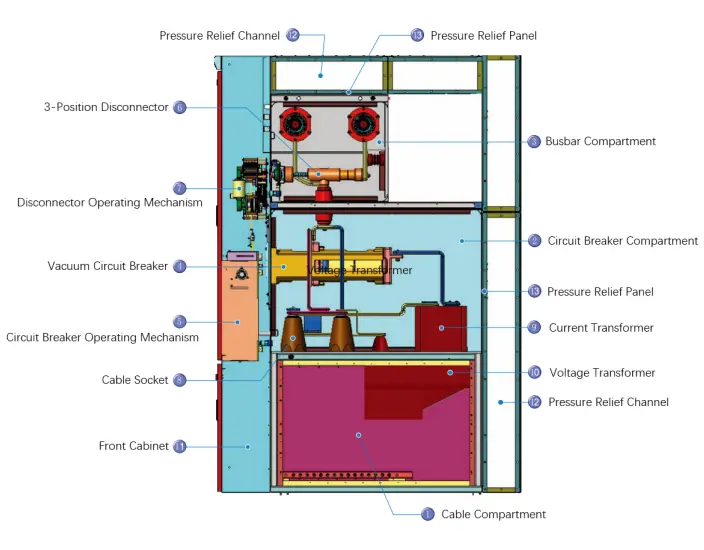
In traditional switchgear, the disconnector and earthing switch are usually two separate components. ROCKWILL RGIS integrates them into a single three-position disconnector, achieving three mutually exclusive operating states through one linked mechanism:
Core design highlight: These three positions are absolutely mutually exclusive. A mechanical interlock mechanism inside the equipment ensures that only one operating state can exist at any given time. This purely mechanical interlock fundamentally eliminates catastrophic conflict states such as "both energized and earthed" — fully meeting the safe operation requirements of compact gas-insulated switchgear.

"Five Prevention" is a mandatory safety principle in the power industry to protect equipment and personnel. ROCKWILL RGIS does not rely on error-prone electronic programs; instead, it locks the equipment into a safe logic through precision mechanical linkages and barriers:
Implementation: A combination of prompting devices and mechanical position limits prevents operation without authorization. The circuit breaker can only be operated when it is fully in a safe position (fully closed or fully open). Forced operation in an intermediate position is physically impossible — eliminating human error at the mechanical level.
Implementation: The disconnector has no arc-quenching capability — operating it under load would produce a high-temperature arc. The equipment features a forced mechanical interlock between the circuit breaker and the disconnector: whenever the circuit breaker is in the "closed" (energized) state, the interlock linkage directly locks the disconnector's operating mechanism. The disconnector can only be operated after the circuit breaker is fully open and the circuit is de-energized.
Implementation: If the circuit is live, the mechanical structure of the three-position disconnector is doubly locked — by both its own position-limiting mechanism and the circuit breaker interlock — preventing it from switching to the "earthed" position. Additionally, the cabinet is equipped with a voltage presence indicating device, forming "mechanical lockout + visual warning" dual protection — completely eliminating the risk of earthing an energized circuit.
Implementation: Whenever the disconnector is in the "earthed" position, the circuit breaker's closing circuit and operating mechanism are continuously locked — the closing operation cannot be executed. The circuit breaker can only be closed after the disconnector is first switched to the "open" position and the interlock is released. This mechanism fundamentally prohibits energizing with the earthing switch closed.
Implementation: ROCKWILL RGIS uses an independent partitioned structure. The door of the high-voltage compartment is linked to the switching mechanism. As long as the compartment is energized or the earthing connection is not applied, the door is securely locked by a mechanical latch. The door lock can only be released after power-off and earthing are confirmed — preventing personnel from inadvertently entering a live high-voltage compartment.
ROCKWILL RGIS's "Five Prevention" design fully complies with international standards such as IEC 62271. Compared to electrical interlocks, which are susceptible to electromagnetic interference, ROCKWILL's pure mechanical hard interlocks offer inherent advantages: strong anti-interference capability, no external power supply required, and extremely low failure rate.
Using the most reliable physical principles, it links the three-position disconnector, circuit breaker, and cabinet doors into a closed loop — comprehensively preventing the risk of human operational error. This not only ensures long-term stable equipment operation but also serves as the ultimate safeguard for the personal safety of on-site maintenance personnel.
Edited From:Garca








