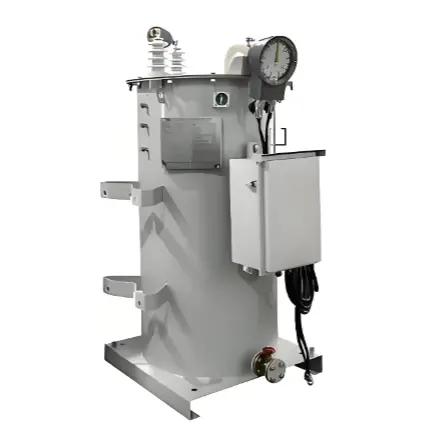
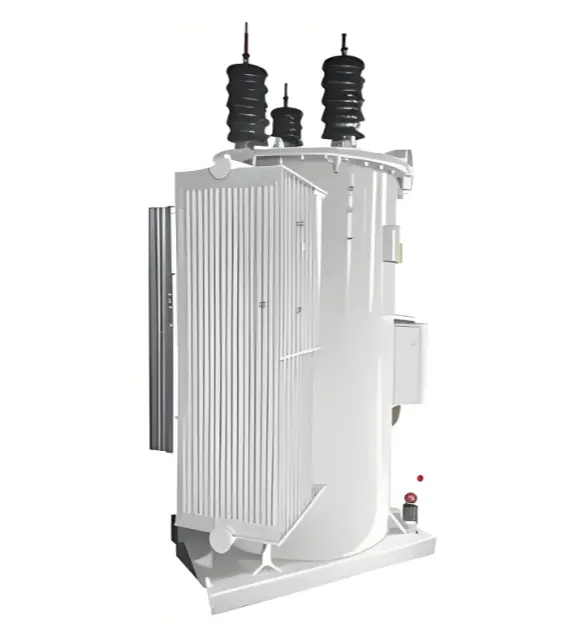
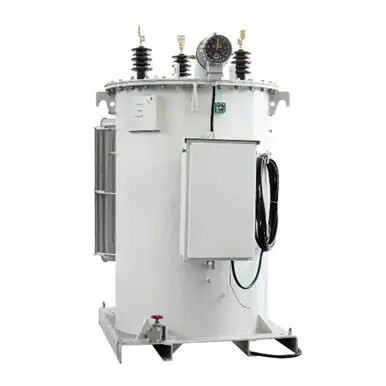
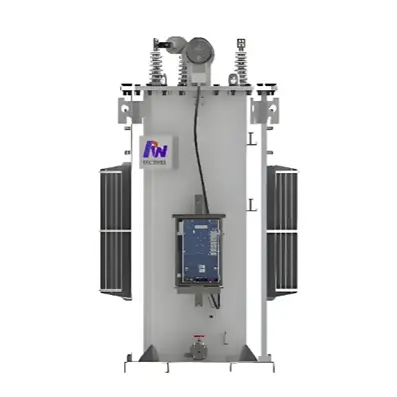
The Rockwill RVR-1 Automatic Voltage Regulator (AVR) incorporates an integrated self-locking protection mechanism for overload, overcurrent, and undervoltage conditions. Upon detection of grid anomalies, the system immediately locks the voltage regulation function and inhibits tap changer operations. This design shifts safety protection to the forefront, delivering active defense capabilities to the power distribution network without the need for supplementary external protection devices.
Mitigation of Mechanical and Electrical Degradation
- On-load tap changing inherently generates arcing at the contact interface during switching transitions. Under nominal operating conditions, the arc naturally extinguishes at the current zero-crossing, resulting in negligible contact wear. However, during overload or overcurrent events, the system current exceeds the rated breaking capacity of the tap changer. This causes a severe escalation in arc energy, potentially leading to contact ablation, welding, or mechanical jamming of the drive mechanism. The self-locking protection inhibits further tap changer operations within milliseconds of overcurrent detection, fundamentally preventing mechanical and electrical damage caused by forced switching under fault conditions.
Prevention of Abnormal Voltage Output and Protection of Downstream Loads
- During undervoltage and overcurrent faults, the grid voltage waveform is frequently distorted or exhibits severe amplitude deviation. If the AVR continues to execute regulation commands under these conditions, tap position adjustments will fail to correct the distorted waveform. Instead, they may propagate high-amplitude transient overvoltages or non-sinusoidal waveforms to the secondary side of the transformer, jeopardizing sensitive downstream loads such as IT infrastructure, precision instrumentation, and medical equipment. Locking the regulation function prevents the AVR from outputting compromised voltage during abnormal states, ensuring downstream equipment is shielded from secondary damage.
Elimination of Misoperation and Enhancement of System Integrity
- The "direct locking" mechanism operates as a hardware-level safety interlock, functioning independently of upper-level communication networks and logic controllers. Even if a remote SCADA system erroneously issues a tap-changing command due to communication interference, or if the local controller experiences logic corruption during fault recovery, the lockout signal will unconditionally inhibit any voltage regulation operation. This non-bypassable interlock mechanism reduces the risk of human error and control logic failures to an absolute minimum.
Clear Fault Demarcation for Streamlined O&M
- In traditional voltage regulators lacking self-locking protection, operators often struggle to diagnose the root cause of a regulation failure following an overload or undervoltage event—whether it stems from regulation delay, communication loss, or hardware failure. The self-locking protection provides an unambiguous lockout status indication, enabling O&M personnel to immediately identify that the system is in a protective state rather than experiencing a malfunction. This clearly defines the fault boundary, narrowing the troubleshooting scope from a comprehensive system inspection to specific upstream line issues (e.g., overload, short circuit, or phase loss), thereby significantly reducing Mean Time To Repair (MTTR) and power outage durations.
Target Applications
The value of this protection mechanism is particularly critical in the following operational environments:
- Radial Distribution Feeders: Long-distance lines at the grid edge characterized by frequent and high-amplitude load fluctuations.
- Industrial Facilities: Plants where the energization of heavy machinery causes transient overcurrents.
- DER Interconnection Points: Grid connection points for distributed energy resources (e.g., PV and wind) subject to bidirectional voltage fluctuations.
- Remote Substations: Unmanned facilities with extended O&M response times.
Summary
Through its rigid "lockout-on-anomaly" logic, the self-locking protection mechanism of the Rockwill RVR-1 AVR prevents mechanical and electrical failures resulting from forced tap changing at the source. Concurrently, it isolates distorted voltages to protect downstream loads, neutralizes risks associated with human error and SCADA communication anomalies, and provides O&M personnel with definitive fault diagnostics. This proactive safety architecture not only extends the operational lifespan of the voltage regulator but also significantly enhances the safety, stability, and maintenance efficiency of the power distribution system.
Edited From:Garca

 Login