Search


Rockwill RVR-1 Voltage Regulator Tap Changer: Why is Arc-Free Switching Achieved, and What are the Advantages?

Rockwill RVR-1 arc-free tap changer: make-before-break contacts + bridging reactor + vacuum interrupter for 2M operations, 32-step precision, and long-term oil stability.

Rockwill
Field: Manufacturing
10Year<
China
Add us on Google

I. Core Principle of No Sustained Arcing in RVR-1 Tap Changer Voltage Regulation

1. Make-Before-Break Dual-Contact Transition with Parallel Current-Limiting Reactor

A conventional single-contact tap changer draws an arc directly when disconnecting a current-carrying tap. The RVR-1 uses dual moving contacts with a make-before-break bridging transition:

  • Steady state: Both contacts rest on the same winding tap, with the main contact carrying the full load current.
  • Tap change: One contact first bridges to the next tap, momentarily shorting two sections of the regulating winding. A parallel reactor connected across the two taps substantially limits the circulating current, eliminating the conditions for a high-current arc.
  • Original tap opens: The original-position contact then disconnects — no current surge, no high-current interruption, and arc generation is suppressed at the source.

iee-business

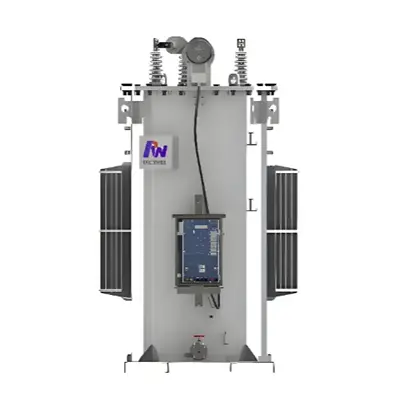
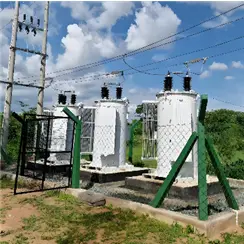
Single Phase Automatic Voltage Regulator

2. Dedicated Vacuum Interrupter Switching Unit

Building on the reactor's current-limiting function, the RVR-1 further employs vacuum interrupters to perform contact opening and closing. The switching action takes place inside a sealed vacuum interrupter. When the contacts part, the resulting metal vapor arc rapidly extinguishes at current zero and cannot re-strike, achieving fast arc suppression. The integrated motor-spring quick-acting mechanism completes the tap change in milliseconds, further reducing arc duration.

This design fundamentally differs from conventional oil-immersed resistor-type on-load tap changers (OLTCs), effectively suppressing arcs during voltage regulation.

3. Oil-Immersed Fully Sealed Environment Aids Arc Suppression

The fully oil-immersed structure provides rapid cooling of the contacts. The insulating oil thermally decomposes from arc energy, generating gas bubbles that assist arc extinction. Even if minor discharge occurs, it is quickly extinguished, preventing sustained arcing and contact erosion.


II. Five Core Advantages of the No-Sustained-Arcing Tap Changer Design

1. Substantially Extended Mechanical Life

The documented mechanical operating life reaches up to 2 million operations (compared to approximately 500,000 for conventional resistor-type OLTCs). With no arc erosion, contacts do not develop pitting, welding, or wear, allowing long-term, frequent voltage regulation without switch damage — ideal for distribution networks with daily voltage fluctuations.

2. Long-Term Insulating Oil Stability, Extended Maintenance-Free Period

In conventional on-load tap changers, arcing decomposes the insulating oil, producing carbon particles and acidic compounds that accelerate oil degradation. The RVR-1's no-sustained-arcing design prevents oil carbonization and darkening, eliminating the need for frequent oil filtration or replacement. Combined with the fully sealed enclosure, this enables long-term maintenance-free operation, with a design life of 20 years.

3. More Reliable Protection System, Reduced Line Fault Risk

Arcing generates high-frequency overvoltages and electromagnetic interference that can trigger protection misoperation or damage winding insulation. The no-sustained-arcing design produces no switching overvoltage stress. A bypass surge arrester provides overvoltage protection, reducing the probability of insulation breakdown in windings and bushings, and minimizing line tripping and outages.

4. Consistent Voltage Regulation Accuracy, 32-Tap Smooth Continuous Adjustment

Arcing causes sudden changes in contact resistance, leading to voltage deviation between tap positions. No-sustained-arcing contacts maintain stable contact resistance, delivering precise regulation across ±10% range in 32 steps, approximately 0.625% (5/8%) per step — with minimal output voltage fluctuation to protect downstream sensitive equipment.

Single Phase Automatic Voltage Regulator 7.62 kV-34.5 kV

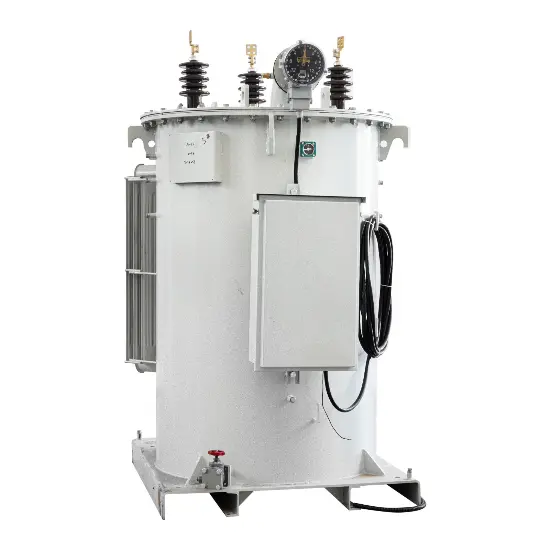
Single Phase Automatic Voltage Regulator

5. Significantly Reduced Maintenance Costs

No need for periodic inspection, contact dressing, or replacement of eroded contacts. Insulating oil replacement intervals are extended several times over, reducing consumable oil costs. Field outage frequency for maintenance is substantially lowered, cutting distribution network maintenance labor and outage losses.


Summary

The RVR-1 achieves effective arc suppression during voltage regulation through a triple-coordination design — make-before-break dual-contact transition, parallel current-limiting reactor, and vacuum interrupter switching unit — acting on current, dielectric medium, and switching sequence. This delivers five core product advantages: extended mechanical life, long-term insulating oil stability, more reliable protection system, consistent voltage regulation accuracy, and significantly reduced maintenance costs.

Edited From:Garca

Give a tip and encourage the author!

Comments

Share your question or perspective
WhatsApp
Send inquiry
+86
Click to upload file
Download
Get the IEE Business Application
Use the IEE-Business app to find equipment, obtain solutions, connect with experts, and participate in industry collaboration anytime, anywhere—fully supporting the development of your power projects and business.
Login
or continue with
New here?
Register