• Product
  • Suppliers
  • Manufacturers
  • Solutions
  • Free tools
  • Knowledges
  • Experts
  • Communities
Search


Hazards of Frequent On-Load Tap-Changer Operation and Analysis of Tap-Changing Frequency Limits

Vziman
Field: Manufacturing
10Year<
China
 
The on-load tap-changer (OLTC) is the core component that maintains grid voltage stability and enables on-load voltage regulation of transformers. However, because each switching operation inevitably involves arcing and mechanical action, excessively frequent operation not only accelerates equipment aging but can also lead to serious safety accidents. This article focuses on oil-immersed resistive-transition on-load tap-changers, with a scope consistent with DL/T 574-2021.
iee-business

1. Main Hazards Caused by Frequent Operation

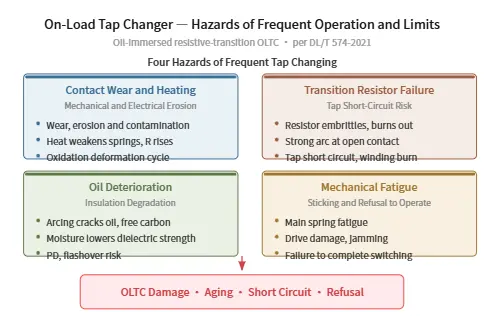
Frequent tap-changing operations accelerate deterioration of the switch from electrical, insulation, and mechanical perspectives, as summarized below:

Hazard Mechanism Consequence
Contact wear and increased heating Frequent voltage regulation causes severe mechanical wear, electrical erosion, and contact contamination; at higher load currents, the thermal effect of current weakens the spring elasticity, reducing contact pressure between the moving and stationary contacts and increasing contact resistance, which in turn causes contact heating Oxidation corrosion and mechanical deformation on the contact surface accelerate, creating a vicious cycle that may ultimately lead to damage of the diverter switch
Transition resistor failure and short-circuit risk The transition resistor withstands a large current surge and instantaneously produces high temperature at every switching operation; frequent operation can make its material brittle, change its resistance value, or even burn it out If switching under load continues after the resistor has burned out, a strong arc is generated at the break, leading to short-circuit between tap positions, burning out the tap section of the high-voltage winding, and even causing irreparable damage to the switch
Oil quality deterioration and insulation degradation Arcing from frequent switching causes cracking of the insulating oil in the switch, producing impurities such as free carbon and moisture Oil quality deteriorates and insulation strength drops, not only limiting the number of switching operations but also potentially triggering partial discharge or flashover that endangers safe equipment operation
Mechanical component fatigue and refusal to operate Long-term frequent operation fatigues mechanical components such as the main spring of the quick-operating mechanism, possibly leading to transmission system damage, mechanical jamming, and limit switch failure The switch cannot operate or fails mid-operation (refusal to operate)
 

iee-business

2. Strict Limits on Tap-Changing Frequency

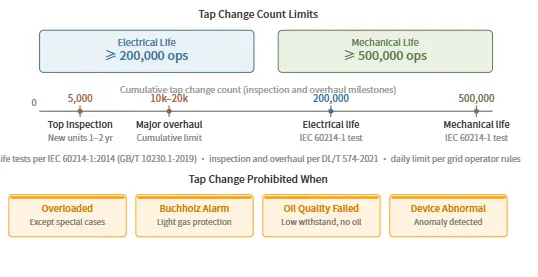
The number of tap-changes of an on-load tap-changer is constrained by its mechanical and electrical life. According to manufacturer product standards and industry practice, the electrical life of an on-load tap-changer is generally not less than 200,000 operations and the mechanical life not less than 500,000 operations, with the test methods based on IEC 60214-1:2014 (corresponding to the current national standard GB/T 10230.1-2019, Tap-changers – Part 1: Performance requirements and test methods). In actual operation, the following limits apply in accordance with maintenance regulations:

Maintenance and Service-Life Limits (per the current industry standard DL/T 574-2021, Guide for the Operation and Maintenance of Tap-Changers of Power Transformers):

  • A newly commissioned tap-changer should undergo a core inspection when in service for 1–2 years or after 5000 tap-changes.
  • After the cumulative number of tap-changes reaches the prescribed maintenance-cycle limit, overhaul should be carried out; if no explicit limit is specified, a core inspection is generally also warranted every 10,000–20,000 tap-changes or every 3–5 years.

Daily Tap-Changing Frequency Limit :Follow the operating regulations of each grid operator (limits vary by voltage class and region; in general, the daily tap-changing frequency of 110 kV and above main transformers is strictly controlled).

Operation Interval :Sufficient interval should be maintained between two consecutive tap-changing operations; specific requirements follow the operating regulations and manufacturer's instructions.

Overload Limit:Tap-changing operation is prohibited when the transformer is running under overload (except in special circumstances).

iee-business

3. Other Cases Where Tap-Changing Is Prohibited

In addition to exceeding the tap-change count limit, tap-changing of the on-load tap-changer is also not allowed under the following conditions:

Prohibited Condition Description
Transformer operating under overload Except in special circumstances
Light-gas relay of the on-load tap-changer gives an alarm
Oil dielectric strength of the tap-changer is unqualified Breakdown voltage below the specified value or no oil in the oil level gauge
Tap-changer malfunctions
 

Summary

As the core component for regulating transformer voltage, the on-load tap-changer suffers a series of serious hazards from frequent operation, including contact wear, transition resistor burnout, insulating oil deterioration, and mechanical fatigue.

To ensure grid safety, tap-changing operations should strictly follow the frequency limits in the maintenance regulations (for example, a core inspection should be carried out 1–2 years after commissioning or after 5000 tap-changes, and overhaul should be carried out after reaching the prescribed maintenance-cycle limit), and the daily tap-changing frequency should be controlled according to the operator's regulations.

At the same time, tap-changing should be prohibited under abnormal conditions such as equipment overload, gas-relay alarm, or unqualified oil quality.

 Edited From:Garca
Give a tip and encourage the author!

Comments

Share your question or perspective
WhatsApp
Send inquiry
+86
Click to upload file
Download
Get the IEE Business Application
Use the IEE-Business app to find equipment, obtain solutions, connect with experts, and participate in industry collaboration anytime, anywhere—fully supporting the development of your power projects and business.
Login
or continue with
New here?
Register