A Novel Collapse Prediction Index for Voltage Stability Analysis and Contingency Ranking in Power Systems

Voltage instability is a serious phenomenon that can occur in a power system because of critical or stressed conditions. To prevent voltage collapse caused by such instability, accurate voltage collapse prediction is necessary for power system planning and operation. This paper proposes a novel collapse prediction index (NCPI) to assess the voltage stability conditions of the power system and the critical conditions of lines. The effectiveness and applicability of the proposed index are investigated on the IEEE 30-bus and IEEE 118-bus systems and compared with the well-known existing indices (L mn , FVSI, LQP, NLSI, and VSLI) under several power system operations to validate its practicability and versatility. The study also presents the sensitivity assumptions of existing indices and analyzes their impact on voltage collapse prediction. The results show the superiority of the proposed index in accurately estimating the maximum load-ability and predicting the critical lines, weak buses, and weak areas in medium and large networks during various power load operations and contingencies.
1.Introduction.
Voltage instability is one of the significant problems in the electricity system that needs to be considered to secure power transfer to consumers. Because of a continuous increase in electrical load the present-day electrical power system urgently requires secure electrical power transmission facilities. From an environmental and economic point of view, it is challenging to install new transmission lines. Also, the situation becomes more complex with the increasing penetration of renewable energies. The most crucial challenge facing the network is excessive loading in transmission lines resulting in a massive voltage drop, which can cause voltage collapse due to overload on the lines. In this case, the line becomes in a critical state, and the system can face collapse under even small disturbances. Voltage collapse leads to the exit of a line from the system when the loading exceeds the allowable limit. Subsequently, the exiting of the line from the system increases the power flow in other lines, potentially causing consecutive exits of the lines and leading to the blackout of the entire network.
2.Voltage Stability Indices(VSIs).
VSIs are used as measurement tools to determine whether a system is stable or not. There are many methods for voltage stability assessment that have been suggested in the literature. Three categories of VSIs are classified: line VSIs, bus VSIs, and overall VSIs. The classification of VSIs, can be grouped into four types: (1) line variables based-indices; (2) bus variables based-indices;(3)Jacobian matrix-based indices; and (4)Phasor Measurement Units (PMU)-based indices. Jacobian matrix-based indices can identify the voltage collapse points and determine the stability margin.
3.Proposed Novel Collapse Prediction Index NCPI.
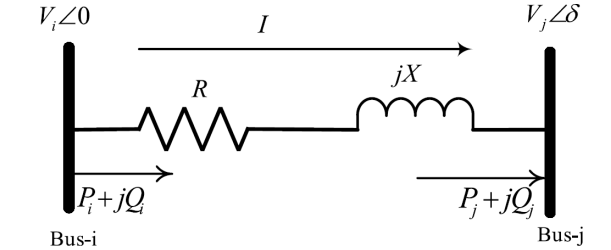
The formulation of the index LQP is based on entirely ignoring the line resistance. This leads to erroneous collapse predictions. This index also ignores the relative direction of active power flow in a line in relation to reactive power flow. In order to avoid these drawbacks, an improved Novel Collapse Prediction Index (NCPI) is formulated based on partially ignoring the resistance of a transmission line, while taking into account the impacts of the active and reactive power flow on the system voltage stability.
4.Voltage stabilty Analysis Based on NCPI.
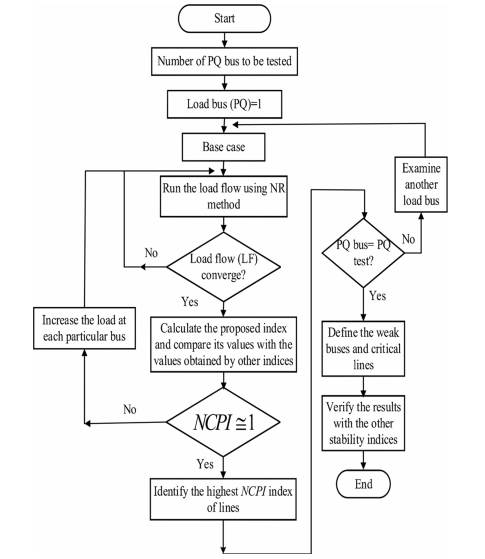
The main goal of voltage stability analysis is to determine the voltage collapse points, maximum load-ability, weak buses and critical lines using the proposed index NCPI. Voltage stability normally has a high sensitivity to reactive power load. Therefore, the heavy reactive power at each particular bus is determined to identify the weak buses and critical lines.
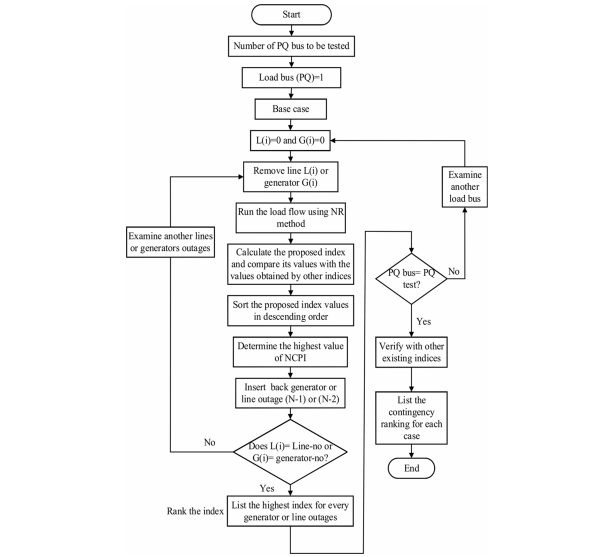
5.Contingency Ranking and Analysis Based on NCPI.
The results show the most sensitive or critical line due to line outage or generation unit outage, which has the highest NCPI value among the lines. The most critical line is eligible to be interrupted from the service due to a line outage. In this case, a series of line outages will occur if operators don't make rectifications in time.
Source: IEEE Xplore
Statement: Respect the original, good articles worth sharing, if there is infringement please contact delete.