• Product
  • Suppliers
  • Manufacturers
  • Solutions
  • Free tools
  • Knowledges
  • Experts
  • Communities
Search


Principles and Applications of Oil-Immersed Vacuum Switches in Suppressing Restrike During Capacitor Bank Switching

Rockwill
Field: Manufacturing
10Year<
China
 
In power systems, shunt capacitor banks are core equipment for reactive power compensation, power factor improvement, and voltage stabilization. However, when switching capacitor banks with vacuum switches (especially oil-immersed vacuum switches), two major challenges arise: closing inrush current and opening restrike overvoltage.
Among these, restrike poses a critical threat to capacitors and system insulation because it can generate extremely high overvoltages. With its unique structure and arc-extinguishing principle, the oil-immersed vacuum switch has become key equipment for suppressing restrike and ensuring system safety. So how exactly does it achieve this?
iee-business

1. Core Problem: What Is Restrike and What Are Its Hazards

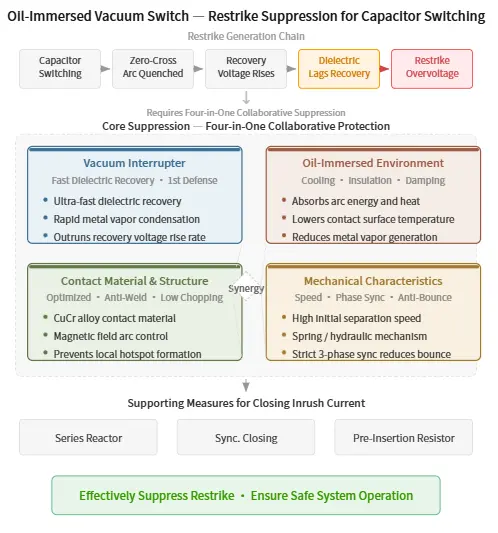
When a vacuum switch interrupts a capacitor bank, the capacitor current leads the voltage by 90°, so the contacts typically extinguish the arc at current zero. At this moment, the capacitor retains a DC voltage close to the system peak value. As the system voltage continues to change, the recovery voltage across the switch contacts rises rapidly. If the dielectric recovery speed of the contact gap cannot keep pace with the rate of recovery voltage rise, the gap will break down again and reignite an arc — this is "restrike."

The hazards of restrike are extremely serious:

Hazard Description
High-amplitude overvoltage Each restrike superimposes a voltage peak on the capacitor; repeated restrikes can drive overvoltage to 3 times the rated system voltage or higher
Insulation damage to equipment Such high overvoltage can puncture the insulation of capacitor internal elements, surge arresters, and even transformers, causing permanent damage
System incidents Severe overvoltage may cause protection maloperation or failure to operate, expanding the fault scope and affecting grid stability

 2. Core Mechanisms for Suppressing Restrike

The oil-immersed vacuum switch effectively suppresses restrike through the synergistic action of the following aspects:

High Dielectric Recovery Strength of the Vacuum Interrupter

This is the first line of defense against restrike. Vacuum possesses extremely high insulation strength and extremely fast dielectric recovery speed. After arc extinction at current zero, the metal vapor inside the vacuum interrupter rapidly diffuses and condenses on the shield, allowing the contact gap to recover to a very high insulation level within microseconds. This rapid recovery capability enables the switch to "outpace" the rising recovery voltage, thereby avoiding restrike.

Auxiliary Cooling and Insulation of the Oil-Immersed Environment

The oil-immersed structure provides additional protection and auxiliary functions for the vacuum interrupter:

Function Description
Contact cooling Insulating oil effectively absorbs arc energy and contact heat, lowering contact surface temperature and reducing metal vapor generation at high temperatures, thus decreasing the probability of restrike caused by excessive metal vapor concentration after arc extinction
Enhanced external insulation Oil serves as the main insulating medium, ensuring safe operation of the switch at high voltage and preventing external flashover
Damping effect The viscosity of oil provides damping for contact movement, improving opening speed stability and reducing contact bounce caused by mechanical vibration — a major trigger of restrike

Optimized Contact Material and Structure Design

Modern oil-immersed vacuum switches adopt contact materials specially optimized for capacitive current interruption (such as copper-chromium alloys), which feature low chopping current, high erosion resistance, and good anti-welding performance. In addition, contact structure designs (such as axial or transverse magnetic field contacts) effectively control the arc shape, preventing the arc from concentrating locally on the contact surface, thereby reducing hot spot formation and further lowering restrike risk.

Precise Mechanical Characteristic Control

The opening speed and three-phase synchronization of the switch are critical to restrike suppression. Oil-immersed vacuum switches are typically equipped with high-performance spring or hydraulic operating mechanisms to ensure sufficiently high initial separation speed during opening, rapidly elongating the arc and accelerating dielectric recovery. Meanwhile, strict three-phase synchronization adjustment avoids voltage imbalance and neutral point displacement caused by non-simultaneous phase operation, reducing the mechanical triggers of restrike.

Mechanism Summary

Defense Key Contribution
Vacuum interrupter dielectric recovery Ultra-fast recovery outpaces recovery voltage rise; first line of defense
Oil-immersed environment Cooling, enhanced external insulation, and damping against contact bounce
Contact material and structure Low chopping current, anti-welding, and magnetic field arc control
Mechanical characteristic control High opening speed and strict three-phase synchronization
 iee-business

3. Supporting Measures for Closing Inrush Current

Although suppressing restrike is the key to the opening process, closing inrush current cannot be ignored either. The enormous inrush current not only impacts the capacitor but may also cause welding of switch contacts. In practical applications, oil-immersed vacuum switches often incorporate the following measures:

Measure Description
Series current-limiting reactor The most common and effective method; increases circuit inductance to limit inrush current amplitude and frequency
Phase-selection closing technology Uses a smart controller to precisely close the switch at voltage zero or a specific phase angle, fundamentally eliminating or greatly reducing inrush current
Pre-charge resistor In special applications, pre-charges the capacitor through a resistor before closing the main switch once the voltage is balanced
 

4. Summary

Through the four-in-one mechanism of "rapid dielectric recovery in the vacuum interrupter + cooling and insulation by the oil-immersed environment + optimized contact material and structure + precise mechanical control," the oil-immersed vacuum switch builds a solid defense line against restrike during capacitor switching. It not only solves the inherent defect of vacuum switches being prone to restrike when interrupting capacitive current, but also combines the advantages of oil-immersed equipment — reliable operation and low maintenance — making it the ideal choice for high-voltage shunt capacitor bank switching. Correctly understanding its operating principle is of great significance for power system planning, design, equipment selection, and safe operation and maintenance.

Edited From: Garca

Give a tip and encourage the author!

Comments

Share your question or perspective
WhatsApp
Send inquiry
+86
Click to upload file
Download
Get the IEE Business Application
Use the IEE-Business app to find equipment, obtain solutions, connect with experts, and participate in industry collaboration anytime, anywhere—fully supporting the development of your power projects and business.
Login
or continue with
New here?
Register