Maintenance earthing switches and fast earthing switches (FES) are two types of switches with distinct characteristics.
Maintenance Earthing Switches
These are typically configured alongside the disconnectors on both sides of a circuit breaker. Their sole purpose is to provide safety grounding on both sides of the circuit breaker during equipment maintenance.
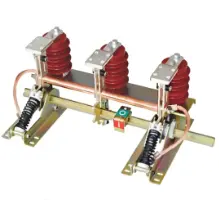
Fast Earthing Switches (FES)
These are positioned on the line side of the outgoing disconnector in an outgoing circuit. They serve two primary functions:
- Managing Induced Current: They are used to open and close capacitive currents generated by electrostatic induction and inductive currents generated by electromagnetic induction from parallel overhead lines.
- Rapid Fault Protection: If tracking occurs on internal insulators or internal arcing happens within the enclosure, the fast earthing switch quickly grounds the main circuit, allowing the circuit breaker to clear the fault current.
Furthermore, the fast earthing switch is situated on the outer side of the line switch. During a single-phase fault, the switches on both sides of the faulted line trip. However, electromagnetic coupling between the healthy phases and the faulted phase creates a secondary arc current (prolonged current). This prevents the fault point from de-ionizing, which can delay or prevent arc extinction. To minimize this secondary arc current, automatic devices immediately close the fast earthing switches on both sides once the circuit breakers trip. After a preset arc-extinction time, the fast earthing switches open again, followed by a single-phase auto-reclosure. This process significantly improves the success rate of the auto-reclosure.

 Login