• Product
  • Suppliers
  • Manufacturers
  • Solutions
  • Free tools
  • Knowledges
  • Experts
  • Communities
Search


How Silicon Steel Minimizes Transformer Core Loss
Echo
Echo
Field: Transformer Analysis
China

Why Transformers Use Silicon Steel Laminations to Reduce Eddy Current Loss

Transformers rely on efficient magnetic cores to transfer energy between windings with minimal loss. One of the most critical design choices is the use of laminated silicon steel sheets—not solid iron or plain steel—for the core. This decision directly addresses a major source of inefficiency: eddy current loss.

What Is Eddy Current Loss?

When a transformer operates under alternating current (AC), the primary winding generates a time-varying magnetic flux. This changing flux passes through the iron core and induces circulating currents within the core material itself. These currents—called eddy currents—flow in closed loops perpendicular to the magnetic field and dissipate energy as heat, reducing efficiency and raising operating temperatures.

Eddy current loss is one component of core (or iron) loss, the other being hysteresis loss.

Why Silicon Steel?

Silicon steel—an alloy of iron with 0.8% to 4.8% silicon—is the industry standard for power transformer cores due to two key properties:

  • High magnetic permeability: Enables strong magnetic flux density with less excitation current, allowing for more compact transformer designs.

  • Increased electrical resistivity: Silicon raises the resistivity of the steel, which inherently suppresses eddy current magnitude.

Additionally, silicon steel exhibits a narrow hysteresis loop, meaning less energy is lost during each magnetization cycle—reducing hysteresis loss and associated heating.
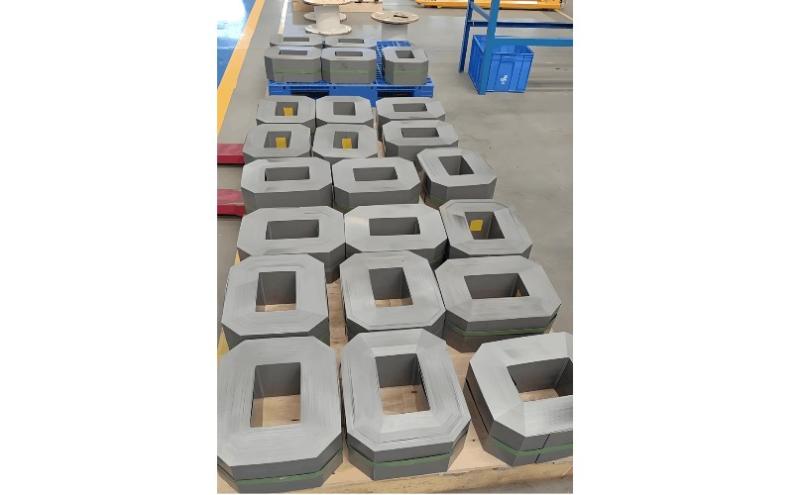
Transformer Core Loss.jpg

Why Laminated Sheets—Not a Solid Block?

If the core were made from a solid block of silicon steel, eddy currents would flow freely through its large cross-section, causing significant power loss and overheating.

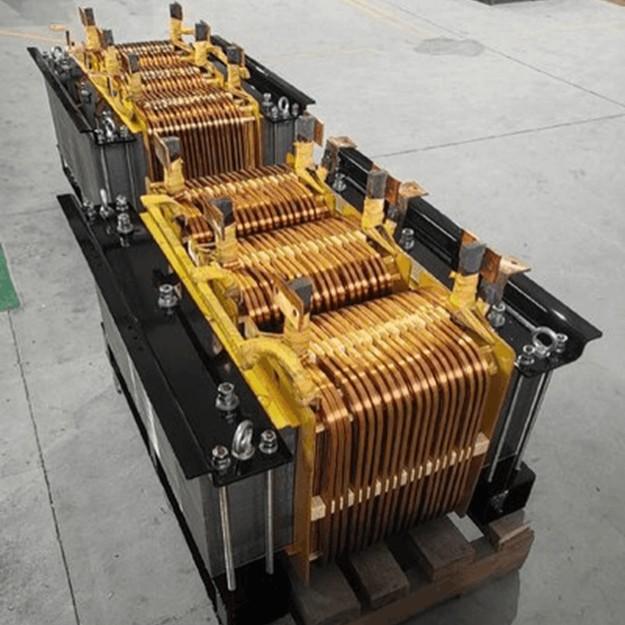
To combat this, transformer cores are built from thin, insulated laminations—typically 0.35 mm thick cold-rolled silicon steel sheets—stacked together. This design:

  • Restricts eddy currents to narrow paths within each lamination,

  • Increases effective electrical resistance along current loops,

  • Dramatically reduces eddy current magnitude and associated heating.

The laminations are coated with an insulating oxide or varnish layer to prevent electrical contact between sheets, ensuring currents cannot bridge across layers.

Practical Design Trade-offs

In theory, thinner laminations = lower eddy current loss. However, manufacturing extremely thin sheets increases:

  • Material cost,

  • Production complexity,

  • Labor time,

  • Risk of reduced core cross-sectional area (lowering magnetic performance).

Therefore, engineers balance efficiency, cost, and manufacturability when selecting lamination thickness—0.35 mm remains the optimal standard for most distribution and power transformers.

Common core shapes include:

  • Single-phase “core-type” (single-window),

  • Three-phase “shell-type” or double-window (“日”-shaped) configurations.
Give a tip and encourage the author!
Recommended
How to Implement Transformer Gap Protection & Standard Shutdown Steps
How to Implement Transformer Neutral Grounding Gap Protection Measures?In a certain power grid, when a single-phase ground fault occurs on a power supply line, both the transformer neutral grounding gap protection and the power supply line protection operate simultaneously, causing an outage of an otherwise healthy transformer. The main reason is that during a system single-phase ground fault, the zero-sequence overvoltage causes the transformer neutral grounding gap to break down. The resulting
Noah
12/05/2025
Innovative & Common Winding Structures for 10kV High-Voltage High-Frequency Transformers
1.Innovative Winding Structures for 10 kV-Class High-Voltage High-Frequency Transformers1.1 Zoned and Partially Potted Ventilated Structure Two U-shaped ferrite cores are mated to form a magnetic core unit, or further assembled into series/series-parallel core modules. Primary and secondary bobbins are mounted on the left and right straight legs of the core, respectively, with the core mating plane serving as the boundary layer. Windings of the same type are grouped on the same side. Litz wire i
Noah
12/05/2025
How to Increase Transformer Capacity? What Needs to Be Replaced for Transformer Capacity Upgrade?
How to Increase Transformer Capacity? What Needs to Be Replaced for Transformer Capacity Upgrade?Transformer capacity upgrade refers to improving the capacity of a transformer without replacing the entire unit, through certain methods. In applications requiring high current or high power output, transformer capacity upgrades are often necessary to meet demand. This article introduces methods for transformer capacity upgrade and the components that need to be replaced.A transformer is a critical
Echo
12/04/2025
Causes of Transformer Differential Current and Hazards of Transformer Bias Current
Causes of Transformer Differential Current and Hazards of Transformer Bias CurrentTransformer differential current is caused by factors such as incomplete symmetry of the magnetic circuit or insulation damage. Differential current occurs when the primary and secondary sides of the transformer are grounded or when the load is unbalanced.Firstly, transformer differential current leads to energy waste. Differential current causes additional power loss in the transformer, increasing the load on the
Edwiin
12/04/2025
Related Products
Send inquiry
Download
Get the IEE Business Application
Use the IEE-Business app to find equipment, obtain solutions, connect with experts, and participate in industry collaboration anytime, anywhere—fully supporting the development of your power projects and business.