Optical Fiber vs Coaxial Cable | Signal Type, Structure & Application Differences

Both optical fiber and coaxial cable are types of guided transmission media. However, several key factors distinguish the two. The most fundamental difference lies in the type of signal they transmit: optical fiber is designed to carry optical (light) signals, whereas coaxial cable is used for transmitting electrical signals.
Definition of Optical Fiber
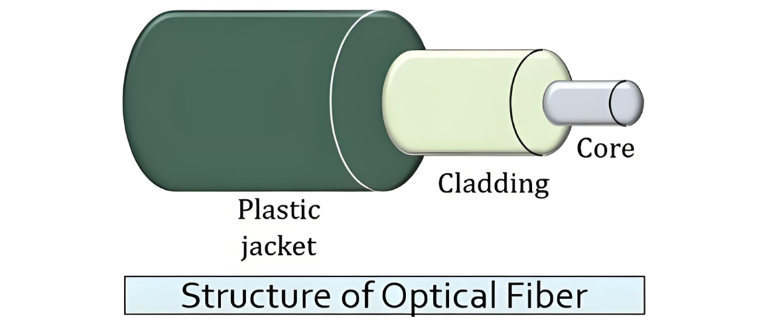
Optical fibers are flexible, transparent waveguides used to transmit light signals from one end to another with minimal loss. They are primarily made of high-purity glass (usually silica) or sometimes plastic, and consist of a core and cladding structure.
The core is the central, innermost region made of ultra-pure silica glass, through which light propagates. It is surrounded by a layer called the cladding, which is also made of glass but with a lower refractive index than the core. This refractive index difference enables total internal reflection, allowing light to travel long distances with low attenuation.
To protect the fragile glass structure from physical damage, moisture, and environmental stress, the entire fiber assembly is encased in a protective outer layer known as a buffer coating or plastic jacket.
The figure below illustrates the schematic structure of an optical fiber:
An optical signal is transmitted through an optical fiber via the principle of total internal reflection (TIR). When light is introduced into the fiber, it propagates through the core by undergoing successive reflections at the interface between the core and the cladding.
For total internal reflection to occur, the refractive index of the core must be higher than that of the cladding. This index difference is essential to guide the light efficiently along the fiber with minimal loss.
As per the principle of TIR, when a light ray traveling in a denser medium (the core) strikes the boundary with a rarer medium (the cladding) at an angle greater than the critical angle, the ray is completely reflected back into the denser medium, rather than being refracted out. This phenomenon allows the light to be confined within the core.
When a light ray enters the core, it travels until it reaches the core-cladding boundary. Due to the difference in refractive indices, and provided the angle of incidence exceeds the critical angle, the ray is reflected back into the core instead of passing into the cladding. This process repeats continuously along the fiber length, enabling the light signal to zigzag down the core and travel from one end of the fiber to the other with high efficiency and low attenuation.
Thus, total internal reflection is the fundamental mechanism that enables long-distance, high-bandwidth optical communication through optical fibers.
Definition of Coaxial Cable
Coaxial cables, commonly referred to as "coax," are a type of guided transmission medium used for carrying electrical signals over a distance. They are constructed as electrical conductors that allow the flow of electrons, typically made with a central core of copper due to its excellent conductivity.
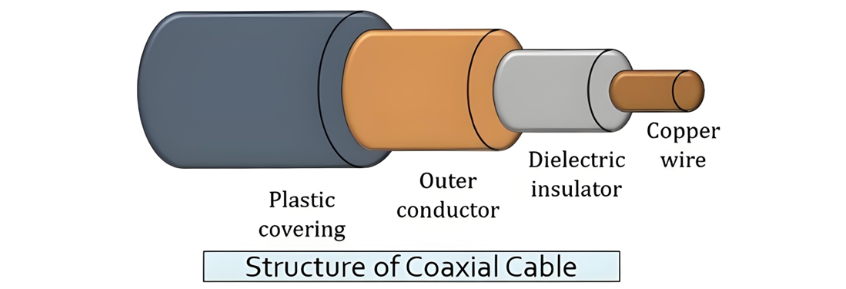
A coaxial cable consists of several layers: a central copper conductor (solid or stranded), surrounded by a dielectric insulating layer, which is then encased by a cylindrical conducting shield—usually made of braided copper or aluminum foil. This layered structure is further protected by an outer insulating jacket that provides mechanical strength and environmental protection.
The term "coaxial" arises from the fact that the inner conductor and the outer shield share the same geometric axis. This design helps minimize electromagnetic interference (EMI) and signal loss, making coaxial cables suitable for transmitting high-frequency signals with good integrity.
The figure below illustrates a coaxial cable used for the transmission of electrical signals:
Optical Fiber:
Optical fibers are used to transmit signals at optical frequencies (light). Due to their high bandwidth, immunity to electromagnetic interference, and low signal attenuation, they are widely employed in high-definition television (HDTV), telecommunications networks, data centers, medical imaging and surgical systems (such as endoscopy), and aerospace applications.
Coaxial Cable:
Coaxial cables are primarily used for transmitting radio frequency (RF) signals. They are commonly found in cable television (CATV) distribution systems, broadband internet connections (e.g., cable modems), telephone networks, and various radio communication systems, including antenna feeds and networking equipment.
Conclusion
Both optical fiber and coaxial cable serve as essential guided media for signal transmission, but they differ fundamentally in the type of signal they carry—optical fibers transmit light signals, while coaxial cables carry electrical signals. These differences lead to distinct performance characteristics, making each suitable for specific applications. As a result, they are employed in complementary, rather than interchangeable, roles across modern communication and electronic systems.