Application of Auto-Reclosing Residual Current Protective Devices in Lightning Protection for Communication Power Supplies
1. Power Interruption Problems Caused by RCD False Tripping During Lightning Strikes
A typical communication power supply circuit is shown in Figure 1. A residual current device (RCD) is installed at the power supply input terminal. The RCD primarily provides protection against electrical equipment leakage currents to ensure personal safety, while surge protective devices (SPDs) are installed on power supply branches to protect against lightning intrusions. When lightning strikes occur, the sensor circuits can induce unbalanced interference lightning pulse currents and differential mode interference currents. When the differential mode current exceeds the RCD's tripping threshold, false operation occurs. Additionally, if the communication equipment's leakage current is near the tripping threshold, unbalanced magnetic flux during rainy seasons can easily cause RCD false tripping.
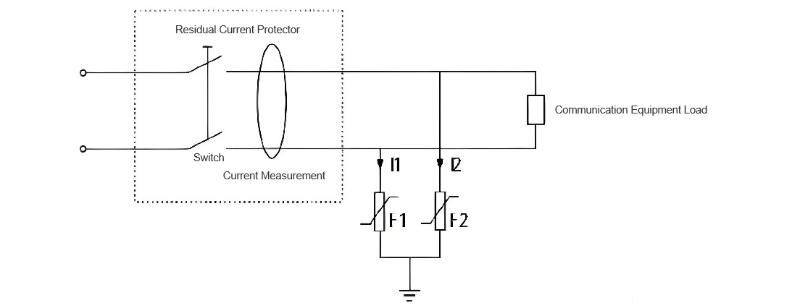
Lightning current is a transient current that may generate a single pulse or multiple pulses. The currents passing through surge protective devices F1 and F2 are I1 and I2 respectively. I1 often does not equal I2, resulting in differential mode interference. When the differential mode interference exceeds the RCD's residual current operating value, the protector trips, the circuit disconnects, communication equipment stops working, and manual power restoration is required. Communication stations are primarily unattended; when lightning strikes occur in a region, some communication stations may lose power and cannot restore communications in a short time. Therefore, this problem must be resolved.
2.Working Principle of Auto-Reclosing Residual Current Protective Device
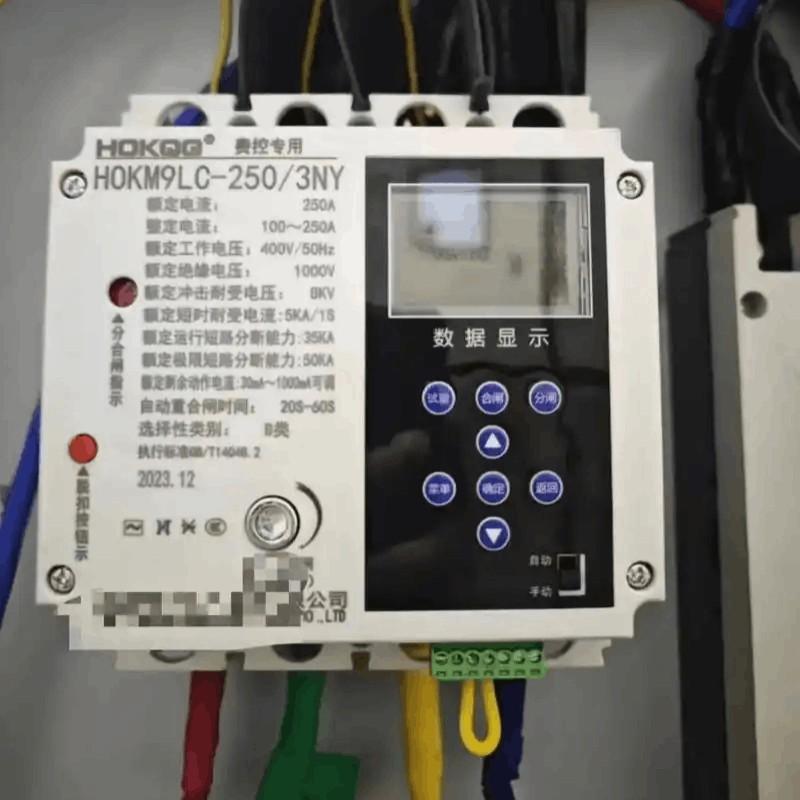
Auto-reclosing is an effective method to solve power interruption problems caused by RCD false tripping. Auto-reclosing is commonly used in high-voltage power systems and has achieved excellent results. However, for safety reasons, it has not yet been widely promoted in low-voltage civilian power systems. China's communication systems have begun using it in recent years and have established the standard: YD/T 2346-2011 "Technical Conditions for Auto-Reclosing Residual Current Protective Devices for Telecommunications," with significant application effects.
When lightning causes RCD false tripping and circuit disconnection, the auto-reclosing residual current protective device automatically closes the switch. Since lightning current is transient, after the lightning strike passes, I1≈I2, reclosing succeeds, power supply is restored, and communications resume.
Auto-reclosing is conditional and must consider safety and other factors. There are two auto-reclosing methods: one detects leakage current conditions to decide whether to reclose; the other recloses automatically without detection.
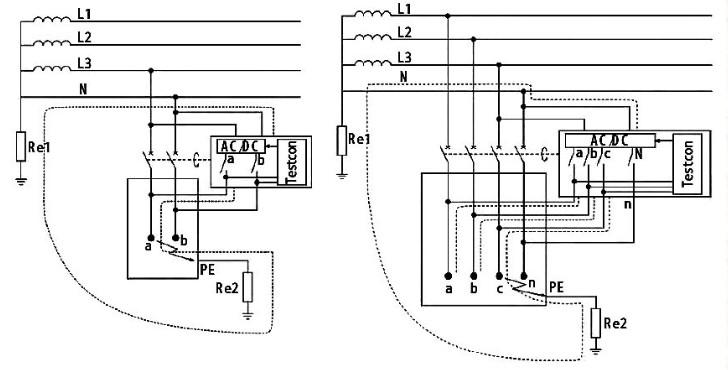
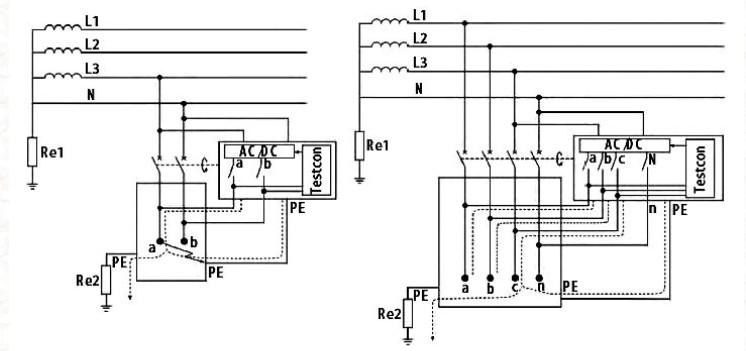
The auto-reclosing device with automatic L-PE leakage fault detection (hereinafter referred to as detection recloser) consists of an electric operating mechanism, control circuit, detection circuit, and output interface. The detection circuit works with the recloser and, under the operation of the recloser's control circuit, completes detection and decides whether to reclose based on the detection results. The detection circuit connects to the RCD phase lines, PE line, grounding resistances Re1 and Re2, and transformer neutral N line, forming a loop through the phase lines, PE line, grounding resistances Re1 and Re2, transformer neutral N line, and detection circuit.
The detection circuit's PE line does not need to connect to equipment enclosures, as shown specifically in Figure 2; alternatively, a loop can be formed through the phase lines, equipment enclosure, and PE line, requiring the recloser's detection circuit PE line to connect to the equipment enclosure, as shown specifically in Figure 3. When the RCD trips, the recloser's leakage detection circuits are a-PE, b-PE, c-PE respectively. The detection circuit signal can be either DC or AC, with voltage not exceeding 24V.
3. Main Performance Requirements
The residual current protection function addresses safety issues, while auto-reclosing solves power interruption problems caused by lightning strikes. YD/T 2346-2011 "Technical Conditions for Auto-Reclosing Residual Current Protective Devices for Telecommunications" considers some parameters as follows.
The auto-reclosing function must balance power supply continuity and safety factors.
(1) Number of Reclosing Attempts From the user's perspective, more reclosing attempts are better; from a safety perspective, fewer attempts are better. For auto-reclosing products that automatically reclose without detecting leakage current, the standard permits up to three automatic reclosing attempts.
(2) Reclosing Time Interval From a power usage perspective, a zero time interval would be ideal; from a safety perspective, it must be sufficiently long. The standard specifies: If the protector lacks post-disconnection line leakage detection capability, the residual current protective device shall automatically reclose once 20~60 seconds after tripping; if unsuccessful, delay 15 minutes for the second reclosing attempt; if the second attempt fails, delay another 15 minutes for the third reclosing attempt; if the third attempt fails, no further reclosing is permitted.
(3) Detection Voltage Detection voltage is also an important safety parameter that cannot be too high. The standard specifies: If the protector has post-disconnection line leakage detection capability, the following requirements apply:
If three reclosing attempts fail within 1 minute, no further reclosing is permitted.
Detection voltage ≤24V.
(4) Lightning Withstand Capability The protector may contain certain electronic circuits and must have adequate lightning withstand capability; otherwise, it cannot be used. The standard specifies: The residual current protective device must have sufficient withstand capability for ground surge currents flowing through capacitive loads passing through the equipment and ground surge currents flowing due to equipment flashover. Time-delay type residual current protective devices must have sufficient immunity against false tripping from ground surge currents flowing due to equipment flashover.
A 1.2/50μs (8/20μs) combined wave, 2kV impulse voltage applied between power lines (L-N) should not cause false operation. A 1.2/50μs, 4kV impulse voltage applied between power lines (L-N) should not damage the sample, which should continue working normally.
When 8/20μs, 20kA lightning current flows between power line L and N, with additionally installed surge protective devices, the sample should work normally without damage.
4. Conclusions and Recommendations
Auto-reclosing residual current protective devices can effectively solve power interruption problems caused by lightning strikes, enhance the lightning resistance capability of communication systems, and are safe and reliable. They represent an effective means of improving the lightning protection capability of communication systems.