110kV Transmission Line Auto-Reclosing Methods: Principles & Applications

1. Introduction
Transmission line faults can be classified into two types based on their nature: transient faults and permanent faults. Statistical data shows that most transmission line faults are transient (caused by lightning strikes, bird-related incidents, etc.), accounting for approximately 90% of all faults. Therefore, after a line is disconnected due to a fault, attempting reclosure once can significantly improve power supply reliability. The function of automatically reclosing a circuit breaker that has tripped due to a fault is called auto-reclosing.
After auto-reclosing restores the circuit breaker:If the transient fault on the line has cleared (e.g., lightning has passed, the bird causing the fault has fallen away), protection devices will not operate again, and the system immediately returns to normal operation.If a permanent fault exists (e.g., tower collapse, energizing onto a grounded circuit), the fault persists after reclosing, and protection devices will trip the circuit breaker again.
Auto-reclosing methods include:
Line no-voltage check
Synchronism check (comparing phase angle differences between bus voltage and line voltage for identical phases to ensure they remain within specified limits)
Line no-voltage & bus voltage present check
Bus no-voltage & line voltage present check
Both line and bus no-voltage check
Non-check reclosing
2. Line No-Voltage Check and Synchronism Check Reclosing
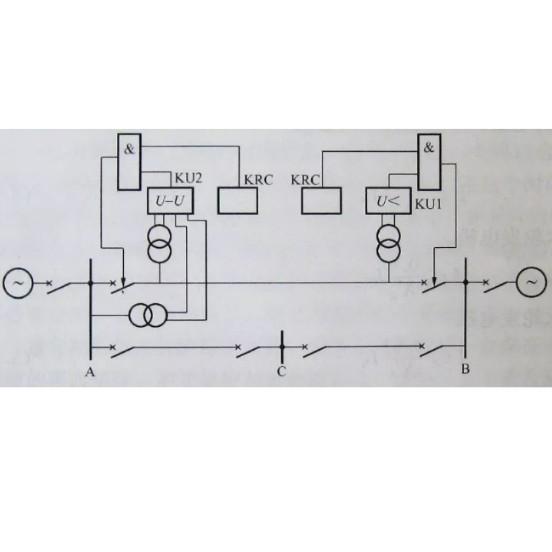
For the MN transmission line shown in the figure below, terminal M employs the "line no-voltage check" reclosing method, while terminal N uses the "synchronism check" reclosing method.
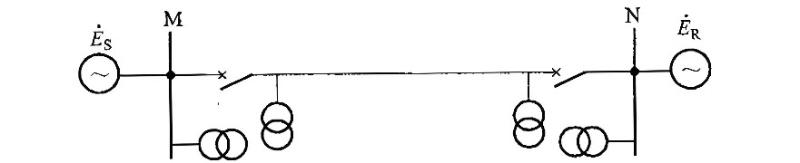
When a short circuit occurs on the MN line and three-phase tripping happens at both ends, the three-phase voltage on the line becomes zero. Therefore, terminal M detects no voltage on the line, satisfying its checking condition, and issues a closing command after the reclosing operation time delay. Subsequently, terminal N detects voltage on both the bus and the line; and the phase angle difference between the identically-named phases (typically phase A) of the bus voltage and line voltage falls within the allowable range specified in the settings. This means terminal N's reclosing satisfies synchronism conditions, and it can issue a closing command after its reclosing operation time delay.
Note: From the above operation process, it can be seen that the line no-voltage check terminal always recloses first. Therefore, this terminal might reclose onto a faulted line and trip again. Consequently, the circuit breaker at this terminal might need to interrupt short-circuit current twice within a short period, resulting in relatively harsh operating conditions. The synchronism check terminal only recloses after confirming voltage on the line and meeting synchronism conditions, so it definitely recloses onto a healthy line, resulting in relatively better operating conditions for its circuit breaker. To balance the burden, the line no-voltage check and synchronism check functions at the two terminals can be periodically swapped.
To enable reclosing to remedy situations where the circuit breaker "steals trip" (trips inadvertently), the synchronism check function is typically also enabled at the line no-voltage check terminal; otherwise, after a "steal trip," the reclosing would be unable to issue a closing command because the line always has voltage. After enabling the synchronism check function, reclosing can be performed using the synchronism check method.
However, at the synchronism check terminal, the line no-voltage check function cannot be enabled. Otherwise, if both terminals have line no-voltage check capability, both might attempt to close simultaneously after tripping of circuit breakers at both ends, causing non-synchronous closing.
Non-check Reclosing Method For lines where synchronism issues do not exist, non-check reclosing method can be used after three-phase tripping. For example, reclosing on single-ended power supply lines can use this method. For this reclosing method, after activation, a closing command is issued simply after a time delay.
Line No-Voltage & Bus Voltage Present and Other Methods 01 Line No-Voltage & Bus Voltage Present Check This method can be used in dual power source systems for the side required to reclose first.
Bus No-Voltage & Line Voltage Present Check This method can be used on the receiving end side of single-ended power source systems, where the receiving end recloses after the power supply side has successfully reclosed first.
3.Both Line and Bus No-Voltage Check
This method requires no voltage on both line and bus before reclosing, and can be used in single-ended power source systems when the receiving end wishes to reclose first.
4.Combinations of the Above Three Methods
When both "Line No-Voltage & Bus Voltage Present" and "Both Line and Bus No-Voltage" checks are enabled simultaneously, this becomes the line no-voltage check method. In this case, bus voltage presence or absence doesn't matter, but the line must have no voltage to satisfy the checking condition.
When both "Bus No-Voltage & Line Voltage Present" and "Both Line and Bus No-Voltage" checks are enabled simultaneously, this becomes the bus no-voltage check method. In this case, line voltage presence or absence doesn't matter, but the bus must have no voltage to satisfy the checking condition.
When "Line No-Voltage & Bus Voltage Present," "Bus No-Voltage & Line Voltage Present," and "Both Line and Bus No-Voltage" checks are all enabled simultaneously, this becomes the "either line or bus no-voltage" check method. This condition is satisfied when either the line has no voltage, or the bus has no voltage, or both have no voltage. This situation is equivalent to the no-voltage check method used in line protection for 220kV and higher voltage levels.