What Are the Several Modes of Automatic Reclosing and Their Characteristics?
Reclosing can be categorized into single-phase reclosing, three-phase reclosing, and comprehensive reclosing.
Single-phase reclosing: After a single-phase fault occurs on the line, single-phase reclosing is performed. If reclosing occurs onto a permanent fault, all three phases are tripped and no further reclosing attempts are made. For interphase faults, all three phases are tripped without reclosing.
Three-phase reclosing: Regardless of fault type, all three phases are tripped followed by three-phase reclosing. If reclosing occurs onto a permanent fault, all three phases are tripped again.
Comprehensive reclosing: For single-phase faults, single-phase reclosing is performed; for interphase faults, all three phases are tripped followed by three-phase reclosing. After reclosing onto any permanent fault, all three phases are tripped.
Single-Sided Power Source Three-Phase Single-Shot Reclosing
Characteristics of three-phase single-shot reclosing on single-sided power source lines:
No need to consider power source synchronization check.
No need to distinguish fault types or select faulted phases.
Operation process of three-phase single-shot reclosing on single-sided power source lines:
Reclosing initiation: Reclosing starts after circuit breaker tripping (non-manual).
Reclosing time delay: After initiation, timing elements delay before issuing closing pulse command.
Single closing pulse: After issuing the closing pulse, timing begins for complete reclosing group reset (15-25 seconds), preventing multiple reclosing attempts.
Blocking after manual tripping.
Post-reclosing accelerated protection tripping: For permanent faults, coordinated with protection systems.
Principles for setting minimum reclosing time:
Time required for feedback current from load motors to fault point after breaker tripping; time needed for fault arc extinction and insulation strength recovery of surrounding medium.
Time required for insulation strength recovery around breaker contacts after arc extinction, refilling of oil/gas in arc-quenching chamber, and operating mechanism recovery.
For reclosing via protective relay trip output, add circuit breaker tripping time.
(Note: This appears to be a duplicate of 3.3 in the original text)
Based on operational experience in China's power systems, the minimum reclosing time is 0.3-0.4 seconds.
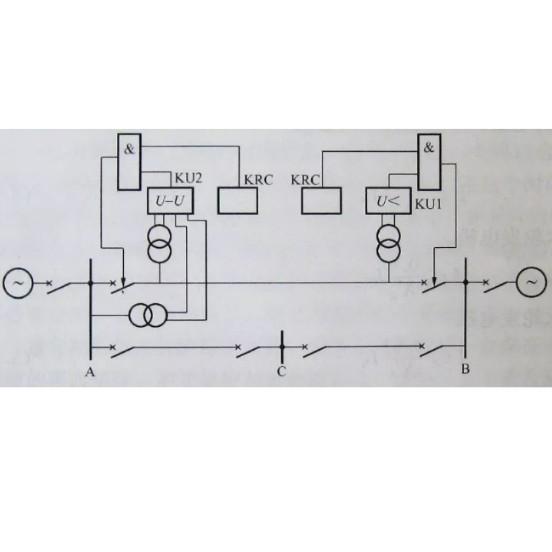
Dual-Sided Power Source Three-Phase Single-Shot Reclosing
Characteristics of three-phase single-shot reclosing on dual-sided power source lines:
After fault tripping, issues exist regarding whether the two power sources remain synchronized and whether non-synchronous reclosing is permitted.
Must ensure circuit breakers on both sides have tripped before reclosing.
Main reclosing methods for dual-sided power source transmission lines:
Fast reclosing:
-
Circuit breakers capable of fast reclosing installed on both sides of the line.
Full-line instantaneous protection installed on both sides, such as pilot protection.
Inrush currents must remain within allowable limits for equipment and system impacts.
Non-synchronous reclosing: Closing under out-of-step conditions. All power system components will experience inrush current impacts.
Synchronism-check automatic reclosing: Closing only permitted after synchronism conditions are satisfied.
Requirements for synchronism-check reclosing:
System structure must ensure no loss of synchronism.
For double-circuit lines, check current flow on the other circuit.
Must verify actual synchronism between both power sources before reclosing.
Optimal reclosing time for dual-sided power source three-phase reclosing:
The optimal reclosing time is calculated and set based on fault conditions most severely affecting system stability. This ensures minimal additional impact on the system when reclosing onto severe permanent faults. While not optimal for other fault types, it provides sub-optimal but acceptable performance, avoiding worst-case scenarios.