Can a 50Hz-Designed Power Transformer Operate on a 60Hz Grid? Key Performance Changes Explained

Can a 50Hz-Designed Power Transformer Operate on 60Hz Grid?
If a power transformer is designed and built for 50Hz, can it run on a 60Hz grid? If so, how do its key performance parameters change?
Key Parameter Changes
Quantitative Case Study
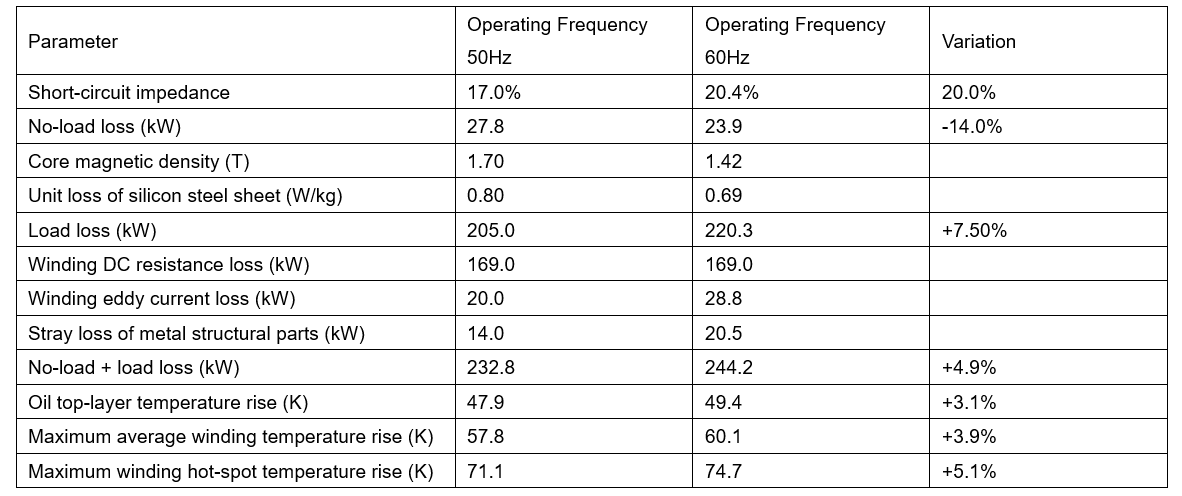
To quantify these trends, calculations for a 50Hz-designed 63MVA/110kV transformer are compared below.
Conclusion
In summary, a power transformer designed and manufactured for a rated frequency of 50Hz can fully operate on a 60Hz grid under the premise that the primary side excitation voltage and transmission capacity remain unchanged. It should be noted that in this case, the total loss of the transformer will increase by approximately 5%, which in turn leads to a rise in the top-oil temperature rise and the average winding temperature rise. In particular, the winding hot-spot temperature rise may increase by more than 5%.
If the transformer already has a certain margin in terms of winding hot-spot temperature rise and the hot-spot temperature rise of metal structural components (such as clamps, riser flanges, etc.), such operation is completely acceptable. However, if the winding hot-spot temperature rise or that of metal structural components is already close to the limit of exceeding the standard, whether long-term operation under such conditions is acceptable requires a case-by-case analysis.