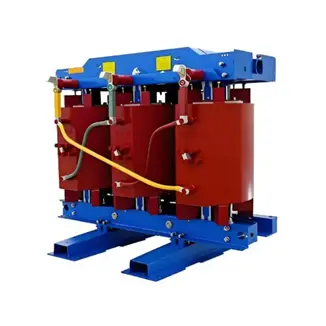
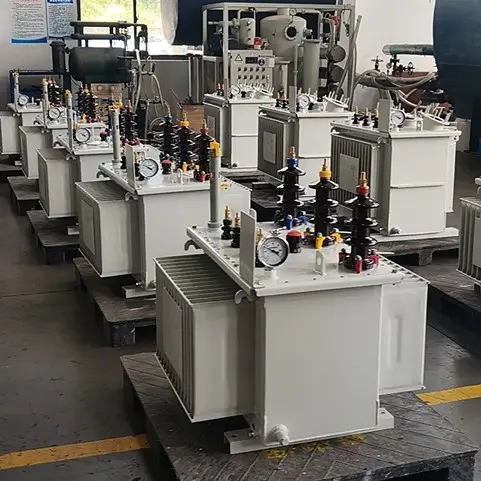
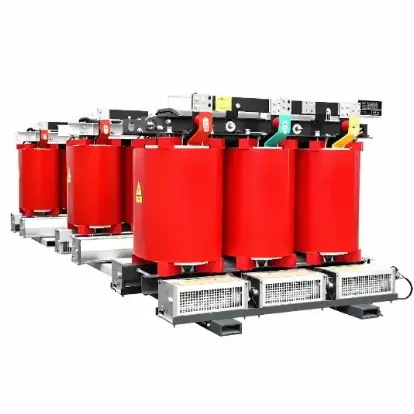
Under the same capacity and external conditions, the heat dissipation performance of oil-immersed transformers surpasses that of dry-type transformers. This is primarily attributed to the significant differences in the physical properties of the cooling media (transformer oil vs. air) and the distinct heat dissipation structural designs.
Below is a detailed technical analysis:
1. Comparison of Physical Properties of Cooling Media
The performance of the cooling medium directly determines the efficiency of heat transfer from the heat sources (windings and core).
| Physical Parameter |
Transformer Oil |
Air |
Heat Dissipation Performance Difference |
| Specific Heat Capacity |
Approx. 1.8–2.2 kJ/(kg·K) |
Approx. 1.005 kJ/(kg·K) |
Oil has about twice the specific heat of air, meaning it can absorb more heat per unit mass. |
| Density |
Approx. 800–900 kg/m3 |
Approx. 1.2 kg/m3 |
Oil is approximately 700 times denser than air. The volumetric heat capacity (heat absorbed per unit volume) of oil is over 1000 times that of air. |
| Thermal Conductivity |
Approx. 0.12–0.15 W/(m·K) |
Approx. 0.026 W/(m·K) |
Oil conducts heat 4–5 times faster than air. |
2. Convective Heat Transfer Efficiency
- Advantage of Liquid Medium: As a liquid, although its flowability is affected by viscosity, oil possesses far greater momentum and heat-carrying capacity than gas when convection (hot fluid rising, cold fluid sinking) occurs.
- Surface Heat Transfer Coefficient: Inside the transformer, the convective heat transfer coefficient between oil and the winding surface is significantly higher than that of air. Even with forced air cooling (fans), dry-type transformers typically struggle to match the heat transfer efficiency of oil's natural convection.
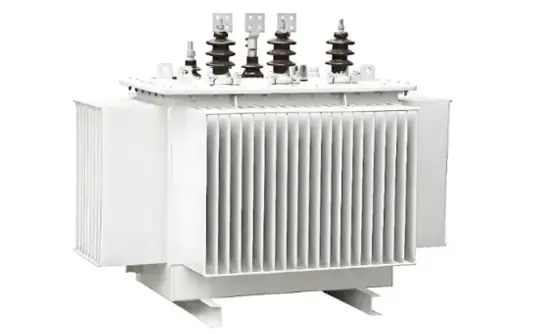
Vziman S13-M Series Sealed Oil-Immersed power Transformer
3. Heat Transfer Path and Contact Area
-
Permeability: Transformer oil has excellent flowability and permeability, allowing it to penetrate the smallest gaps within the windings and come into direct contact with each conductor to carry away heat.
-
Difference in Thermal Resistance:
-
Dry-Type Transformer: Heat must pass through a solid epoxy resin insulation layer with relatively low thermal conductivity before dissipating via air convection. This results in a large overall thermal resistance.
-
Oil-Immersed Transformer: Heat is transferred directly from the heat source into the oil, which has a higher thermal conductivity, resulting in minimal thermal resistance. Heat is rapidly conducted to the tank wall and radiator fins via oil convection, then dissipated into the atmosphere through a large heat exchange surface area.
4. Operational Stability and Overload Capability
- Thermal Time Constant: Due to the large mass and high specific heat capacity of the oil, oil-immersed transformers possess significant "thermal inertia." During short-term surge loads or overloads, the oil acts as a thermal buffer, absorbing instantaneous heat without causing a sharp spike in winding temperature.
- Radiator Expandability: Oil-immersed transformers can easily expand their heat dissipation surface area by adding external cooling tubes, radiators, or forced oil-directed air cooling (ODAF). Dry-type transformers, however, have limited flexibility for expanding heat dissipation area due to air insulation distance constraints and structural design.
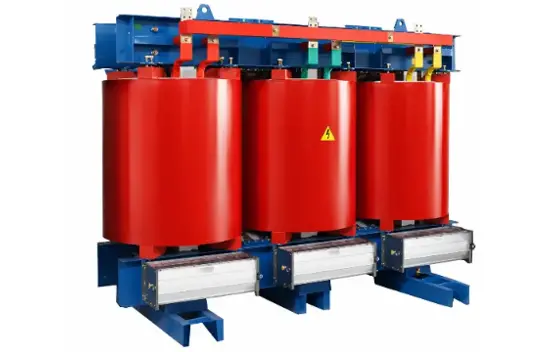
Vziman SC(B) Series dry-type distribution transformer
5. Transformer Selection
Choose Oil-Immersed (Outdoor / Large Capacity / Heavy Loads)
- Outdoor independent substations or open-air installation
- Relatively large capacity (typically above 1000 kVA)
- High load fluctuation (factories, mines, metallurgical industries, etc.)
- Sensitive to initial investment, seeking high cost-effectiveness
- Allows use of oil as cooling medium
Vziman S-Series Oil-Immersed Transformer – Engineered for demanding conditions with superior heat dissipation and excellent overload capacity. Featuring high-thermal-conductivity insulating oil and an efficient oil circulation system, it precisely controls winding temperature rise, effectively extending equipment service life. Whether in high-temperature, high-altitude, or heavy load-fluctuating industrial environments, it maintains stable output and reliably meets all challenges.
Choose Dry-Type (Indoor / High Safety Requirements / Maintenance-Free)
- Indoor installation in densely populated areas
- Strict fire and explosion protection requirements
- High environmental requirements (no oil leakage risk)
- Underground distribution rooms (no need for oil containment pits)
- Limited maintenance capacity, requiring maintenance-free operation
Vziman SCB-Series Dry-Type Transformer – Adopting environmentally friendly insulation materials and advanced temperature control technology, it achieves truly fire-proof, explosion-proof, and pollution-free operation. The high-thermal-conductivity epoxy resin vacuum casting process ensures excellent moisture resistance, flame retardancy, and short-circuit withstand capability. Essentially maintenance-free throughout its designed service life, it significantly reduces operation and maintenance costs.
6. Conclusion
An oil-immersed transformer is analogous to a computer equipped with a "liquid cooling system," while a dry-type transformer is more like a traditional "air-cooled heatsink." Although dry-type transformers have advantages in fire safety and maintenance convenience, oil-immersed transformers hold an absolute edge in heat dissipation efficiency and supporting large capacities (especially in high-voltage, high-power applications), thanks to the superior physical properties of insulating oil.
Edited From:Echo

 Login