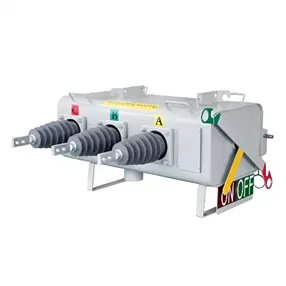
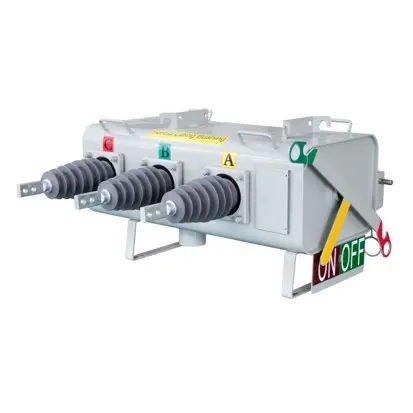
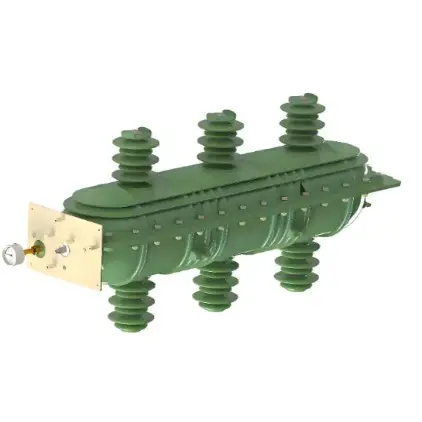
1. What Is a Load Break Switch?
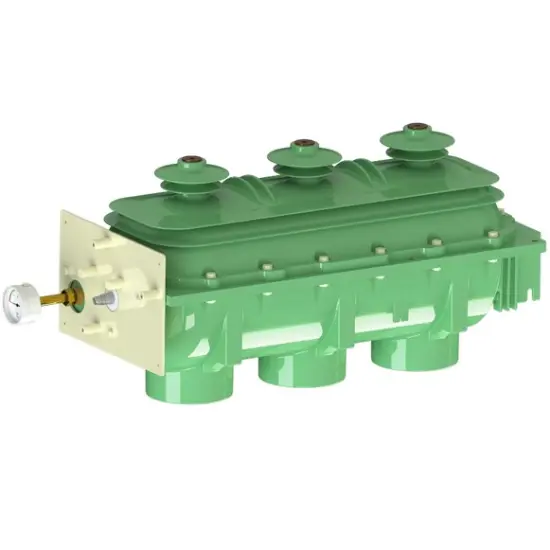
A load break switch (LBS) is a medium-voltage switch that sits functionally between a disconnector and a circuit breaker. It can close onto and break rated load current, normal load current, and specified overload current, but it cannot interrupt short-circuit current (short-circuit protection is normally provided by a series fuse or an upstream breaker).
In simple terms: a disconnector can only be operated with no load, and a circuit breaker can interrupt fault current but at high cost. The load break switch fills the gap — it switches under load frequently, at a fraction of a breaker's price.
2. How It Works
The core challenge is how to safely extinguish the arc formed when contacts separate under load. No matter how fast the contacts open, drawing an arc is unavoidable during load switching. The arc-extinguishing capability therefore defines the switch's performance limit.
Common arc-extinguishing methods:
- Air: simple, but limited breaking capacity and short life;
- Vacuum: strong interruption in a vacuum chamber, good for frequent operation, but costlier;
- Gas (SF₆ and its substitutes): sealed tank with high dielectric strength and arc-quenching ability, combining insulation and interruption in a compact footprint — the mainstream solution for RMUs and cable branch cabinets today.
3. Main Types
| Criterion |
Type |
Feature |
| Installation |
Indoor / Outdoor |
Outdoor needs stronger sealing and anti-pollution design |
| Interrupting medium |
Air / Vacuum / SF₆ / Eco gas (e.g. g3) / Solid insulation |
Determines breaking capacity, life, and environmental profile |
| Poles |
3-pole / Single-pole |
3-pole for three-phase systems |
| Operating mechanism |
Manual spring / Motor spring / Magnetic |
Determines convenience and automation level |
The three-position (closed—open—earthed) integrated design is now standard: grounding switch integrated in the same tank as the load switch, with mechanical interlocking that fundamentally prevents "earthing while energized" — essential for compact RMUs.
4. Load Break Switch vs Disconnector vs Circuit Breaker
| Function |
Disconnector |
Load Break Switch |
Circuit Breaker |
| Break rated load current |
✘ (no-load only) |
✔ |
✔ |
| Break short-circuit current |
✘ |
✘ (via fuse) |
✔ |
| Frequent operation |
Not suitable |
Suitable |
Possible but costly |
| Visible disconnection (for maintenance) |
✔ |
✔ (visible earthing) |
Generally not |
| Cost |
Low |
Medium |
High |
In short: wherever load switching is needed but short-circuit breaking is not, a load break switch is the right tool.
5. Key Parameters at a Glance
Beyond rated voltage, current, and frequency, pay attention to:
- Rated breaking current: load/loop current safely interruptible;
- Rated short-time withstand current (e.g. 25kA/2s): thermal withstand under fault;
- Rated short-circuit making current (peak): dynamic withstand when closing onto a fault;
- Transfer current: the coordination point between the load switch and fuse in an LBS-fuse combination;
- Mechanical endurance: e.g. 2,000–5,000 operations, defining service life and maintenance intervals.
6. The LBS-Fuse Combination
Although an LBS cannot break short-circuit current, combined with a fuse it forms an economical fault-protection unit: the load switch handles normal load switching, while the fuse melts within milliseconds on short circuit and trips the three-pole switch via a striker, preventing single-phasing. This classic scheme is widely used in RMUs, cable branch cabinets, and transformer protection.
7. The Eco Trend: Two Routes to SF₆-Free
Why Action Is Urgent
SF₆ offers near-perfect insulation and interruption, but it is among the most potent greenhouse gases — GWP ~23,500× CO₂ and an atmospheric lifetime of 3,200 years. Regulation is tightening fast:
- The EU is phasing out new SF₆ installations for medium-voltage equipment (≤24kV) starting 2026, expanding from 2032 onward;
- 3M stopped producing Novec 4710 at the end of 2025 (the key component of g3 gas), exposing g3-dependent equipment to supply-chain risk.
Two Main Routes
Route 1: Eco gas (g3-type) — seamless performance, but still fluorinated g3 is a mixture of fluoronitrile (C4-FN) and CO₂, delivering interruption and insulation performance fully equivalent to SF₆ with identical footprint and ratings — a true drop-in replacement. However, it contains fluorine and falls under PFAS-class substances, facing both EU regulatory scrutiny and supply-chain uncertainty.
Route 2: Fluorine-free (vacuum + air / nitrogen / CO₂) — the current mainstream A vacuum interrupter handles breaking, while air, nitrogen, or CO₂ is used purely for insulation. These natural gases have GWP close to zero and contain no PFAS at all. The technology is mature at MV level with footprints comparable to SF₆ equipment, making it the first choice for new projects — especially in the EU.
Route Comparison
| Aspect |
g3 (fluoronitrile mix) |
Vacuum + Air/N₂ |
Vacuum + CO₂ |
| Breaking method |
Gas arc quenching |
Vacuum |
Vacuum |
| Insulating medium |
Fluoronitrile + CO₂ |
Air / Nitrogen |
CO₂ |
| GWP |
~400 (<1% of SF₆) |
≈0 |
1 |
| Contains fluorine (PFAS) |
Yes |
No |
No |
| Performance vs SF₆ |
Identical, same footprint |
Mature at MV; slightly larger tanks at HV |
Needs larger tanks or higher pressure |
| Supply chain |
3M ceased; relies on alternative sources |
No dependency |
No dependency |
| Regulatory outlook |
Affected by EU PFAS restrictions |
Most robust |
Robust |
Rockwill's "Dual-Route" Advantage
- g3 route: RLS series indoor g3 load break switches (12/24/36kV, 630/800A, short-time withstand up to 50kA/2s) — seamless, zero-footprint replacements for existing SF₆ sites and space-constrained projects;
- Fluorine-free route: Pure Air/Nitrogen insulated SF₆-free RMU (24kV) and 12–38.5kV maintenance-free air/nitrogen RMU — vacuum interruption with GWP≈0 and no PFAS, directly meeting EU and other strict low-carbon market requirements.
Selection advice: For EU-bound projects or hard carbon-footprint mandates, prefer the fluorine-free air/nitrogen route; for retrofitting existing SF₆ sites where footprint and operating habits must stay unchanged, the g3 route works best. Rockwill supplies both — so customers are never locked into a single policy outcome.
8. Typical Applications
- Urban RMUs / ring-main switching stations: frequent load switching in tight spaces;
- Cable branch cabinets, compact substations: compact three-position design saves space; interlocked earthing keeps maintenance safe;
- PV / wind new-energy stations: low-loss, low-carbon eco switches align with net-zero targets;
- Industrial parks, data centers, large public buildings: high-reliability, low-maintenance nodes;
- High-altitude and frigid regions: sealed tank plus liquefaction-resistant gas mix ensures stable operation in harsh environments.
Contact us:
Edited From:Dyson

 Login
Login