The contact system is one of the most critical components in an isolating switch, also called a disconnector. Its design directly affects contact resistance, temperature rise, short-circuit withstand capability, mechanical life, and long-term operational reliability.
Unlike circuit breakers, isolating switches do not have arc-extinguishing devices. They are intended to provide a reliable, visible isolation gap and to carry rated current continuously in the closed position. Therefore, contact form selection must balance conductivity, mechanical stability, self-cleaning capability, environmental adaptability, and maintenance requirements.
Why Contact Form Matters?
Contact performance influences several key parameters:
- Contact resistance: Lower and more stable resistance reduces losses and heating.
- Temperature rise: Poor contact pressure or oxidation can cause hot spots.
- Short-circuit stability: Electrodynamic forces during faults may open or deform weak contacts.
- Self-cleaning effect: Sliding or wiping action helps remove oxide films and contamination.
- Service life: Contact wear, spring fatigue, and corrosion affect maintenance intervals.
- Visible isolation: Some designs provide clearer open-position indication than others.
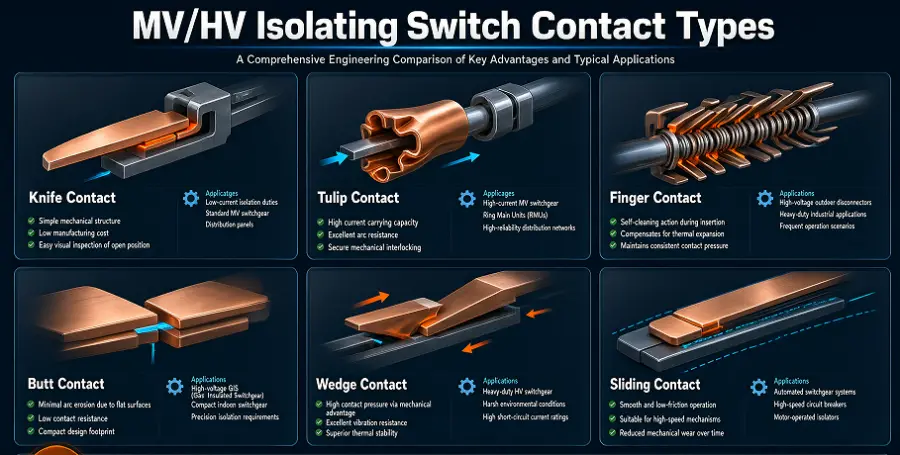
1. Knife Contact
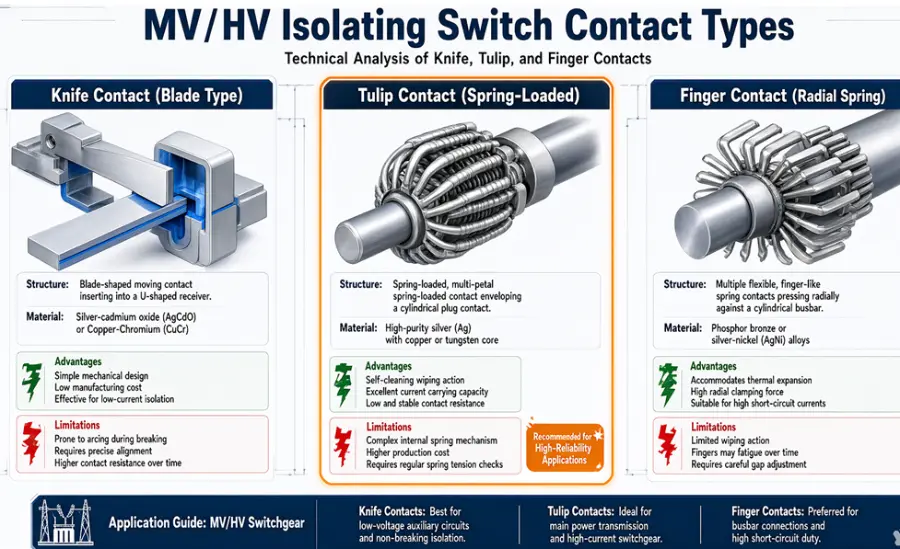
Structure: A flat or blade-shaped movable contact engages with a fixed jaw or contact surface. The engagement may be face contact or line contact.
Advantages:
- Simple structure and relatively low manufacturing cost
- Clear open and closed positions, suitable for visible isolation
- Easy to inspect, maintain, and replace
- Widely used in low-voltage switches and high-voltage disconnectors
Limitations:
- Contact pressure depends on spring force or blade elasticity
- Limited self-cleaning effect compared with multi-finger designs
- More sensitive to oxidation, contamination, and mechanical misalignment
Typical applications: Low-voltage distribution panels, medium-voltage disconnectors, and traditional air-insulated switchgear.
2. Butt Contact
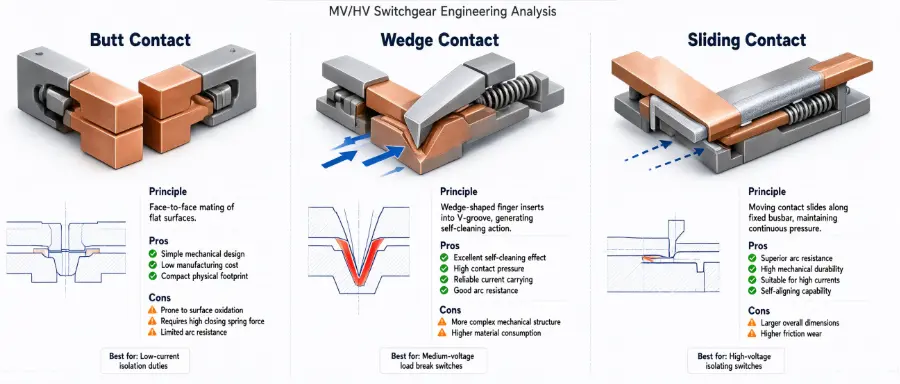
Structure: The moving and stationary contacts meet end-to-end on a flat or slightly curved surface.
Advantages:
- Simple mechanical design
- Fast opening and closing action
- Compact axial dimension
Limitations:
- No self-cleaning effect during operation
- Contact resistance varies significantly with contact pressure
- Prone to contact bounce during closing
- Susceptible to arc erosion because the arc acts directly on the main contact surface
Typical applications: Mainly used in low-current distribution devices and some low-voltage switching devices; less common as the main contact form in high-current isolating switches.
3. Finger Contact
Structure: Multiple flat or arc-shaped contact fingers are mounted on a conductive base, usually with springs or self-elastic structures to maintain contact pressure. The moving contact inserts between or against the fingers.
Advantages:
- Good self-cleaning effect due to relative sliding during make/break operations
- High electrodynamic stability; short-circuit current tends to press fingers tighter against the moving contact
- Contact area can be increased by adding more fingers
- Suitable for higher rated currents
Limitations:
- Lateral dimensions increase with current rating
- Assembly and adjustment requirements are higher
- Generally used as a main current-carrying contact rather than an arc-breaking contact
Typical applications: Medium- and high-voltage isolating switches, busbar connections, and heavy-current switchgear.
4. Tulip Contact
Structure: The stationary contact consists of multiple trapezoidal or arc-shaped contact fingers arranged circumferentially around a cylindrical moving contact rod. Springs or flexible conductors maintain uniform contact pressure.
Advantages:
- Excellent self-cleaning effect due to sliding motion during insertion
- Low contact bounce because contact pressure is perpendicular to the moving direction
- High electrodynamic stability under short-circuit conditions
- Reliable line contact with low and stable contact resistance
Limitations:
- More complex structure and higher manufacturing cost
- Insertion stroke is relatively long
- Current capacity depends on finger number, spring design, and heat dissipation
Typical applications: Commonly used in medium-voltage switchgear, gas-insulated switchgear, and disconnectors requiring stable low-resistance connections.
5. Wedge Contact
Structure: A wedge-shaped moving contact engages with paired spring-loaded contact plates, or vice versa. The wedge action converts axial motion into radial contact pressure.
Advantages:
- Strong self-cleaning effect through sliding friction
- High electrodynamic stability
- Contact pressure increases with wedge engagement
- Can be scaled by adding contact plate groups
Limitations:
- Requires precise alignment to avoid uneven contact pressure
- Larger transverse size may complicate assembly
- Main contact surfaces may still be affected by arc erosion if used in breaking applications
Typical applications: High-current isolating switches, heavy-duty disconnectors, and equipment where stable contact under large rated current is required.
6. Sliding Contact
Structure: Sliding contacts maintain continuous electrical connection while allowing relative movement. Common forms include Z-shaped finger sliding contacts and roller-type sliding contacts.
Advantages:
- Suitable for applications requiring continuous movement without disconnection
- Z-shaped finger types offer compact height, simple assembly, stable contact, and self-cleaning
- Roller-type contacts have low friction and low mechanical wear
Limitations:
- Roller-type contacts have weaker self-cleaning ability
- Contact reliability depends on spring pressure and surface condition
- Usually not used as the main isolating break, but as an intermediate or transfer contact
Typical applications: Intermediate contacts in high-voltage switchgear, pantograph-type disconnectors, busbar expansion joints, and moving conductive arms.
Selection Criteria
When selecting an isolating switch contact form, engineers should evaluate:
- Rated current: Higher current usually requires larger contact area and better heat dissipation.
- Short-time withstand current: Contacts must remain stable under short-circuit electrodynamic forces.
- Contact resistance and temperature rise: Stable low resistance improves efficiency and reduces hot spots.
- Operating environment: Humidity, dust, salt fog, and pollution levels affect contact reliability.
- Maintenance access: Some designs allow easier inspection, cleaning, and replacement.
- Visible isolation requirement: Knife-type and some open-type disconnectors provide clearer visual confirmation.
- Applicable standards: Designs should comply with relevant standards such as IEC 62271-102:2018+Amd1:2022 for high-voltage alternating-current disconnectors and earthing switches, IEC 60947-3 for low-voltage switchgear and controlgear, and applicable IEEE or local standards.
Selection Guide
| Contact type |
Best for |
Key advantage |
Main limitation |
| Knife |
LV/MV disconnectors |
Simple, visible break |
Limited self-cleaning |
| Butt |
Low-current devices |
Fast operation |
Poor arc and bounce performance |
| Finger |
HV isolators, high current |
Scalable, stable |
Requires precise assembly |
| Tulip |
MV switchgear, GIS |
Low bounce, reliable contact |
Complex structure |
| Wedge |
High-current disconnectors |
Strong pressure, self-cleaning |
Sensitive to alignment |
| Sliding |
Moving/intermediate joints |
Continuous contact |
Not a primary isolation break |
FAQ
What is the most reliable contact type for high-current disconnectors?
Finger, tulip, and wedge contacts are commonly preferred for high-current applications because they provide larger contact area, better self-cleaning, and higher electrodynamic stability.
Why are tulip contacts widely used in MV switchgear?
Tulip contacts offer stable line contact, low contact bounce, and good self-cleaning during insertion. These characteristics help maintain low contact resistance over repeated operations.
Can knife contacts be used in high-voltage applications?
Yes. Knife contacts are still used in many high-voltage disconnectors, especially where a clear visible break and simple maintenance are required. Their performance depends on contact pressure, material selection, and environmental protection.
Which contact form has the best self-cleaning effect?
Tulip, wedge, and finger contacts generally provide better self-cleaning because of sliding or wiping action during operation. Butt contacts have the weakest self-cleaning effect.
Conclusion
Isolating switch contact forms are not interchangeable; each type serves different electrical, mechanical, and environmental requirements. For low-voltage and general-purpose applications, knife and simple butt contacts remain cost-effective. For medium- and high-voltage distribution systems, finger, tulip, and wedge contacts are often preferred because they provide better self-cleaning, lower contact resistance, and higher short-circuit stability. Sliding contacts are mainly used where continuous movement is required rather than as the primary isolation point.
When specifying isolating switches for export projects, engineers should evaluate rated current, short-circuit withstand capability, operating environment, maintenance accessibility, and compliance with applicable IEC or local standards.
Need help selecting the right disconnector contact design for your project? Contact our engineering team for datasheets, drawings, and IEC-compliant specifications.









 Login



