What Is a Grounding Transformer?
A grounding transformer creates an artificial neutral point for three-phase systems that have no accessible neutral, such as delta-connected or ungrounded wye-connected networks at 6 kV, 10 kV, 12.47 kV, 13.8 kV, 24 kV, 33 kV or 35 kV.
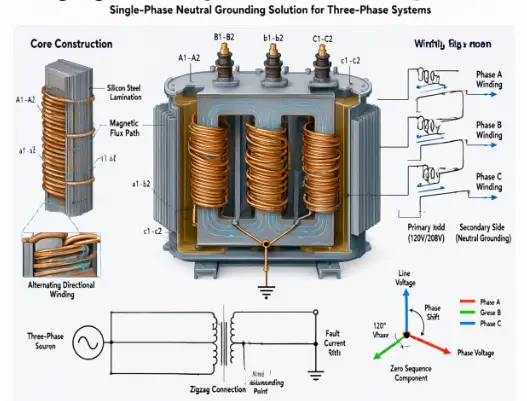
It is most commonly built with a zigzag connection, because each phase winding is split into two halves wound on different core limbs.
Under normal conditions, the transformer draws only a small magnetizing current. During a single-phase earth fault, however, the zigzag structure offers low zero-sequence impedance, allowing zero-sequence current to flow through the neutral point and enabling the arc-suppression coil, neutral earthing resistor, or protection relay to operate correctly.
Grounding transformers are typically rated for long-time no-load operation and short-time fault duty, such as 10 s, 30 s or 60 s.
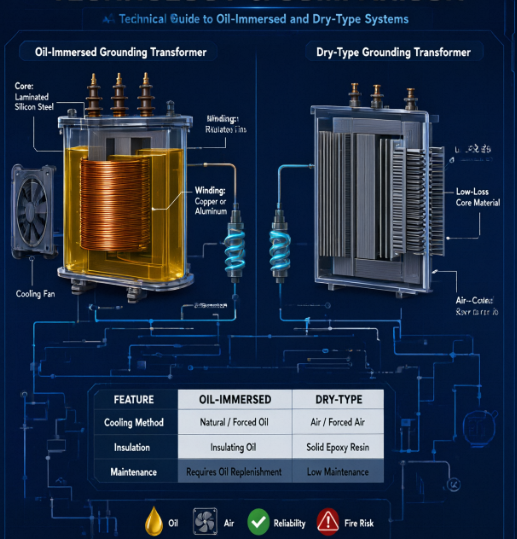
Oil-Immersed vs. Dry-Type Grounding Transformers
| Comparison item |
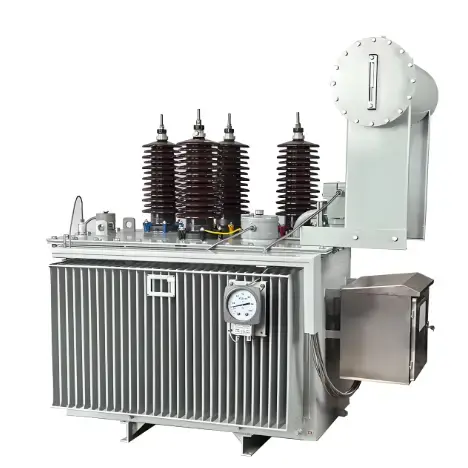
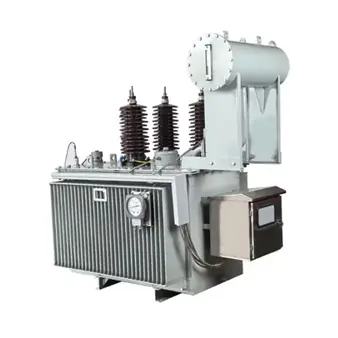
Oil-immersed grounding transformer |
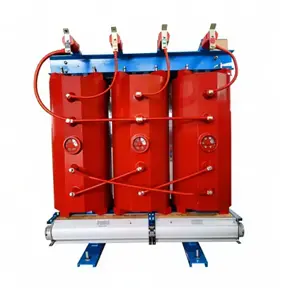
Dry-type grounding transformer |
| Insulation & cooling |
Transformer oil provides insulation and oil circulation cooling |
Air cooling with epoxy resin, VPI insulation or Nomex-based insulation |
| Fire safety |
Oil is combustible; leakage and fire risk must be managed |
Non-oil, low fire risk; suitable for indoor and personnel-dense areas |
| Overload capability |
Strong short-time overload and thermal stability |
Limited by winding temperature rise; often requires ventilation or forced air cooling |
| Environmental adaptability |
Good resistance to humidity, condensation and pollution; suitable for outdoor substations |
Sensitive to dust, condensation and salt mist unless specially treated; IP rating and environmental class must be checked |
| Typical capacity & voltage |
Suitable for larger ratings and higher system voltages, including 33 kV and 66 kV applications |
More common in small and medium ratings; typical products are available up to around 3150 kVA, with higher ratings depending on manufacturer and cooling method |
| Initial cost |
Generally lower for the same rating |
Generally higher due to solid insulation and manufacturing process |
| Maintenance |
Requires oil level check, oil testing, leakage inspection and periodic maintenance |
Basically maintenance-free; mainly visual inspection, temperature monitoring and cleaning |
| Installation |
Usually outdoor; may require an oil containment pit or bund |
Can be installed indoors, often close to switchgear or inside package substations |
| Typical applications |
Outdoor substations, PV/wind plants, industrial networks, 33/66 kV systems |
Indoor switchrooms, buildings, data centres, hospitals, tunnels, metro stations, chemical plants |
When to Choose an Oil-Immersed Grounding Transformer?
Choose oil-immersed when:
- The installation is outdoor, such as a conventional substation, PV plant, wind farm or industrial switchyard.
- The system voltage is relatively high, for example 33 kV or 66 kV.
- The grounding transformer must carry a high short-time earth-fault current or operate under heavy ambient temperature.
- The project is CAPEX-sensitive and has qualified maintenance personnel.
- Long service life, high thermal inertia and proven outdoor reliability are prioritized.
When to Choose a Dry-Type Grounding Transformer?
Choose dry-type when:
- The equipment is installed indoors, in a basement, building, tunnel, metro station, data centre, hospital or chemical plant.
- Fire protection regulations restrict or prohibit oil-filled equipment.
- Environmental requirements are strict, and oil leakage risk must be avoided.
- The site has limited maintenance resources.
- The rating is small or medium, typically for 6 kV, 10 kV, 12.47 kV, 13.8 kV or 35 kV distribution systems.
- The dry-type unit is specified with an appropriate environmental class, such as C2 for low temperature, E2 for humidity/pollution, and F1/F0 for fire performance.
Note: Dry-type grounding transformers can be used in coastal or corrosive environments, but only when the insulation system, enclosure, creepage distance and anti-corrosion treatment are properly specified. They are not automatically superior to oil-immersed units in salt-mist areas.
Common Misunderstandings
- “Dry-type is always more expensive.”
Not necessarily. Dry-type units usually have a higher purchase price, but they can reduce civil works, fire-protection costs, indoor space requirements and maintenance workload. For indoor projects, the total cost of ownership may be competitive.
- “Oil-immersed transformers cannot be used indoors.”
They can, but additional fire protection, oil containment, ventilation and safety clearance are usually required. In many building projects, dry-type remains the simpler choice.
- “Any transformer can be used as a grounding transformer.”
No. A standard distribution transformer does not provide the same low zero-sequence impedance as a zigzag grounding transformer. Using a normal transformer to connect an arc-suppression coil usually limits the usable capacity to about 20% of the transformer rating, whereas a zigzag grounding transformer can utilize 90%–100% of its capacity for earthing purposes.
Key Parameters to Specify
When preparing a datasheet or inquiry, these parameters should be clearly defined:
- System voltage and highest voltage for equipment, for example 12 kV, 13.8 kV, 24 kV, 33 kV or 36 kV.
- System frequency, 50 Hz or 60 Hz.
- Connection type, typically ZNyn or ZN, depending on whether a secondary auxiliary winding is required.
- Zero-sequence impedance, which shall be determined by system study, fault current limitation and neutral earthing coordination. Zigzag grounding transformers are designed for low zero-sequence impedance, but the exact value must be specified case by case.
- Rated earth-fault current, for example 200 A, 400 A, 600 A or 1200 A.
- Fault duration, such as 10 s, 30 s or 60 s.
- Continuous kVA rating, if the grounding transformer also supplies a station auxiliary load.
- Neutral earthing method, including arc-suppression coil, neutral earthing resistor, or direct/reactance earthing.
- Insulation level / BIL, according to IEC, IEEE or local utility requirements.
- System X/R ratio and short-circuit duty, to ensure correct thermal and dynamic withstand capability.
- Altitude, especially for installations above 1000 m.
- Harmonics or non-linear load conditions, if the grounding transformer also carries auxiliary load.
- Enclosure IP rating and noise level, particularly for indoor installations.
- Environmental class, especially for dry-type units: temperature class, humidity class, pollution class and IP rating.
- Applicable standards, such as IEC 60076-6, IEC 60076-11, IEEE C57.32-2015 (inactive-reserved as of March 2026), IEEE C62.92, GB/T 1094.6 and GB/T 10228.
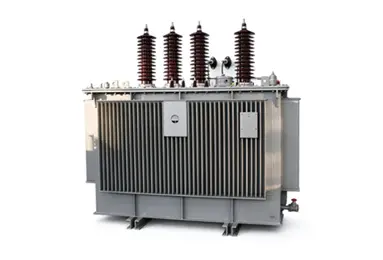
Grounding Transformer supplier
Selection Rule of Thumb
- Indoor, fire-restricted, low-maintenance, or environmentally sensitive sites → dry-type grounding transformer.
- Outdoor, high-voltage, high-fault-current, heavy-duty or CAPEX-sensitive sites → oil-immersed grounding transformer.
The final decision should not be based only on purchase price. It should consider installation environment, fire code, zero-sequence impedance coordination, fault duration, maintenance capability and total cost of ownership.

 Login