
• Product
  • Suppliers
  • Manufacturers
  • Solutions
  • Free tools
  • Knowledges
  • Experts
  • Communities
Search


Revolutionary 550 kV Capacitor-Free Arc-Quenching Circuit Breaker Debuts in China

Baker
Baker
Field: News
Engineer
4-6Year
Canada

Recently, a Chinese high-voltage circuit breaker manufacturer, in collaboration with numerous renowned enterprises, successfully developed a 550 kV capacitor-free arc-quenching chamber circuit breaker, which has passed the full suite of type tests on its first attempt. This achievement marks a revolutionary breakthrough in the interrupting performance of circuit breakers at the 550 kV voltage level, effectively resolving the long-standing “bottleneck” issue caused by reliance on imported capacitors. It provides strong technical support for building next-generation power systems and significantly contributes to clean energy transmission and China’s “Dual Carbon” goals (carbon peak and carbon neutrality).

As a critical component of power systems—often hailed as the “guardian of grid safety”—the arc-quenching capability of circuit breakers directly impacts grid stability. Traditional extra-high-voltage (EHV) circuit breakers rely on external capacitor banks to assist in arc interruption, resulting in complex structures, large physical footprints, and high operation and maintenance costs. Moreover, these capacitors have been entirely dependent on imports, leading to prolonged procurement cycles.
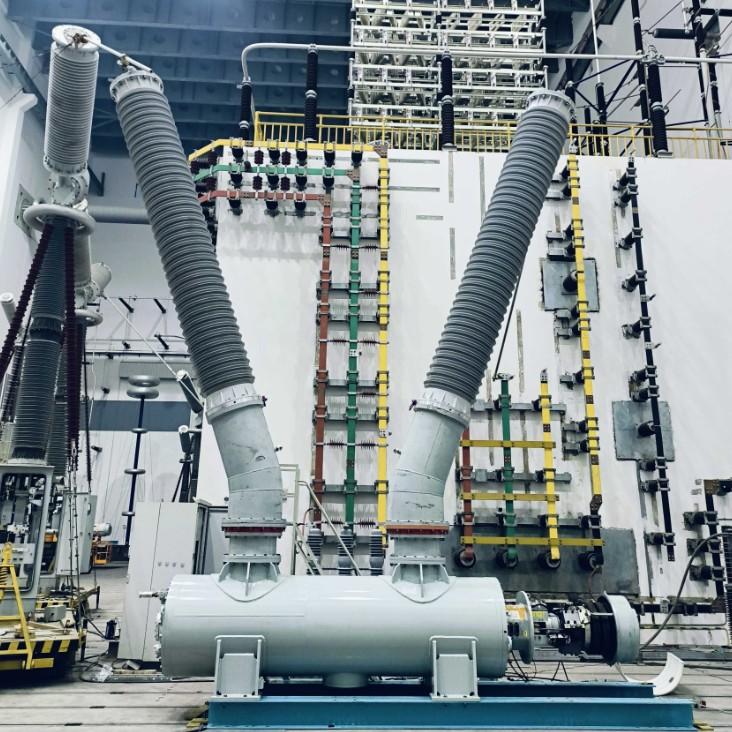
550 kV capacitor-free arc-quenching chamber circuit breaker.jpg

To address these challenges, the R&D team at the Chinese manufacturer leveraged internationally advanced arc simulation and measurement systems to conduct in-depth studies on how parameters such as puffer cylinder pressure, fluid temperature, flow velocity, and mass flow rate affect interrupting performance. Through multi-stage gas flow field optimization, they significantly enhanced breaking capability. Crucially, the team pioneered a capacitor-free arc-quenching chamber design, completely eliminating dependence on traditional capacitor banks.

The new 550 kV circuit breaker features a capacitor-free arc-quenching structure, substantially increasing the insulation distance to ground. Its coaxial design ensures mechanical simplicity and compactness. The unit supports cover-opening inspections, effectively avoiding risks associated with capacitor oil leakage or damage, thereby greatly improving equipment reliability. By removing integrated capacitors per phase, eliminating capacitor supports, and optimizing both moving and stationary end brackets, the design enhances assembly efficiency and quality while reducing reliance on imported core components. This innovation shortens manufacturing lead times and achieves full domestic control over the production process.

Looking ahead, the Chinese high-voltage circuit breaker manufacturer will continue to prioritize market demand, drive innovation-led development, and leverage synergies across industry–academia–research partnerships. The company remains committed to advancing landmark core technologies and building a world-class high-end equipment industrial cluster, contributing Chinese ingenuity to the global energy transition.


Give a tip and encourage the author!
Recommended
Why Do We Need a Grounding Transformer and Where Is It Used?
Why Do We Need a Grounding Transformer?The grounding transformer is one of the most important devices in power systems, primarily used to connect or isolate the system neutral point to ground, thereby ensuring the safety and reliability of the power system. Below are several reasons why we need grounding transformers: Prevent Electrical Accidents:During the operation of a power system, abnormal conditions such as voltage leakage may occur in equipment or lines due to various reasons. If the neut
Echo
12/05/2025
How to Implement Transformer Gap Protection & Standard Shutdown Steps
How to Implement Transformer Neutral Grounding Gap Protection Measures?In a certain power grid, when a single-phase ground fault occurs on a power supply line, both the transformer neutral grounding gap protection and the power supply line protection operate simultaneously, causing an outage of an otherwise healthy transformer. The main reason is that during a system single-phase ground fault, the zero-sequence overvoltage causes the transformer neutral grounding gap to break down. The resulting
Noah
12/05/2025
GIS Dual Grounding & Direct Grounding: State Grid 2018 Anti-Accident Measures
1. Regarding GIS, how should the requirement in Clause 14.1.1.4 of the State Grid’s "Eighteen Anti-Accident Measures" (2018 Edition) be understood?14.1.1.4: The neutral point of a transformer shall be connected to two different sides of the main mesh of the grounding grid via two grounding down conductors, and each grounding down conductor shall meet the thermal stability verification requirements. Main equipment and equipment structures shall each have two grounding down conductors connected to
Echo
12/05/2025
Innovative & Common Winding Structures for 10kV High-Voltage High-Frequency Transformers
1.Innovative Winding Structures for 10 kV-Class High-Voltage High-Frequency Transformers1.1 Zoned and Partially Potted Ventilated Structure Two U-shaped ferrite cores are mated to form a magnetic core unit, or further assembled into series/series-parallel core modules. Primary and secondary bobbins are mounted on the left and right straight legs of the core, respectively, with the core mating plane serving as the boundary layer. Windings of the same type are grouped on the same side. Litz wire i
Noah
12/05/2025
Send inquiry
Download
Get the IEE Business Application
Use the IEE-Business app to find equipment, obtain solutions, connect with experts, and participate in industry collaboration anytime, anywhere—fully supporting the development of your power projects and business.





