• Product
  • Suppliers
  • Manufacturers
  • Solutions
  • Free tools
  • Knowledges
  • Experts
  • Communities
Search


How Do Differences in Dry-Type Transformer Resin Casting Processes Affect Transformer Service Life and Maintenance-Free Performance?

Vziman
Field: Manufacturing
10Year<
China
 
Dry-type transformers have become the standard configuration for high-rise buildings, rail transit, data centers, new energy power stations, and other critical scenarios due to their oil-free, flame-retardant, environmentally friendly, and maintenance-free characteristics. However, transformers on the market that are all classified as "dry-type" can differ dramatically in price and quality.
With the same capacity and voltage class, products from different manufacturers show significant differences in partial discharge levels, crack resistance, service life, and failure rate. The root cause of this variation often lies not in the external design, but in the invisible resin casting process.

Resin casting is far from simply "dipping the windings into resin" — it is a systematic engineering discipline involving materials science, thermodynamics, fluid mechanics, and mechanics. Subtle differences in the casting process directly translate into enormous gaps in transformer performance across its full life cycle.

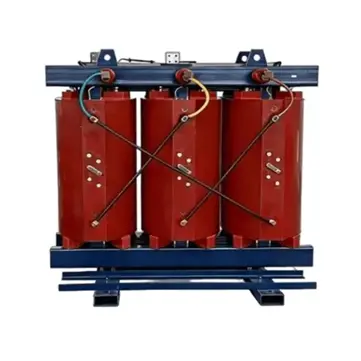
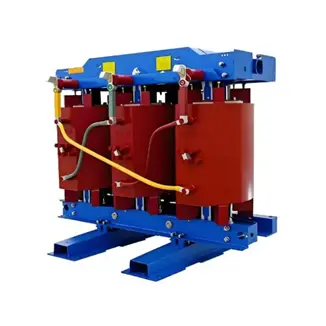
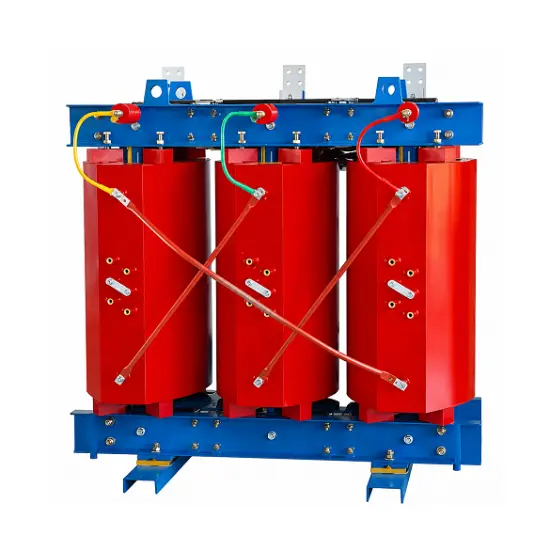
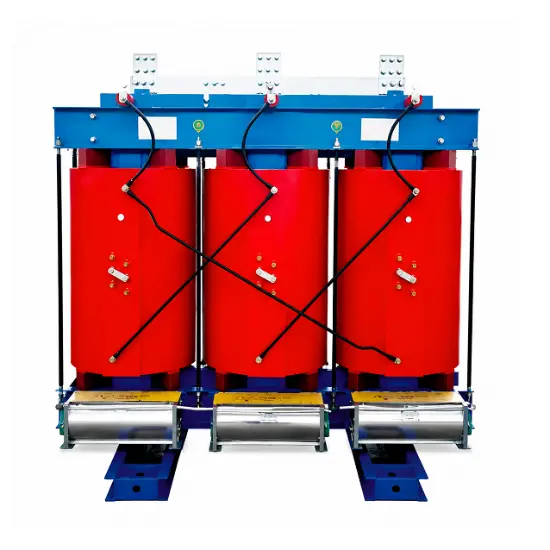
Three Phase Dry Type Distribution Transformer  33kV 34.5kV 35kV

Three red cylindrical coil dry type transformer mounted on blue metal base with colored connecting wires

1. Core Differences in the Casting Process

The casting processes of different manufacturers mainly differ in the following aspects:

Process Aspect High-Quality Process Ordinary Process
Vacuum level control High vacuum with continuous evacuation for thorough degassing Insufficient vacuum or evacuation time, gas trapped in windings
Drying pretreatment Full preheating and drying to eliminate moisture Incomplete drying, residual moisture impairs insulation
Resin injection method Slow injection under vacuum for full penetration Atmospheric or semi-vacuum casting with incomplete penetration
Curing process Programmed stepped curing for uniform solidification and stress relief Excessively fast curing, high residual internal stress
Fiber reinforcement Glass fiber mesh or felt reinforcement Insufficient or unevenly distributed reinforcement
Filler system Premium spherical or fused silica micro-powder fillers Average fillers with poor interfacial bonding
 These differences ultimately manifest through three key dimensions: partial discharge level, thermal cycling crack resistance, and sealing and moisture protection performance.

2. Partial Discharge: The "Invisible Killer" of Insulation Life

Partial discharge is the number one cause of insulation aging and eventual breakdown in dry-type transformers. The casting process has the most direct influence on PD:

  • Bubbles and voids: If gas is not fully expelled during casting, micro-voids remain inside the windings. Under operating voltage, partial discharge occurs within these voids, and high-energy particles continuously bombard the insulation, causing electrical erosion and aging.
  • Interface separation: Poor bonding at the filler-resin or resin-conductor interface can also become a source of partial discharge.
  • The value of vacuum processing: High-quality processes dry the windings and inject resin under vacuum, ensuring resin penetrates between every turn and fundamentally eliminating bubble retention.

Factory PD level is the "mirror" that reveals the casting process quality. Transformers with low PD levels age slowly and can achieve decades of electrical service life; transformers with excessive PD may suffer insulation breakdown within a few years or even less.

3. Crack Resistance: The "Mechanical Toughness" for Thermal Cycling

Transformers experience repeated heat generation during operation and cooling during shutdown, subjecting the windings to continuous thermal expansion and contraction as well as mechanical stress. The influence of the casting process on crack resistance is reflected in:

  • Internal stress control: If curing temperature is improperly controlled, curing shrinkage generates internal stress. High-quality processes use programmed stepped curing curves that allow slow, uniform solidification, releasing internal stress to the maximum extent.
  • Toughening system: Premium formulations add toughening agents to improve resin fracture toughness, enabling the insulation to expand and contract with the winding without cracking.
  • Thin insulation structure: Modern high-quality processes commonly adopt glass fiber reinforced thin insulation structures with an elastic resin layer, providing better compliance with winding deformation.

Transformers with weak crack resistance may develop fine cracks on the coil surface after several years of operation; these cracks gradually propagate into through-cracks, ultimately causing a sharp drop in insulation performance or even short-circuit faults.

4. Sealing and Moisture Protection: The Physical Foundation of Maintenance-Free Performance

The core advantage of dry-type transformers over oil-immersed types is maintenance-free operation, which relies heavily on the solid insulation barrier formed by casting. Compared with open-impregnated (VPI) transformers, the differences are very clear:

Aspect Epoxy Cast Transformer VPI (Open-Impregnated) Transformer
Winding protection Full-vacuum encapsulation forming a dense resin body Open varnish impregnation covering only the surface
Moisture resistance Near-perfect moisture barrier Limited sealing; easily absorbs moisture in high humidity
Restart after shutdown No preheating required; direct loading Typically requires preheating to remove moisture
Dust and corrosion protection Fully encapsulated, complete protection Only partial protection
Maintenance Truly maintenance-free Periodic insulation testing required
 High-quality cast transformers can operate directly without any moisture treatment in high-temperature, high-humidity environments or after prolonged shutdown. In contrast, transformers with poor workmanship may have fine porosity in the resin layer, slowly absorbing moisture in high-humidity environments with declining insulation resistance, often requiring tedious preheating and drying procedures before restart — their "maintenance-free" claim is not genuinely delivered.

5. The Underlying Logic of Intrinsic Material Properties

Beyond the process itself, the intrinsic properties of the resin material also determine the quality ceiling:

Property Benefit
Low viscosity Better resin flow, reducing void retention during casting
High toughness Stronger resistance to thermal cycling cracking
High glass transition temperature (Tg) Stable modulus at elevated temperatures, stronger thermal fatigue resistance
Low dielectric loss (tan δ) Reduced high-frequency self-heating, preventing the "temperature rise → increased loss → further temperature rise" cycle
Excellent electrical strength Withstands higher field strength with greater insulation margin
 

In high-frequency, high-voltage applications such as emerging solid-state transformers (SST), low dielectric loss is especially critical, suppressing temperature rise caused by high-frequency losses at the source.

6. How to Judge Process Quality?

For users, the casting process level can be assessed without opening the unit through the following approaches:

  • Review the factory PD test report: The lower the PD level, the better the process.
  • Inspect coil surface quality: A smooth, uniformly colored surface free of bubbles and pinholes indicates good process control.
  • Evaluate the factory's vacuum system: Check whether high-vacuum casting equipment and rigorous process procedures are in place.
  • Understand the material system: Quality manufacturers will clearly disclose the resin system, toughening agents, and glass fiber reinforcement scheme.
  • Compare long-term operation cases: Reference the actual operating years and failure rates of similar products under comparable conditions.

Summary

The resin casting process of dry-type transformers is the "core determinant" of partial discharge level, crack resistance, sealing and moisture protection performance, and ultimately service life. The process differences may seem subtle, but they directly determine whether a transformer can achieve true maintenance-free operation and stable operation for decades.

Edited From:Leon

Give a tip and encourage the author!

Comments

Share your question or perspective
WhatsApp
Send inquiry
+86
Click to upload file
Download
Get the IEE Business Application
Use the IEE-Business app to find equipment, obtain solutions, connect with experts, and participate in industry collaboration anytime, anywhere—fully supporting the development of your power projects and business.
Login
or continue with
New here?
Register