
• Product
  • Suppliers
  • Manufacturers
  • Solutions
  • Free tools
  • Knowledges
  • Experts
  • Communities
Search


Generator Circuit-Breakers (GCB) vs. Conventional High-Voltage Circuit-Breakers: The Key Differences

Rockwill
Field: Manufacturing
10Year<
China
 
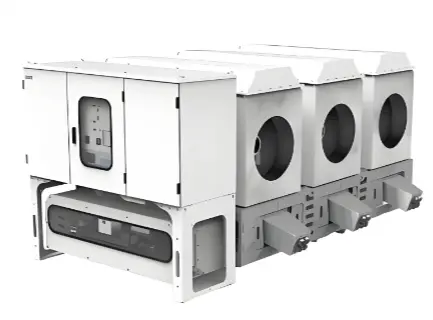
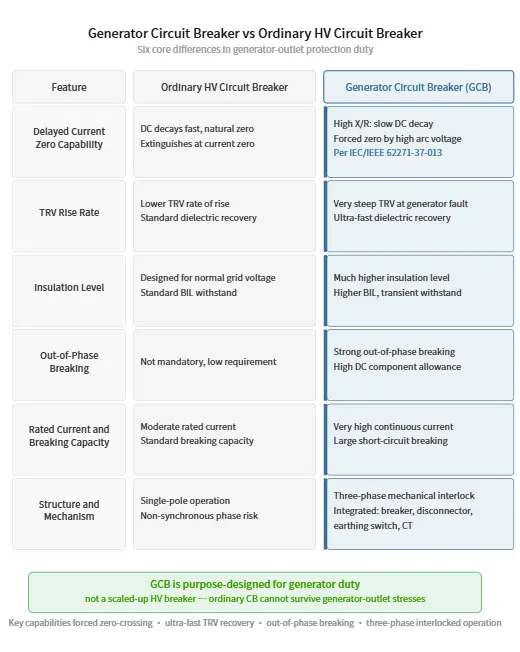
A generator circuit-breaker (GCB) is the dedicated protective device installed between the generator and the step-up transformer. GCBs and conventional high-voltage circuit-breakers both rely on an arc-quenching medium to interrupt fault current, but the generator circuit is a different world: it has much higher inductance and much longer time constants, and that changes the engineering rules. The table below summarises the key differences, based on the relevant IEC standards.
iee-business

1. Interrupting "Delayed Zero-Crossing" Short-Circuit Currents

  • Conventional circuit-breakers: extinguish the arc at the natural current zero. In a typical distribution network, the DC component of the short-circuit current decays quickly, so current zero arrives almost immediately and interruption is straightforward.
  • Generator circuit-breakers: face a very different situation. With the extremely high X/R ratio of the generator circuit, the DC component decays very slowly, which can push the zero crossing far out into the future — a condition known as "delayed zero-crossing". Per IEC/IEEE 62271-37-013, the GCB must be able to interrupt currents carrying a very high percentage of DC component. It does this by building up a high arc voltage as the contacts part, forcing the current to zero so the fault can be cleared safely.

2. Rate of Rise of Transient Recovery Voltage (TRV)

  • Conventional circuit-breakers: see a relatively gentle TRV rise for terminal faults at contact separation, so the required dielectric recovery performance is modest.
  • Generator circuit-breakers: see the TRV rise extremely fast with very little time delay on generator-source faults. To survive that, a GCB needs a dielectric recovery speed well beyond what a distribution breaker of the same class would offer.

3. Insulation Level and Withstand Capability

  • Conventional circuit-breakers :are insulated mainly against normal grid voltage variations.
  • Generator circuit-breakers: have to cope with rapid voltage changes when the generator is disconnected, which can impose very high transient overvoltages on the breaker. GCBs are therefore built with significantly higher insulation levels and lightning impulse withstand capability than distribution breakers of comparable ratings.

4. Out-of-Phase Breaking and Closing

  • Conventional circuit-breakers :usually have no mandatory out-of-phase breaking requirement, or only a mild one.
  • Generator circuit-breakers :must offer strong out-of-phase breaking. If the generator and the grid are out of synchronism — mismatched in voltage and frequency — the switch gap is stressed by extremely high voltage. GCBs are therefore specified for far higher out-of-phase breaking currents than conventional breakers, with a higher permissible DC component in the asymmetric current as well.

5. Rated Current and Breaking Capacity

  • Conventional circuit-breakers: are built for modest current ratings.
  • Generator circuit-breakers: are designed for heavy current. Their rated continuous current and short-circuit breaking current dwarf those of distribution circuit-breakers, because they must handle the extreme duty of large generating units.

6. Construction and Operating Mechanism

  • Conventional circuit-breakers:especially at higher voltages, where phase spacing is large — are often built as single-pole operated devices, which carries the risk of non-simultaneous phase operation.
  • Generator circuit-breakers are typically fitted with a three-phase mechanically interlocked operating mechanism to guarantee synchronous operation. This prevents the negative-sequence current that non-simultaneous operation would produce in the generator stator, which could otherwise damage the rotor. Modern GCBs also tend to integrate the circuit-breaker, disconnector, earthing switch and instrument transformers into one compact assembly.

iee-business

Summary

A GCB is not just a conventional high-voltage circuit-breaker dropped into the generator circuit; it is special-purpose protection built for the unique demands of generator systems. The conventional breaker operates in a distribution network where the DC component decays fast and system impedance stays relatively stable, while the GCB must cope with delayed-zero-crossing currents from high X/R ratios, an extremely steep TRV, demanding out-of-phase duties and very high current ratings.

Add the three-phase interlocked mechanism, and you have a design that eliminates the rotor damage risk caused by non-simultaneous operation. Distribution breakers are simply not up to the electrical stress at the generator outlet — only a GCB can clear these faults in milliseconds and deliver the protection that large generating units and their step-up transformers depend on.

Edited From: Garca

Give a tip and encourage the author!

Comments

Share your question or perspective
WhatsApp
Send inquiry
+86
Click to upload file
Download
Get the IEE Business Application
Use the IEE-Business app to find equipment, obtain solutions, connect with experts, and participate in industry collaboration anytime, anywhere—fully supporting the development of your power projects and business.
Login
or continue with
New here?
Register