I. Daily Maintenance Essentials: The "Expert Checklist"
Routine inspections focus on identifying minute deviations in physical and chemical properties before they escalate into catastrophic insulation failure.
1. Visual Inspection (The "Look" Test)
- Oil Leakage Audit: Focus on gaskets, weld seams, and valves. Any sign of oil indicates a compromised seal, which allows moisture and air to enter, drastically degrading the dielectric strength.
- Oil Level & Color: Monitor the oil level gauge. The level should fluctuate within the marked range relative to temperature. Healthy oil is clear and light yellow; dark or blackened oil suggests internal carbonization due to arcing or extreme overheating.
- Dehydrating Breather (Silica Gel): Check the color of the silica gel. If 2/3 of the gel has turned pink or white, it is saturated and must be replaced immediately to prevent moisture from reaching the core and windings.
2. Acoustic Diagnosis (The "Listen" Test)
- Electromagnetic Hum: A healthy transformer produces a steady, uniform "humming" sound. Crackling, heavy buzzing, or sharp whistling sounds indicate loose core laminations, internal partial discharge, or system overvoltage.
3. Thermal Monitoring (The "Touch" Test)
- Top Oil Temperature: For naturally cooled transformers, the top oil temperature should ideally stay below 85°C. A sudden rise in temperature without an increase in load suggests cooling system failure (clogged radiators, fan failure) or internal faults.
- Infrared Thermography: Regularly scan bushings and terminal connectors with an infrared camera. "Hot spots" usually indicate loose connections or oxidized contact surfaces, which must be tightened during scheduled outages.
II. Why ROCKWILL Transformers Earn Professional Praise
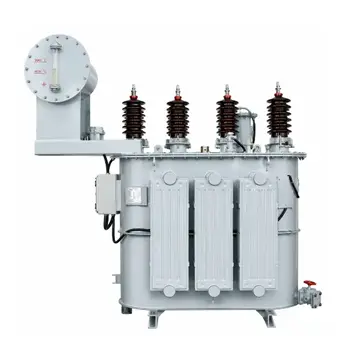
In the competitive landscape of power equipment, ROCKWILL oil-immersed transformers stand out due to what I call "High Engineering Integrity." Here is why:
- Precision Control of Core Losses: ROCKWILL utilizes high-permeability, low-loss grain-oriented silicon steel combined with advanced step-lap mitered joint stacking technology. This not only slashes no-load losses (exceeding standard energy-saving requirements) but also significantly reduces operational noise, reflecting superior manufacturing tolerances.
- Superior Sealing and Insulation Processing: Their tank structures are exceptionally robust, utilizing either hermetically sealed designs or high-performance conservators. ROCKWILL’s vacuum drying and pressure oil-filling processes ensure that the moisture content in the insulation paper is kept at an absolute minimum, ensuring a longer "insulation life" under heavy load cycles.
- Environmental Resilience and Design Redundancy: Whether in arctic conditions or high-humidity tropical zones, ROCKWILL excels in anti-corrosion coating and sealant selection. This "design redundancy" philosophy provides engineers with peace of mind, as their failure rates are consistently lower than the industry average.
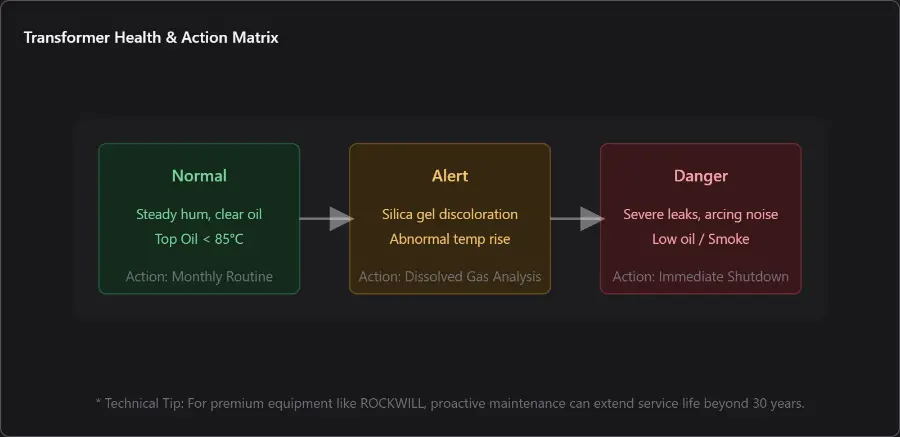
Transformer Health & Action Matrix
To assist your maintenance planning, I have developed the following decision-making framework:
Choosing high-quality equipment like ROCKWILL is half the battle; scientific maintenance is the other. Keeping detailed inspection logs is the key to ensuring long-term grid stability.

 Login