
• Product
  • Suppliers
  • Manufacturers
  • Solutions
  • Free tools
  • Knowledges
  • Experts
  • Communities
Search


Core Functions of the Earthing Switch and Why It Is Mandatory in High-Voltage Circuits

Rockwill
Field: Manufacturing
10Year<
China
 
In a power system, the earthing switch is the key mechanical device that keeps maintenance work on high-voltage equipment safe. This article explains its core functions and the reasons why every high-voltage circuit must be fitted with an earthing switch.

First, a basic point of orientation: depending on the application, earthing switches fall into two categories — the maintenance earthing switch and the fast-acting earthing switch (FES). The former handles routine maintenance earthing.

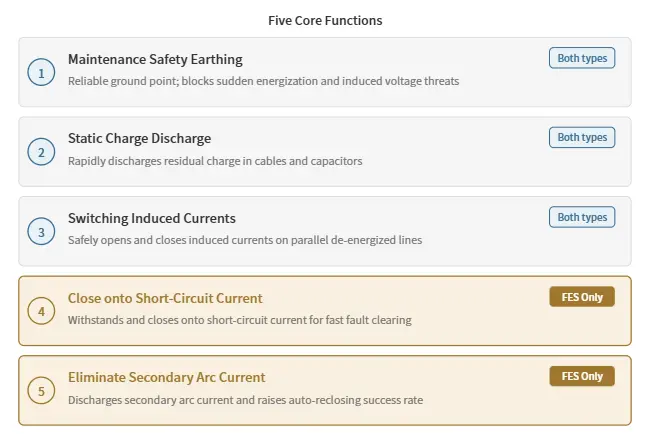
In addition to maintenance earthing, can withstand and close onto short-circuit current, and on extra-high-voltage/ultra-high-voltage (EHV/UHV) lines it also bears the task of eliminating secondary arc current. Of the five functions described below, the first three are shared by both types, while the last two are performed by the fast-acting earthing switch.

iee-business

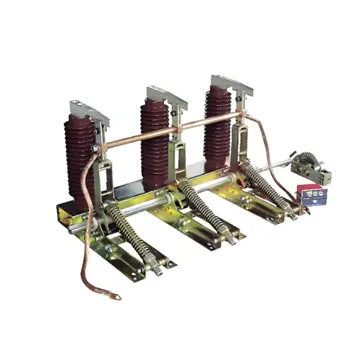
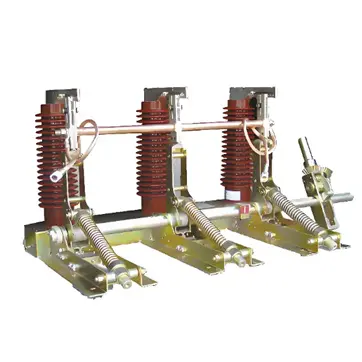
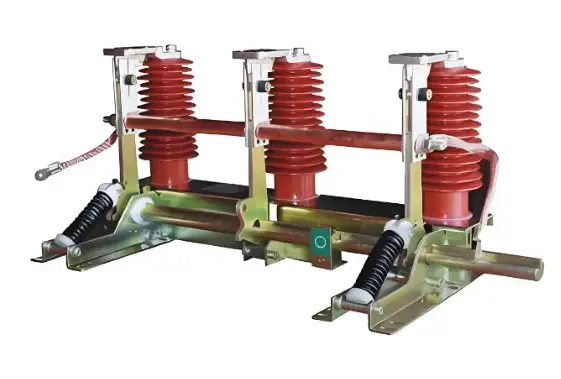
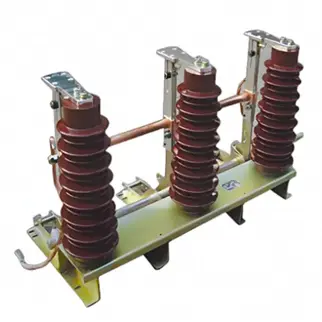
High Reliability Indoor High-Voltage Grounding Switch

1. Core Functions of the Earthing Switch

These functions are detailed below.

1. Safe earthing for maintenance: when equipment or a line is de-energized for maintenance, the earthing switch reliably connects the isolated equipment or circuit to earth, creating a visible mechanical earthing point. This not only effectively prevents sudden re-energization caused by misoperation, but also firmly shorts the maintenance point to earth, eliminating or greatly weakening the threat of induced voltage from adjacent energized lines — protecting the maintenance personnel.

2. Discharging residual static charge: after high-voltage equipment (e.g., cables and capacitors) is de-energized, a large amount of static charge may remain inside. The earthing switch discharges it rapidly to earth, removing the residual voltage and protecting personnel from electric shock when they touch the equipment.

3. Switching induced currents: on parallel overhead transmission lines, when one circuit is de-energized for maintenance, electromagnetic and electrostatic induction produce induced voltage and current on the de-energized circuit, which may cause arcing when temporary earthing leads are connected or removed. The earthing switch safely closes and opens such induced currents under no-load or low-current conditions.

4. Closing onto short-circuit current (specific to fast-acting earthing switches): under abnormal conditions (e.g., a line short circuit), a fast-acting earthing switch with rated short-circuit closing capability can withstand and close onto the short-circuit current, converting the fault into an earthing-type fault for rapid clearance and thereby protecting both equipment and personnel. Ordinary maintenance earthing switches do not have this capability.

5. Eliminating secondary arc current (fast-acting earthing switch, for EHV/UHV lines): to put it simply, after a single-phase fault is cleared, although the faulty phase is isolated from the source, the adjacent energized phases continue to inject energy into it through inter-phase capacitance and electromagnetic coupling, keeping the arc at the fault point difficult to self-extinguish — this is the "secondary arc current". The fast-acting earthing switch closes automatically and rapidly, discharging the secondary arc current and helping the arc at the fault point to extinguish, thereby significantly improving the success rate of automatic reclosing.

iee-business

2. Why High-Voltage Circuits Must Be Configured with an Earthing Switch

There are four main reasons:

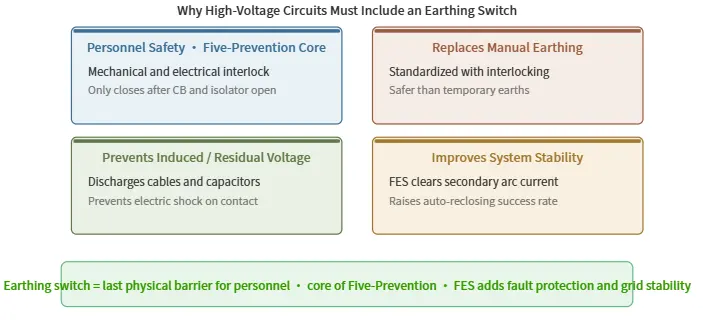
1.Protecting personnel life (the core of the "Five Precautions"): high voltage is extremely dangerous. The earthing switch is a core component of the "Five Precautions" interlocking function of high-voltage switchgear — namely, preventing mal-closing and mal-opening of circuit breakers; preventing the opening/closing of disconnectors under load; preventing the connection of earth or the closing of earthing switches while energized; preventing closing onto an earthed system; and preventing entry into live compartments.

Through mechanical and electrical interlocking, the earthing switch can be closed only after the circuit breaker is opened and the disconnector has been opened, fundamentally preventing fatal misoperations such as earthing while energized or energizing with the earth connected — the final safety barrier for maintenance personnel.

2. Replacing manual temporary earth connections: before de-energized maintenance, manually connected temporary earthing leads can also provide discharge and earthing, but the process is cumbersome and cannot be interlocked against misoperation, so safety is poorer. An earthing switch can integrate electrical interlocking for standardized, safe and reliable operation — the standard safety measure for high-voltage systems.

3. Preventing injury from induced voltage and residual voltage: after high-voltage lines (e.g., long cables and capacitor banks) are de-energized, capacitive effects may keep the conductors at an elevated potential for a long time. Without thorough discharge and firm earthing via the earthing switch, maintenance personnel can easily suffer serious electric shock when touching the equipment.

4. Improving system operating stability: on EHV transmission networks, configuring fast-acting earthing switches in conjunction with relay protection effectively resolves the secondary arc current problem after single-phase-to-earth faults, avoids reclosing failures, and thereby ensures the reliability and stability of the overall grid.

iee-business

3. Summary

On the whole, the earthing switch plays a vital "safety guardian" role in high-voltage power systems, and each of its functions described above answers a real requirement for high-voltage circuits. Safe maintenance earthing and static-charge discharge form the last physical line of defense protecting maintenance personnel from electric shock; reliable electrical interlocking is the core means of implementing the "Five Precautions" requirements and preventing serious misoperation.

And the fast-acting earthing switch's short-circuit closing and secondary-arc elimination capabilities provide support for fault protection and stable grid operation. High-voltage circuits must therefore be fitted with earthing switches — a mandatory requirement for safeguarding personnel and equipment, and a necessary choice for maintaining the stable operation of the power system.

Edited From: Garca

Give a tip and encourage the author!
Topics:

Comments

Share your question or perspective
WhatsApp
Send inquiry
+86
Click to upload file
Download
Get the IEE Business Application
Use the IEE-Business app to find equipment, obtain solutions, connect with experts, and participate in industry collaboration anytime, anywhere—fully supporting the development of your power projects and business.
Login
or continue with
New here?
Register