

• Product
  • Suppliers
  • Manufacturers
  • Solutions
  • Free tools
  • Knowledges
  • Experts
  • Communities
Search


Core Differences Between Skid-Mounted Oil-Immersed Substations and Conventional Box-Type Substations

Vziman
Field: Manufacturing
10Year<
China

A skid-mounted oil-immersed substation is a power facility in which core electrical equipment — including transformers, high-voltage switchgear, and low-voltage switchgear — is highly integrated and installed on a steel skid base (or prefabricated enclosure). It is typically assembled, wired, and commissioned at the factory, so once delivered to site, it only needs external cable connections to be energized and put into service.

The term "oil-immersed" indicates that the core equipment uses oil-immersed transformers, which rely on insulating oil for heat dissipation and insulation. This design offers strong short-circuit and overload resistance while effectively reducing equipment size.

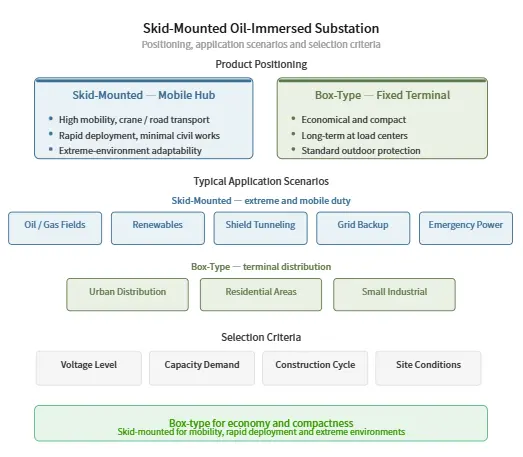
Compared with a conventional box-type substation, the core differences of a skid-mounted oil-immersed substation mainly lie in four aspects:

iee-business

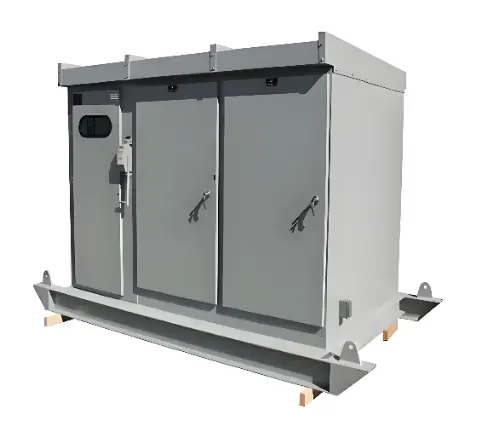
Skid‑mounted packaged substation with steel cabinet housing and lifting lugs on base skid

1. Structural Design and Mobility

  • Skid-mounted oil-immersed substation: It adopts a modular design, with all equipment mounted as a whole on a high-strength steel skid base, giving it exceptional mobility. It supports whole-unit lifting, road transport, and even repeated relocation, allowing flexible redeployment to meet changing needs — such as oilfield development and emergency power supply.
  • Conventional box-type substation: Although it also offers a degree of mobility, it is more often designed for fixed or semi-fixed installation, mainly embedded deep in load centers (such as residential communities and parks) for long-term power supply. Its frequency of relocation and flexibility fall short of skid-mounted substations.

2. Capacity Ratings and Application Scenarios

  • Skid-mounted oil-immersed substation: It focuses on large capacity and high voltage ratings. Through compact and weight-reducing technology, higher voltage ratings and larger capacity configurations are now achievable. It mainly targets scenarios with stringent reliability requirements and fluctuating loads, such as field operations at large oil and gas fields, large-scale renewable energy grid integration, shield tunneling, and temporary stand-in power supply during urban grid renovation.
  • Conventional box-type substation: Constrained by enclosure size and heat dissipation conditions, it is typically used at medium- and low-voltage ratings with relatively small transformer capacity. According to relevant civil building electrical design standards, its capacity selection is subject to certain limits. It is widely applied to terminal power distribution scenarios such as urban distribution networks, residential areas, and small-to-medium industrial and mining enterprises.

3. Construction Approach and Project Cycle

  • Skid-mounted oil-immersed substation: It adopts a brand-new construction model of "factory prefabrication + on-site modular lifting." Most assembly and commissioning work is completed at the factory, eliminating extensive on-site civil works such as foundations, cable trenches, and building works. Overall time-to-commissioning is greatly shortened compared with conventional approaches, delivering extremely high construction efficiency.
  • Conventional box-type substation: Although it is also a factory-prefabricated product that shortens the construction period, it still requires on-site foundation pouring, enclosure positioning, and cable connections. Its overall construction model more closely resembles a "miniaturized version" of a conventional civil-engineering substation.

4. Environmental Adaptability and Protection Design

  • Skid-mounted oil-immersed substation: It is purpose-built for extremely harsh operating conditions. For field environments involving sandstorms, extreme temperatures, and high salt spray, it typically employs a fully enclosed cabin with a high protection rating, and is equipped with an intelligent temperature control system, shock and vibration isolation design, and multiple anti-corrosion schemes, ensuring safe and stable operation under complex geological and climatic conditions.
  • Conventional box-type substation: It likewise features fully enclosed operation with moisture resistance, rust resistance, fire protection, and heat insulation, and can cope with ordinary harsh outdoor environments. However, its protection design is more geared toward long-term fixed operation, and it lags behind purpose-built skid-mounted substations in redundant design for severe vibration and extreme operating conditions.

iee-business


Summary

Although skid-mounted oil-immersed substations and conventional box-type substations are both prefabricated power equipment, their positioning is fundamentally different. The conventional box-type substation is a "fixed terminal" for urban distribution networks and conventional industry, valued for economy and compactness.

The skid-mounted oil-immersed substation is a "mobile hub" for extreme conditions, large-capacity demands, and high-frequency relocation, with high mobility, rapid deployment, and strong environmental adaptability as its core competitiveness. When selecting between them, the voltage rating, capacity requirements, construction cycle, and site conditions of the project should all be taken into full consideration.

Edited From:Noah

Give a tip and encourage the author!

Comments

Share your question or perspective
WhatsApp
Send inquiry
+86
Click to upload file
Download
Get the IEE Business Application
Use the IEE-Business app to find equipment, obtain solutions, connect with experts, and participate in industry collaboration anytime, anywhere—fully supporting the development of your power projects and business.
Login
or continue with
New here?
Register