Search


Capacitive Current Estimation for Overhead and Cable Power Lines

Learn how to estimate capacitive current in overhead lines, cable lines, and double-circuit lines based on voltage level, conductor type, and line length. Includes practical formulas and voltage-specific constants.

Leon
Field: Fault Diagnosis
10Year<
China
Add us on Google

The capacitive current is mainly determined by the length of the feeder, the cross-sectional area of the conductor, the dielectric constant, the height above the ground, and the rated voltage. The specific estimation methods are as follows:

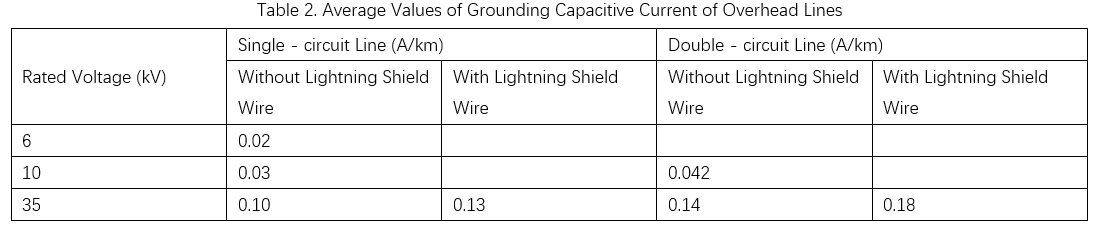
  • Estimation of capacitive current of overhead lines: For overhead lines of 3 - 35 kV, the capacitance per phase to ground is usually 5000 - 6000 pF/km. Based on this, the value of the single-phase grounding capacitive current per kilometer for lines of different voltage levels can be estimated.

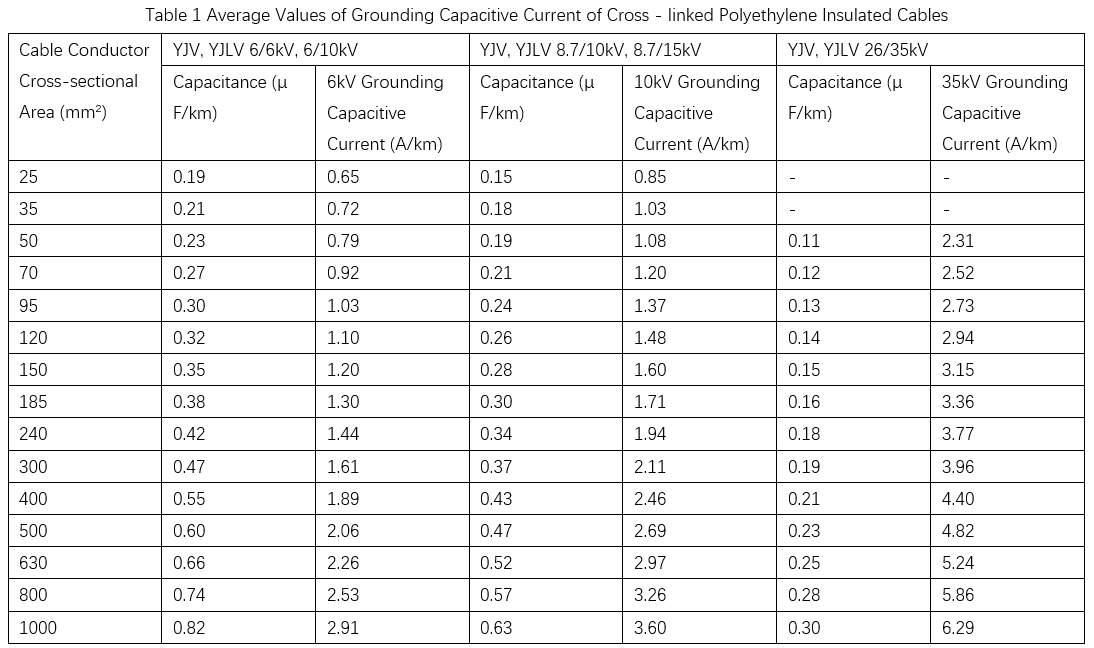
  • Estimation of capacitive current of cable lines: The capacitive current of cable lines is much larger than that of overhead lines and needs to be calculated separately. Its value is closely related to the cross-sectional area, structure, and rated voltage of the cable.

  • Estimation of capacitive current of double-circuit overhead lines on the same pole: The capacitive current of such lines is not twice that of a single-circuit line. When equivalently calculated as a single-circuit line, the formula is: Ic = (1.4 - 1.6)Id (where Id is the capacitive current corresponding to the length of a single circuit in the double-circuit lines). The constant values need to be distinguished by voltage level: 1.4 corresponds to 10 kV lines, and 1.6 corresponds to 35 kV lines.

Capacitive Current Estimation for Overhead and Cable Power Lines

Capacitive Current Estimation for Overhead and Cable Power Lines

Give a tip and encourage the author!

Comments

Share your question or perspective
WhatsApp
Send inquiry
+86
Click to upload file
Download
Get the IEE Business Application
Use the IEE-Business app to find equipment, obtain solutions, connect with experts, and participate in industry collaboration anytime, anywhere—fully supporting the development of your power projects and business.
Login
or continue with
New here?
Register