• Product
  • Suppliers
  • Manufacturers
  • Solutions
  • Free tools
  • Knowledges
  • Experts
  • Communities
Search


Free Expert Guides on Power Systems, Circuit Design & Electrical Troubleshooting

Access free engineering resources from IEE Business—covering power design, circuit layout, equipment selection, and troubleshooting. Expert-developed guides help engineers, procurement, and project teams make better decisions. Stay ahead on smart grids, renewables, efficiency, and AI tools. Improve reliability, reduce downtime, and enhance outcomes with real-world solutions. Explore our knowledge hub today.
What is the reason behind transmission lines being single stranded and not twisted around each other at high voltages?
Why are high voltage transmission lines mostly single strand and not twistedThe design and material selection of high-voltage transmission lines are based on a variety of factors, including safety, efficiency, construction difficulty and cost-effectiveness. Here are some explanations for why high-voltage transmission lines are mostly single-stranded and not twisted:Safety and reliabilityHigh voltage transmission lines usually carry high voltage, which has extremely high requirements for safety a
10/05/2024
Consult
Tip
Consult
Tip
What is the reason for high voltage lines having a larger diameter than low voltage lines?
Analysis of reasons why the diameter of high voltage line is larger than that of low voltage lineThe diameter of the high-voltage line is larger than that of the low-voltage line, mainly due to the following reasons:Energy conservation and power matchingAccording to the law of conservation of energy, the transformer keeps the power constant while converting the voltage. Even at different voltage levels, the total power of input and output is the same 1. Since the higher the voltage, the smaller
10/04/2024
Consult
Tip
Consult
Tip
What type of wire is typically used for making electric cables?
Electric cables are composed of one or more wires enclosed in a protective covering. The choice of wire material depends on several factors including conductivity, cost, flexibility, strength, and resistance to corrosion. The most commonly used types of wire for making electric cables include:Copper (Cu) High Conductivity: Copper has excellent electrical conductivity, second only to silver among common metals. Good Flexibility: Copper is relatively soft and ductile, which makes it easy to work w
09/30/2024
Consult
Tip
Consult
Tip
Which wire is more suitable for electrical use, raw copper or tinned copper?
Comparison of tinned copper wire and original copper wireIn electrical use, the choice of the right wire material is very important, because it directly affects the performance and life of the circuit. For the original copper wire (bare copper wire) and tinned copper wire, they have different characteristics and application occasions.Electrical conductivityRaw copper wire and tinned copper wire are very good in electrical conductivity. However, because tinned copper wires have a layer of tin on
09/29/2024
Consult
Tip
Consult
Tip
Can two copper wires of different sizes be safely twisted together?
Safety of stranding two copper wires of different specificationsBefore discussing whether two copper wires of different specifications can be safely twisted together, we need to consider several key factors, including the electrical performance of the wire, mechanical strength, and the requirements of the installation environment. Here's an analysis based on search results:Electrical performanceThe specific cross-sectional design of stranded copper wire gives it resistance characteristics simila
09/29/2024
Consult
Tip
Consult
Tip
A copper wire is 2.0 mm thick and 2 meters long. What is the resistance?
To calculate the resistance of a copper wire, we can use the resistivity formula: R is resistance (unit: ohms, Ω) ρ is the resistivity of the material (unit: ohms · meters, Ω·m) L is the length of the wire (unit: m, m) A is the cross-sectional area of the wire (unit: square meters, m²)For copper wires, the resistivity is approximately 1.72×10⁻⁸Ω⋅m (the standard value at 20°C).First, we need to calculate the cross-sectional area A of the wire. Suppose the wire has a circular cross-section and a d
09/25/2024
Consult
Tip
Consult
Tip
Advantages of using stranded conductors instead of solid conductors in electrical wiring circuits
Using stranded conductors instead of solid conductors in electrical wiring circuits has the following benefits:Mechanical propertiesBetter flexibilityA stranded conductor consists of strands of thin wire twisted together and is softer than a solid conductor. This makes it easier to bend and install during the wiring process, especially if you need to bypass obstacles or wire in tight Spaces.For example, in some complex electrical control cabinets, the use of stranded conductors can easily arrang
09/25/2024
Consult
Tip
Consult
Tip
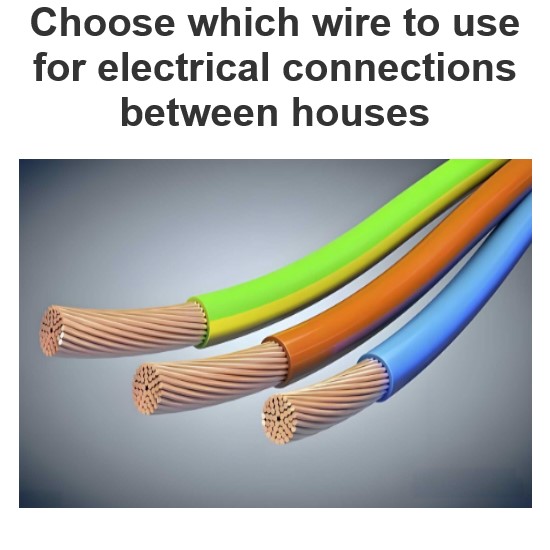
Choose which wire to use for electrical connections between houses
The type of wire used for electrical connections between two buildings or houses, such as in a situation where power needs to be shared or distributed, typically depends on several factors including the distance between the buildings, the load requirements (current draw), the voltage level, and environmental conditions. Here are some common types of wires and cables that might be used:Aluminum WireAluminum wire is commonly used for overhead power lines due to its light weight and good conductivi
09/25/2024
Consult
Tip
Consult
Tip
The charging capacitor is calculated by the discharge time of the resistor
The calculation of the time for the capacitor to discharge through the resistor involves the characteristics of the RC circuit (that is, the circuit consisting of the resistor and the capacitor). In RC circuits, the process of capacitor discharge can be described by an exponential function.Discharge time calculation formulaWhen a capacitor is discharged, the change of its voltage V(t) with time t can be expressed by the following formula: V(t) is the voltage of the capacitor at time t; V0 is the
09/24/2024
Consult
Tip
Consult
Tip
The difference between charging and discharging capacitors with alternating current
Capacitors behave differently in AC circuits than they do in DC circuits. Capacitors in an AC circuit can be viewed as constantly charging and discharging because the voltage of an AC power supply changes periodically.Behavior of capacitors in AC circuits Equivalent to short circuit: In a high-frequency AC circuit, a capacitor behaves like a short circuit because its impedance (capacitive reactance) is very low. Equivalent to open circuit: In low-frequency AC circuits, capacitors have a higher c
09/24/2024
Consult
Tip
Consult
Tip
Send inquiry
+86
Click to upload file
Download
Get the IEE Business Application
Use the IEE-Business app to find equipment, obtain solutions, connect with experts, and participate in industry collaboration anytime, anywhere—fully supporting the development of your power projects and business.