• Product
  • Suppliers
  • Manufacturers
  • Solutions
  • Free tools
  • Knowledges
  • Experts
  • Communities
Search


Free Expert Guides on Power Systems, Circuit Design & Electrical Troubleshooting

Access free engineering resources from IEE Business—covering power design, circuit layout, equipment selection, and troubleshooting. Expert-developed guides help engineers, procurement, and project teams make better decisions. Stay ahead on smart grids, renewables, efficiency, and AI tools. Improve reliability, reduce downtime, and enhance outcomes with real-world solutions. Explore our knowledge hub today.
What is arcing ground? What are the causes, consequences and cure?
Definition of arc groundingArc grounding is a kind of grounding fault phenomenon in power system. It mainly refers to the existence of grounding current in the form of arc when single-phase grounding fault occurs in the system where the neutral point is not grounded or the system is grounded through arc suppression coil.Cause of arc groundingInsulation damage Equipment aging: During the long-term operation of the power equipment, due to the effect of electrical, thermal, mechanical and other str
10/10/2024
Consult
Tip
Consult
Tip
Should the earthing switch be properly designed to take the fault current at the point of insulation?
Earthing switches (or grounding switches) are designed to provide a safety measure within electrical systems, ensuring that electrical equipment can be reliably earthed during maintenance or other operations, thereby protecting personnel and equipment. Regarding whether grounding switches should be designed to absorb fault currents at insulation points, this involves understanding the function and design specifications of grounding switches.Function of Earthing SwitchesThe primary functions of g
10/10/2024
Consult
Tip
Consult
Tip
Before an earthing switch can be closed, do you have to ensure the circuit is dead?
Yes, before closing an earthing switch (or grounding switch), it is crucial to ensure that the circuit has been de-energized. This is done for safety reasons to prevent electric shocks or damage to equipment. Here is a detailed explanation of why this is necessary and the steps involved:Why Should You De-Energize First?1. Safety (Safety) Avoid Electrical Shock (Avoid Electrical Shock): Ensuring the circuit is de-energized prevents electric shocks when closing the earthing switch. Prevent Fires (
10/10/2024
Consult
Tip
Consult
Tip
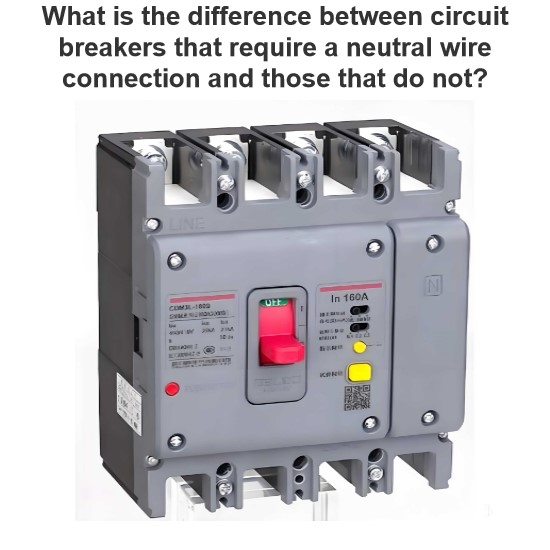
What is the difference between circuit breakers that require a neutral wire connection and those that do not?
Circuit breakers (Circuit Breakers) are essential components in electrical systems used to protect circuits from faults such as overload and short circuits. Depending on whether they require a neutral line connection, circuit breakers can be classified into two types: those that require a neutral line connection and those that do not. Below are the distinctions between these two types of circuit breakers:Circuit Breakers That Require Neutral Line Connection (Neutral Connected Breaker)Characteris
10/10/2024
Consult
Tip
Consult
Tip
What is the purpose of grounding in electrical systems?
Grounding in electrical systems serves multiple purposes, which can be primarily summarized into the following aspects: Personal Safety Protection: Earthing prevents electrical equipment enclosures from becoming electrified due to insulation damage, thereby avoiding electric shock accidents when personnel come into contact with them. By connecting the metal parts of electrical equipment to the grounding electrode, even if the equipment's insulation fails, it ensures that current is diverted thro
10/09/2024
Consult
Tip
Consult
Tip
What are the differences between an AC and a DC circuit breaker in terms of operation and switching?
Ac circuit breaker and DC circuit breaker operation and switching differenceThere are some important differences between AC circuit breakers and DC circuit breakers in terms of operation and switching, and these differences mainly stem from the differences in the physical characteristics of AC and DC.Differences in operating principlesAc circuit breakers and DC circuit breakers have different operating principles. Ac circuit breakers use the periodic change of alternating current and rely on the
10/07/2024
Consult
Tip
Consult
Tip
What is the reason for the neutral wire not touching the ground in a circuit?
In a circuit, the reason why the neutral wire is not grounded is mainly related to the design of the circuit, safety, and the way the system operates. Here are some common reasons:Prevent current leakage Current balance: In a three-phase system, if the neutral line is grounded, it may cause current imbalance, which affects the stability of the system. Prevent current leakage: If the neutral wire is grounded, when the system fails, a current loop may be formed through the grounding system, result
10/04/2024
Consult
Tip
Consult
Tip
What are the different kinds of DC circuit breakers and their uses?
Dc circuit breakers can be divided into different types according to their working principle and characteristics, and each type has its specific purpose. The following are several common types of DC circuit breakers and their characteristics:Mechanical DC circuit breaker Working principle: Mechanical DC circuit breakers use mechanical structures (such as springs, pistons, etc.) to achieve on-off operation. They can turn off large currents and have the advantages of low cost and low loss, but the
10/04/2024
Consult
Tip
Consult
Tip
What type of devices are relays? Are they mechanical or electronic?
Types and working principles of relaysA relay is a control device that can control the on-off of other circuits based on changes in the input signal (usually current or voltage). In modern technology, relays are mainly divided into two types: mechanical relays and electronic relays.Mechanical relayMechanical relays are an early development, which uses mechanical principles to achieve switching functions. This type of relay usually includes a manually operated device that controls the on-off of t
10/04/2024
Consult
Tip
Consult
Tip
Why are stones laid on the ground in an electric substation?
The ground of the substation is paved with stone mainly for the following reasons: Fire prevention and safety: The laying of pebbles or small stones under the transformer plays a role in fire prevention. When the transformer overheating or oil injection fire, the oil will flow through the cobblestone layer, into the oil discharge pool, so as to avoid the blockage of the oil ditch, while reducing the fire, conducive to fire suppression 1. In addition, cobblestones prevent small animals from enter
10/04/2024
Consult
Tip
Consult
Tip
Send inquiry
+86
Click to upload file
Download
Get the IEE Business Application
Use the IEE-Business app to find equipment, obtain solutions, connect with experts, and participate in industry collaboration anytime, anywhere—fully supporting the development of your power projects and business.