• Product
  • Suppliers
  • Manufacturers
  • Solutions
  • Free tools
  • Knowledges
  • Experts
  • Communities
Search


Free Expert Guides on Power Systems, Circuit Design & Electrical Troubleshooting

Access free engineering resources from IEE Business—covering power design, circuit layout, equipment selection, and troubleshooting. Expert-developed guides help engineers, procurement, and project teams make better decisions. Stay ahead on smart grids, renewables, efficiency, and AI tools. Improve reliability, reduce downtime, and enhance outcomes with real-world solutions. Explore our knowledge hub today.
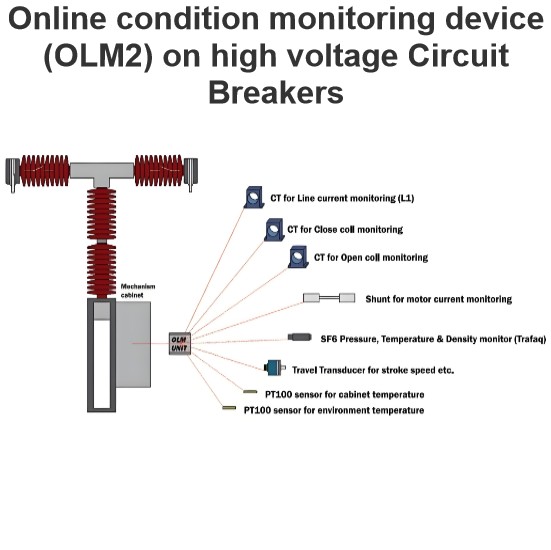
Online condition monitoring device (OLM2) on high voltage Circuit Breakers
This device is capable of monitoring and detecting various parameters according to the specifications outlined:SF6 Gas Monitoring: Utilizes a specialized sensor for measuring SF6 gas density. Capabilities include measuring gas temperature, monitoring SF6 leak rates, and calculating the optimal date for refilling.Mechanical Operation Analysis: Measures operational times for closing and opening cycles. Evaluates primary contacts separation speed, damping, and contact overtravel. Identifies signs o
02/13/2025
Consult
Tip
Consult
Tip
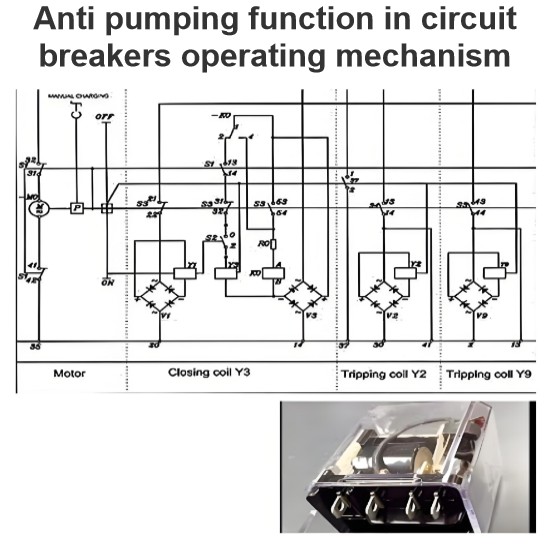
Anti pumping function in circuit breakers operating mechanism
The anti - pumping function stands as a crucial characteristic of control circuits. In the absence of this anti - pumping function, assume that a user connects a maintained contact within the closing circuit. When the circuit breaker is closed onto a fault current, the protective relays will promptly trigger a tripping action. However, the maintained contact in the closing circuit will attempt to close the breaker (once again) onto the fault. This repetitive and dangerous process is referred to
02/12/2025
Consult
Tip
Consult
Tip
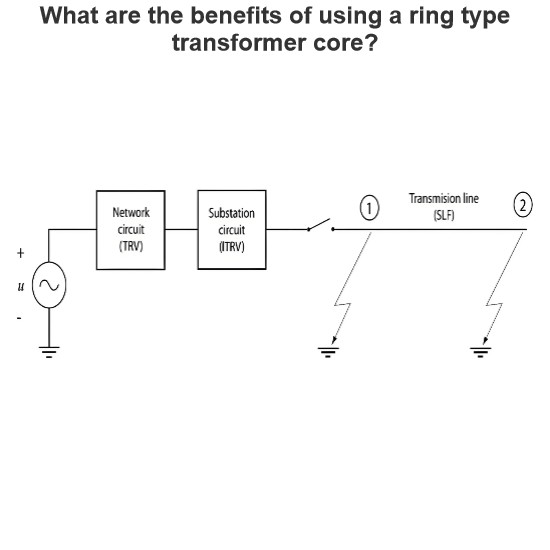
Initial Transient Recovery Voltage (ITRV) for high voltage circuit breakers
Transient Recovery Voltage (TRV) stress similar to that encountered during a short-line fault can also occur due to the busbar connections on the supply side of a circuit breaker. This specific TRV stress is known as Initial Transient Recovery Voltage (ITRV). Given the relatively short distances involved, the time to reach the first peak of ITRV is typically less than 1 microsecond. The surge impedance of the busbars within a substation is generally lower compared to that of overhead lines.The f
02/08/2025
Consult
Tip
Consult
Tip
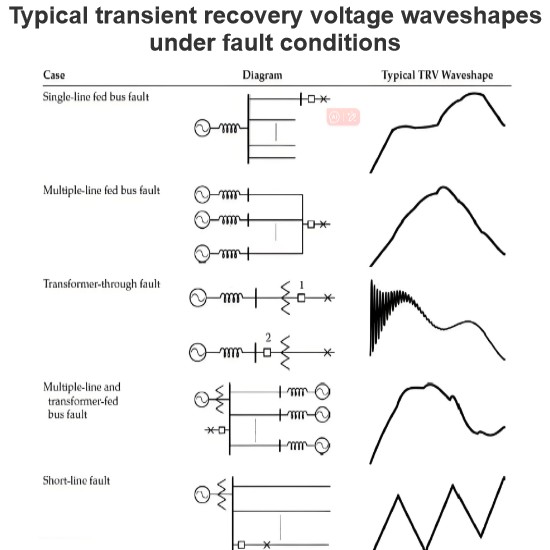
Typical transient recovery voltage waveshapes under fault conditions
Transient Recovery Voltages (TRVs) caused by fault current interruptions are typically categorized into three types of waveshapes: exponential, oscillatory, and sawtoothed. Additionally, significant TRV conditions can be classified under two main scenarios: Short Circuit Current Interruption: This is the simplest scenario involving the interruption of a symmetrical, rated-frequency short-circuit current. Since this current naturally reduces to zero at least once every half cycle, it represents t
02/07/2025
Consult
Tip
Consult
Tip
Gasket design for SF6 leakage
Leakage Causes and Gasket Design ConsiderationsLeaks in equipment often occur due to the deterioration of gasket materials over time and with use. Three critical factors influence gasket design and performance: Hardening of Gaskets:High ambient temperatures and the heat generated by electrical currents passing through circuit breakers during normal operation can reduce the elasticity of gaskets, causing them to harden over time. Chemical Attack:In substations, SF6 gas undergoes chemical changes
02/06/2025
Consult
Tip
Consult
Tip
Auxiliary contact in switchgears
Auxiliary contacts are essential components in circuit breakers and switchgear, providing critical functionality for control and indication. Here's a breakdown of their purpose and operation:Purpose of Auxiliary Contacts: Breaker Trip & Closing Control: Auxiliary contacts are used in control circuits to manage the supply to the trip coil and closing coil, ensuring proper operation of the circuit breaker. Breaker ON/OFF Indication: These contacts provide signals to indicate whether the b
02/05/2025
Consult
Tip
Consult
Tip
Trip free operating mechanism definition acc to IEEE C37.04
Trip-Free Operation of Medium Voltage Circuit BreakersDefinition and BehaviorThe trip-free operation of medium voltage circuit breakers ensures that, regardless of any closing command, the breaker will open if a tripping signal (either mechanical or electrical) is received. This characteristic guarantees safe and reliable operation under all conditions. The behavior of the circuit breaker under different scenarios is detailed below: Simultaneous Closing and Tripping Signals:If a closing operatio
01/25/2025
Consult
Tip
Consult
Tip
Air break circuit breakers technical history in high voltage
Air-Blast Circuit Breakers: A Historical OverviewIntroductionAir-blast circuit breakers leverage the superior dielectric strength and thermal properties of compressed air compared to atmospheric air. This technology allows for the design of high-voltage circuit breakers, utilizing an axial blast of compressed air directed at the arc to extinguish it efficiently. For over five decades, this method was the preferred technology for extra-high voltage applications until the advent of SF6 (sulfur hex
01/24/2025
Consult
Tip
Consult
Tip
Relays and circuit breaker combination
Operation Mechanism of a Circuit BreakerEnergy Storage and ReleaseA closed circuit breaker (CB) stores sufficient energy in one form or another to open its contacts. When a protective relay signals to open the circuit, this stored energy is released, causing the circuit breaker to trip and open.Connection Between Relay and Circuit BreakerExcept in special cases where protective relays are mounted directly on the breaker, the connection between the relay and the circuit breaker is typically achie
01/23/2025
Consult
Tip
Consult
Tip
Energisation of back to back(b to b) cables by circuit breaker according to IEC
The energization of a cable by the closing of a circuit breaker (CB) indeed results in a transient inrush current. The characteristics of this inrush current are influenced by several factors within the electrical system. Here is a refined and detailed explanation:Factors Influencing Inrush CurrentApplied Voltage: The voltage level at the moment the CB closes directly affects the magnitude of the inrush current. Higher voltages can lead to higher initial current peaks.Cable Surge Impedance: This
01/22/2025
Consult
Tip
Consult
Tip
Send inquiry
+86
Click to upload file

IEE Business will not sell or share your personal information.

Download
Get the IEE Business Application
Use the IEE-Business app to find equipment, obtain solutions, connect with experts, and participate in industry collaboration anytime, anywhere—fully supporting the development of your power projects and business.