• Product
  • Suppliers
  • Manufacturers
  • Solutions
  • Free tools
  • Knowledges
  • Experts
  • Communities
Search


Anti pumping function in circuit breakers operating mechanism

Edwiin
Edwiin
Field: Power switch
China

The anti - pumping function stands as a crucial characteristic of control circuits. In the absence of this anti - pumping function, assume that a user connects a maintained contact within the closing circuit. When the circuit breaker is closed onto a fault current, the protective relays will promptly trigger a tripping action. However, the maintained contact in the closing circuit will attempt to close the breaker (once again) onto the fault. This repetitive and dangerous process is referred to as “pumping,” and it will ultimately result in a catastrophic failure of certain components within the system. The failure could occur in the conductors leading to the fault, the circuit breaker itself, or other parts of the system.

The anti - pumping relay is configured in such a way that it latches in as long as the closing signal persists. Once the anti - pumping relay latches in, it opens a contact within the closing circuit.

Consequently, the circuit breaker closes. But if the closing signal remains active, the closing circuit features an open contact, which effectively prevents any further closing operations for the duration of the maintained closing signal.

In the wiring diagram, this relay can be identified as K0 in the closing coil circuit, and you can find it at the bottom of the diagram.
Give a tip and encourage the author!
Recommended
Main Components of a Transformer – Operating Principle, Faults, and Phenomena of the Gas Relay
Gas accumulation: Free gas is present in the transformer oil. Response: The gas in the liquid rises and accumulates in the Buchholz relay, compressing the transformer oil. As the liquid level drops, the float also descends. The movement of the float drives a switch element (magnetic contact), thereby triggering an alarm signal. However, the float is not affected, because a certain amount of gas can flow through the pipe into the storage chamber.Fault: Due to leakage causing loss of transformer o
Noah
11/27/2025
Relay Protection Types in Substations: A Complete Guide
(1) Generator Protection:Generator protection covers: phase-to-phase short circuits in stator windings, stator ground faults, inter-turn short circuits in stator windings, external short circuits, symmetrical overload, stator overvoltage, single- and double-point grounding in the excitation circuit, and loss of excitation. Tripping actions include shutdown, islanding, limiting fault impact, and alarm signaling.(2) Transformer Protection:Power transformer protection includes: phase-to-phase short
Echo
11/05/2025
Sealing Structure for Oil-Filled SF6 Gas Density Relay Contact Lead Wires
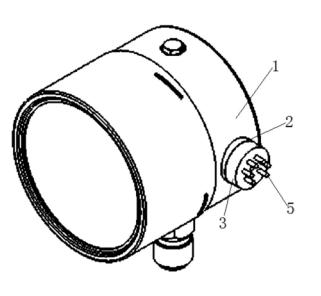
I. CLAIMS A sealing structure for lead wires of contacts in an oil-filled SF6 gas density relay, characterized by comprising a relay housing (1) and a terminal base (2); the terminal base (2) comprising a terminal base housing (3), a terminal base seat (4), and conductive pins (5); the terminal base seat (4) being disposed inside the terminal base housing (3), the terminal base housing (3) being welded onto the surface of the relay housing (1); a central through-hole (6) being provided at the ce
Dyson
10/27/2025
SF6 Density Relay Oil Leakage: Causes, Risks & Oil-Free Solutions
1. Introduction SF6 electrical equipment, renowned for its excellent arc-quenching and insulating properties, has been widely applied in power systems. To ensure safe operation, real-time monitoring of SF6 gas density is essential. Currently, mechanical pointer-type density relays are commonly used, providing functions such as alarm, lockout, and on-site display. To enhance vibration resistance, most of these relays are filled internally with silicone oil.However, oil leakage from density relays
Felix Spark
10/27/2025
Related Products
Send inquiry
Download
Get the IEE Business Application
Use the IEE-Business app to find equipment, obtain solutions, connect with experts, and participate in industry collaboration anytime, anywhere—fully supporting the development of your power projects and business.