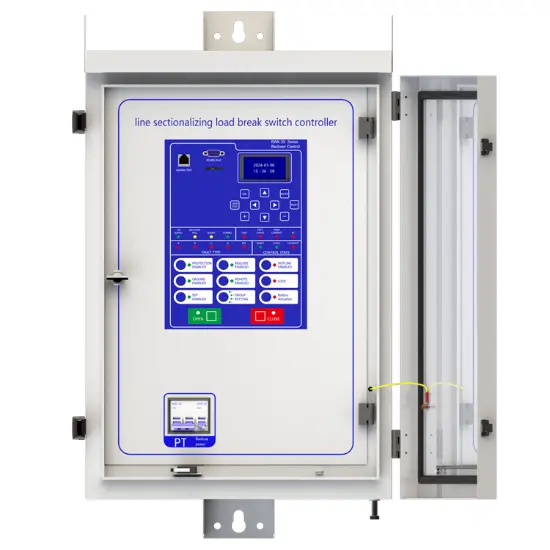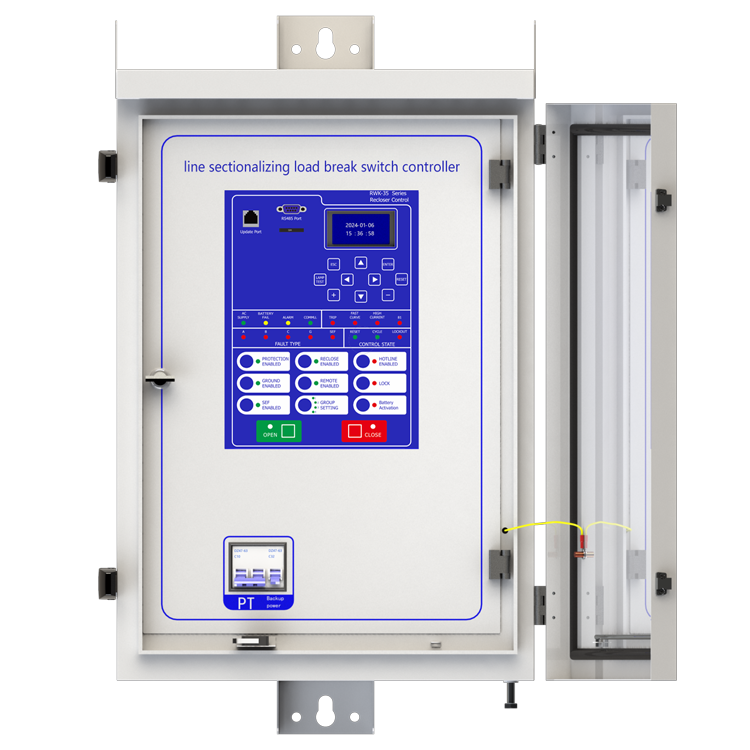
line sectionalizing load break switch controller
Sectionalizer controller for load‑break switch (-10℃~+55℃). Count‑based sectionalizing, multi‑protection & non‑volatile event storage for 50/60Hz overhead feeder fault isolation.
This document describes sectionalizer controller for load‑break switch. It complies with IEC 60255‑1 general requirements for measuring relays, and meets environmental tests of IEC 60068‑2 and EMC tests .
Anti‑corrosion stainless‑steel enclosure implements counting‑based sectionalizing logic. Integrated protection functions include phase overcurrent, earth‑fault, sensitive earth‑fault, cold‑load pickup, switch‑onto‑fault, over‑voltage, under‑voltage and frequency protection, supporting multiple IEC & US inverse‑time curves.
Local LCD‑keypad HMI is provided with RS485 interface supporting IEC60870‑5‑101/104, DNP3.0 and Modbus‑RTU. Events and trip counters are saved in non‑volatile flash memory without data loss on power‑off, for automatic fault‑section isolation in overhead distribution networks.
Yes. Fault count resets automatically if healthy load‑current persists longer than configured reset time. Repeated faults keep accumulating counts until the preset trip count is reached.
Multiple IEC and US‑standard inverse‑time curves plus definite‑time mode are available. Curve type, time‑dial and time‑adder parameters can be adjusted to coordinate timing with upstream reclosers and relays for multi‑level overhead‑line protection setting.
Supported protocols include IEC60870‑5‑101, IEC60870‑5‑104, DNP3.0 and Modbus‑RTU. Remote metering, status monitoring and breaker control are available. Password protection is required for parameter modification against unauthorized access.
The controller cannot interrupt short‑circuit fault current by itself; fault clearing is completed by upstream switchgear. It counts fault occurrences. When the count reaches preset value, the load‑break switch trips under no‑voltage /no‑current condition to isolate faulty feeder section.