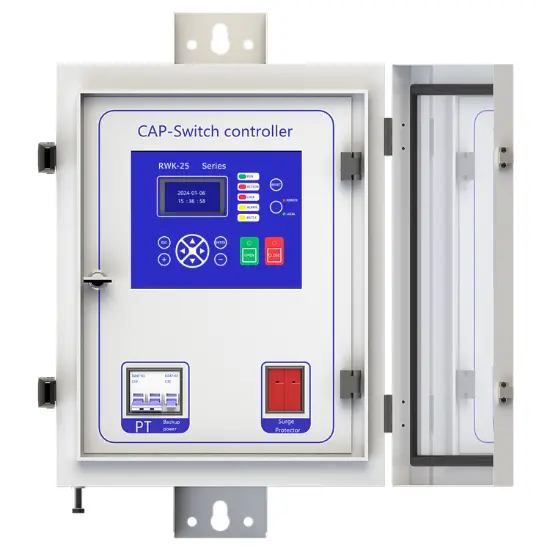
Capacitor bank controller used manual
Capacitor‑switch controller (-10℃~+55℃), for switchgear up to 40.5kV. Local / remote control, operation lockout & event logging for reactive‑power capacitor bank switching.
This document describes capacitor‑switch controller. It complies with IEC 60255‑1:2022 general requirements for measuring relays and IEC 60255‑27:2023 product‑safety (including insulation) requirements. It meets mechanical environmental tests IEC 60255‑21‑1 and full‑set EMC standard IEC 60255‑26:2023.
Environmental performance follows IEC 60068‑2 and IEC 60068‑2‑78. Compatible with vacuum, oil, gas circuit‑breakers and permanent‑magnet actuators. Configurable trip/close pulse width and dead‑time lockout via software. Local LCD‑keypad HMI with optional RF remote controller.
Non‑volatile memory stores operation, alarm and self‑check events. Alarms cover control‑circuit breakage, operating‑supply undervoltage and over‑operation‑count. Designed for pole‑mount outdoor reactive‑power capacitor‑bank switching.
It works with vacuum, oil and gas breakers including permanent‑magnet actuators. Trip/close pulse time defines energizing duration for breaker coil, adjustable from 20‑999 ms. It must match coil specification: too‑short pulse fails operation; over‑long pulse risks coil burnout.
No. Counters, trip, startup and alarm events are saved inside non‑volatile flash memory. Records can be viewed on‑LCD and manually cleared with password. Power loss will not erase historical data.
Mode is changed via front‑panel button with dedicated LED indication. Under local mode, panel keys and optional RF remote work while external binary‑input commands are blocked. Remote mode accepts only external control and disables local manual switching.
Dead‑time lockout restricts frequent capacitor switching to avoid repeated inrush stress on breaker mechanism and capacitor bank. It can be disabled by setting value to zero, but reasonable lockout time is recommended for site‑side equipment protection.