1.Introduction
Wind energy is a renewable energy source with significant development potential. In recent years, wind power technology has garnered extensive attention from scholars worldwide. As a key direction for wind power development, variable-speed constant-frequency (VSCF) technology employs the doubly-fed wind power system as an optimized solution. In this system, the generator’s stator windings connect directly to the grid, while VSCF control is achieved by regulating the frequency, amplitude, phase, and phase sequence of the rotor winding power supply. Since the converter only transmits slip power, its capacity can be significantly reduced.
Currently, doubly-fed wind power systems primarily use AC/AC or AC/DC/AC converters. AC/AC converters have been largely replaced by voltage-source AC/DC/AC converters due to their high output harmonics, low input power factor, and excessive power devices. Although matrix converters have been explored for doubly-fed systems, their complex structure, high voltage endurance requirements, and non-decoupled input/output control limit their adoption in wind power applications.
This study develops a voltage-source AC/DC/AC doubly-fed wind power system controlled by dual DSPs. The grid-side converter adopts voltage-oriented vector control, and the rotor-side converter uses stator-flux-oriented vector control. Experiments confirm that the system supports bidirectional power flow, independent input/output power factor regulation, low harmonic distortion, stable wide-range operation, and high-quality power generation from unstable energy sources like wind.
2.System Configuration
As shown in Figure 1, the system comprises five parts:
Doubly-fed generator (wound-rotor induction generator)
Voltage-source AC/DC/AC bidirectional PWM converter (back-to-back three-phase rectifier/inverter using IPM modules)
Dual-DSP controller (fixed-point DSP TMS320LF2407A + floating-point DSP TMS320VC33)
Grid-connection protection device (rotor/stator contactors)
Virtual variable-speed wind turbine (DC motor + SIEMENS SIVOREG thyristor speed control system)
Key Details
Converter connection: Grid-side via three-phase inductors; rotor-side via slip rings/brushes to generator rotor windings.
Dual-DSP roles: LF2407A handles data exchange, PWM generation, and grid signals; VC33 executes core algorithms; dual-port RAM enables real-time data sharing; CPLD processes address decoding.
Grid protection: Upon faults, disconnect stator contactor and block PWM first; delay before opening rotor contactor.
3 Vector Control for Doubly-Fed Generator
3.1 Control Principles
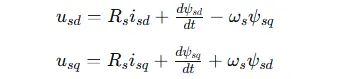
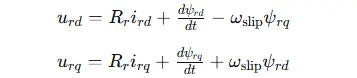
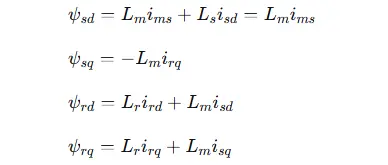
In the synchronous rotating frame (d-axis aligned with stator flux), the doubly-fed generator model is:
Stator voltage equations:
Rotor voltage equations:
Flux equations:
Torque equation:

Neglecting stator resistance voltage drop, stator flux satisfies:

Control strategy:
Constant stator generalized excitation current ims → Electromagnetic torque Te∝irq
For unity power factor, excitation current fully supplied by rotor (ims=ird)
After feedforward decoupling compensation, regulate urd and urq to control rotor flux and torque, respectively.
3.2 Grid Control
4.Grid-Side Rectifier Vector Control
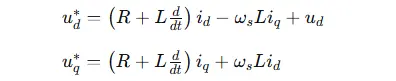
In the two-phase synchronous rotating frame (d-axis aligned with phase-A voltage), the PWM rectifier model is:
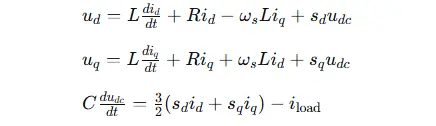
Power equations:

Control logic:
5 Experimental Results
Key Verifications:
Reliable soft grid-connection across a wide speed range;
Independent power factor regulation (stator/grid side both reach unity);
Bidirectional power flow capability of AC/DC/AC converter meets generation demands.
6.Conclusion
This study develops a dual-DSP-based voltage-source AC/DC/AC doubly-fed wind power system. Combined with grid-side voltage-oriented and rotor-side stator-flux-oriented vector control, experiments demonstrate:
The system achieves bidirectional power flow and independent input/output power factor regulation;
Low harmonics and high power factor ensure power quality;
Soft grid-connection/disconnection reduces mechanical/electrical stress;
Applicability to megawatt-class large-scale wind power installations.

 Login