I. Project Background & Core Pain Points
Malaysia lies in the tropics — year-round high temperature and humidity, with annual average relative humidity exceeding 80%. A high-rise residential complex's basement distribution system has long operated in this harsh environment. The original oil-immersed transformers gradually exposed multiple structural defects, becoming a "major headache" for property management:
- Prominent Safety Hazards (Safety Anxiety): Oil-immersed transformers carry oil leakage risk; insulation performance accelerates deterioration in hot-humid conditions; short-circuit and flashover fault probabilities rise significantly; fire hazard cannot be ignored.
- Frequent Failures, Reactive O&M (Management Pain Point): Equipment highly sensitive to humidity; frequent failures drive escalating resident power outage complaints; O&M pressure mounts; effective early-warning means lacking.
- Capacity Bottleneck Emerging (Development Constrained): With rising occupancy rates and EV charger proliferation, power demand grows continuously; original equipment capacity can no longer meet supply needs; capacity expansion retrofit is urgent.
From the resident perspective, these equipment-level issues have directly translated into daily life disruptions: rainy-season basement dampness and heat, disturbing burnt odor around distribution rooms; elevators stalling during peak load, trapping elderly and children — recurring complaints; every planned outage halts the entire building's rhythm, owner chat groups flood with grievances, property satisfaction plummets.
Based on the above, owner core demands focus on three dimensions:
| Demand Dimension |
Specific Targets |
| Safety & Reliability |
Eliminate fire hazards; adapt to high humidity; ensure continuous supply |
| O&M Convenience |
Reduce patrol frequency; lower maintenance costs |
| Economic Sustainability |
Control initial investment; extend equipment life |
II. Technical Solution
2.1 Core Equipment Selection
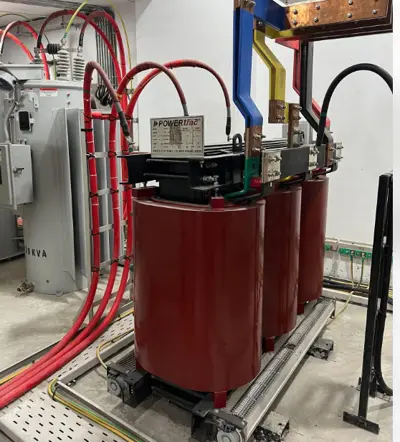
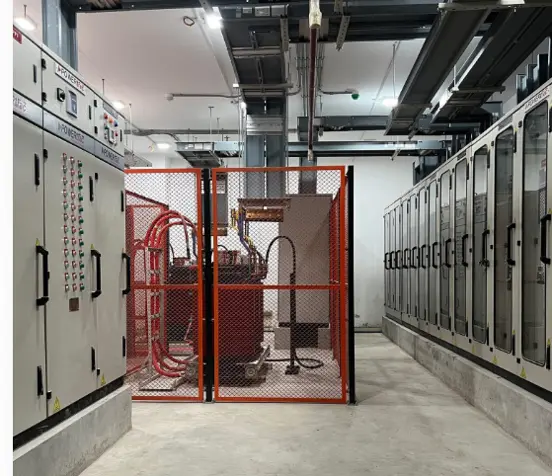
SCB Series Epoxy Resin Cast Dry-Type Transformers selected. Windings use vacuum epoxy resin casting, forming a solid insulation layer that completely isolates moisture and dust, fundamentally solving insulation aging in high-humidity environments. Compared to same-capacity oil-immersed units, volume is significantly reduced, saving footprint and reserving space for future expansion.
2.2 Intelligent Temperature Control & Cooling
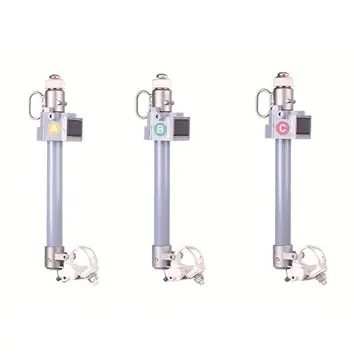
Each transformer equipped with intelligent temperature controller, monitoring winding temperature in real-time via embedded platinum resistance (Pt100), with staged response:
| Temperature |
Action |
| 80°C |
Auto-start cooling fans |
| 130°C |
Over-temperature alarm |
| 150°C |
Over-temperature trip |
Thresholds above based on Class F insulation; Class H corresponds to 100°C / 155°C / 175°C — final values per equipment technical datasheet.
Equipment base fitted with forced-air cooling system, combined with basement mechanical ventilation, creating "natural convection + forced air cooling" dual cooling mechanism.
2.3 Installation & Cable Routing
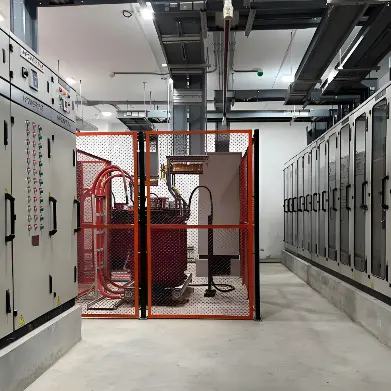
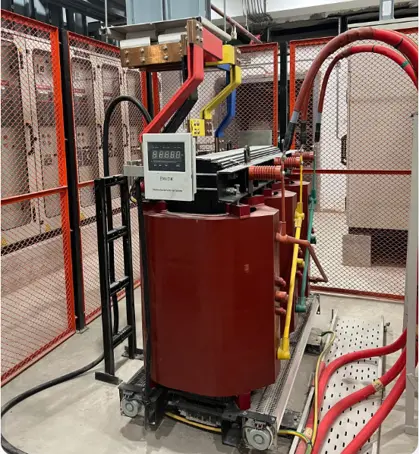
- HV Side: Red insulated jacketed flexible connections; bend radius per code.
- LV Side: Yellow/Green/Red/Blue phase sequence labeling for maintenance ease.
- Safety Protection: Orange metal mesh fencing + temperature controller electronic warning — dual safeguard.
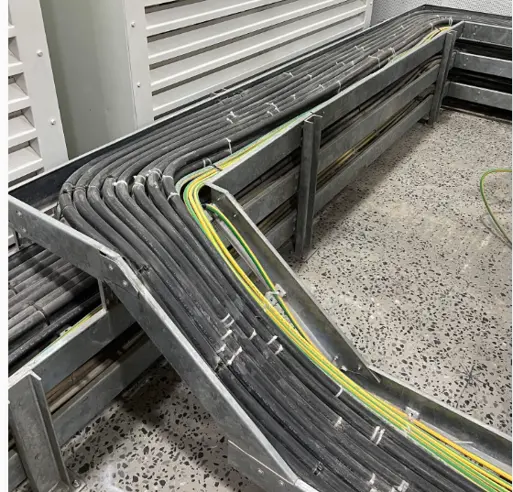
- Cable Routing: Power and control cables in separate trenches, strong/weak current separation; all metallic parts equipotential bonded; grounding resistance per MS IEC 60364.
III. Economic Benefit Analysis
3.1 Initial Investment
- Volume significantly smaller than same-capacity oil transformers → saves substation floor area → indirectly adds parking or equipment room space.
- No oil pit, oil drainage piping, or dedicated fire protection facilities required → civil construction cost reduced accordingly.
3.2 O&M Cost
Annual maintenance man-hour comparison below. Dry-type transformers eliminate two high-frequency tasks: oil sampling and quarterly patrols — O&M burden drastically reduced:
| Maintenance Item |
Oil-Immersed (hrs/yr) |
Dry-Type (hrs/yr) |
| Oil sampling (2×4h) |
8 |
0 |
| Quarterly patrol (4×3h) |
12 |
0 |
| Daily cleaning + annual patrol |
4 |
4 |
| Total |
24 |
4 |
Man-hours estimated per domestic high-rise residential O&M practice; actual per local property standards.
Annual maintenance man-hours reduced ~83%. Intelligent temperature controller supports remote monitoring, enabling "unattended + anomaly alarm" operation.
3.3 Full Lifecycle Returns
- Design Life: ≥30 years at rated conditions — 10+ years longer than oil-immersed.
- Energy Saving: Dry-type transformer no-load losses significantly lower than same-capacity oil units; actual energy savings per selected model.
| Comparison Dimension |
Oil-Immersed |
Dry-Type |
Improvement |
| Footprint |
Baseline |
Significantly reduced |
Per selection |
| Civil cost |
Baseline |
Reduced |
Per selection |
| Annual maintenance |
24 hrs |
4 hrs |
≈83% ↓ |
| Design life |
~20 years |
≥30 years |
50%+ ↑ |
| No-load loss |
Baseline |
Significantly lower |
Per selection |
3.4 Investment Payback Estimate
Typical high-rise residential retrofit investment covers: equipment procurement, civil adaptation, and installation/commissioning. vs. traditional oil-immersed solution, dry-type generates ongoing returns in:
- O&M Labor Savings: Annual man-hours 24h → 4h; at local electrician hourly rate, annual labor cost savings significant.
- Energy Savings: Reduced no-load loss × 8,760 hrs/yr continuous operation → cumulative annual electricity savings.
- Avoided Failure Losses: Reduced resident complaint handling costs, emergency repair fees, and property reputation damage from outages.
Combined benefits project 3–5 year payback, with continued net returns throughout remaining lifecycle. Exact payback period per actual model selection and local tariffs.
IV. Implementation Plan
"Phased, Low-Disruption" strategy; overall schedule:
| Phase |
Work Content |
Duration |
| Preparation |
Site survey, temporary power scheme, construction permits |
1 week |
| Equipment Production & Logistics |
Factory scheduling, factory acceptance testing, sea freight & customs |
5–6 weeks |
| Civil Adaptation |
Foundation modification, ventilation upgrade, grounding grid |
1 week |
| Equipment Installation |
Old equipment removal, new equipment positioning, wiring |
3 days |
| Commissioning & Acceptance |
Insulation/withstand voltage tests, temp control integration, loaded trial run |
2 days |
| Handover & Training |
Documentation transfer, O&M training |
1 day |
Core power-off work scheduled during weekend off-peak; 72-hour advance resident notice; emergency generator for critical loads (elevators, fire protection). If construction window coincides with monsoon season (Oct–Mar), rain contingency plan prepared for civil phase.
V. Risk Analysis
Risks across construction process with mitigation:
| Risk Item |
Level |
Mitigation |
| Power outage during construction |
High |
Emergency generator for elevators, fire protection, critical loads |
| New/old equipment interface mismatch |
High |
Pre-survey HV/LV cabinet interfaces & busbar dimensions; reserve adapter solution |
| Old equipment removal safety |
Medium |
De-energize → verify zero voltage → install grounds; dedicated safety supervisor |
| Restricted transport access |
Medium |
Pre-survey; segmented hoisting if needed |
| Sea freight & customs delays |
Medium |
Early shipping schedule; 1-week buffer |
| Commissioning unexpected faults |
Low |
Manufacturer on-site; spares delivered concurrently |
Risk Level: High = potential injury/major property loss; Medium = equipment damage/schedule delay; Low = manageable impact.
VI. Acceptance Criteria
Equipment must pass key indicators before delivery to ensure design performance met:
| Acceptance Item |
Standard |
Method |
| Insulation Resistance |
Per IEC 60076-11 |
Insulation resistance tester |
| Power Frequency Withstand Voltage |
Per project voltage level & local electrical code |
Withstand voltage test set |
| Temperature Control Interlock |
80°C fan auto-start, 130°C alarm, 150°C trip |
Simulation test |
| Grounding Resistance |
Per MS IEC 60364 |
Ground resistance tester |
| Phase Sequence Verification |
A/B/C phases consistent with system |
Phase sequence meter |
| Noise Test |
Per equipment technical datasheet |
Sound level meter |
| Loaded Trial Run |
Rated load continuous 24h; temp rise normal, no abnormal noise |
Field observation + IR thermography |
VII. After-Sales Service
To ensure long-term stable operation, the following commitments are provided:
- Warranty: 24 months free warranty from acceptance sign-off.
- Response: 2-hour remote response; Peninsular Malaysia 24-hour on-site; East Malaysia 48-hour on-site.
- Inspection: 2 free on-site inspections per year during warranty, with health assessment report.
- Spare Parts: Critical spare parts supply guaranteed for 10 years post-production discontinuation.
- Training: ≥8 hours specialized training at handover.
VIII. Summary
This solution centers on SCB Epoxy Resin Cast Dry-Type Transformers, systematically resolving safety, O&M, and economic challenges of residential distribution systems in hot-humid environments:
- Safety: Hermetic structure eliminates oil leakage; dual cooling ensures stable operation.
- O&M: Maintenance-free design + remote monitoring drastically reduces labor dependency.
- Economics: Full lifecycle cost significantly optimized; long-term benefits prominent.
The project provides a replicable benchmark case for residential distribution retrofits in Southeast Asia and similar tropical regions.

 Login