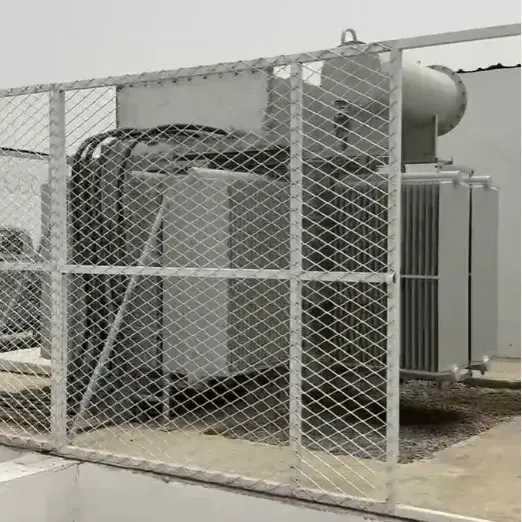
High temperature, high humidity, confined space and fluctuating loads in the basements of high-rise residential buildings in tropical regions impose stringent requirements on the safety and stability of power distribution equipment.
This project adopts SCB epoxy-cast dry-type transformers to replace traditional oil-immersed equipment, thoroughly addressing challenges including moisture corrosion, fire risks and heavy maintenance workload, and has achieved favorable engineering application results.
I. Project Overview & Application Pain Points
Geographic Environment: Project located in Malaysia's tropical rainforest climate zone, annual average temperature ~28°C, relative humidity >80% year-round, concentrated rainfall during monsoon season.
Load Characteristics: High-density high-rise residential complex (12 buildings, 30+ stories each), predominantly residential and air-conditioning loads. With rising temperatures in recent years, AC utilization is extremely high, resulting in significant load fluctuations during evening peak (20:00–22:00) and hot seasons.
Distribution Layout & Pain Points: Transformers and LV switchgear installed in underground equipment level — compact space, adjacent to densely occupied areas. Traditional oil-immersed transformers would pose not only oil leakage risk contaminating groundwater, but also unacceptable fire hazards for high-rise residences. The project urgently needed a safe, moisture-proof, compact, and low-maintenance distribution solution.
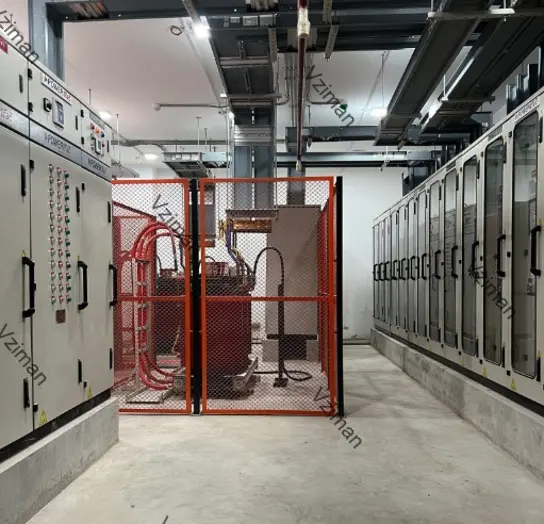
Figure 1: Post-retrofit distribution room overview. Transformer zone isolated by orange metal fencing, balancing safety clearances, ventilation, and compact layout for efficient underground space utilization.
II. Solution Comparison & Selection Basis
Based on basement space constraints, high-rise fire safety requirements, moisture-proof needs, and O&M accessibility, a systematic comparison was conducted between traditional oil-immersed and SCB epoxy resin cast dry-type transformers:
| Comparison Dimension |
Traditional Oil-Immersed Transformer |
SCB Epoxy Resin Cast Dry-Type (Selected) |
Technical Notes |
| Fire Safety & Environment |
Contains insulating oil; leakage & fire risk; typically requires accident oil pit & drainage facilities |
Flame-retardant, self-extinguishing; oil-free, zero leakage risk; suitable for load center & basement installation |
Saves civil construction investment |
| Hot-Humid Adaptability |
Insulation oil risks emulsification & degradation in high humidity; requires regular oil supervision |
Windings epoxy cast — excellent moisture & dust resistance; terminals & creepage surfaces still require ventilation & periodic cleaning |
Maintenance simplified |
| Overload & Thermal Management |
Overload capability limited by oil temperature rise & oil aging |
With forced-air cooling & intelligent temperature control: good short-time overload capability; high thermal class suits evening AC peak loads |
Per manufacturer curves |
| Installation Space |
Unit + safety clearances + accident oil pit = large footprint |
Compact structure; can be placed close to LV switchgear; suitable for intensive basement distribution |
Releases usable space |
| O&M Workload |
Regular oil analysis, filtration, oil level & seal checks |
Primarily cleaning, tightening, IR thermography, insulation & functional checks |
Lower lifecycle cost |
Further O&M Risk Perspective: Per Malaysia Energy Commission (Suruhanjaya Tenaga) statistics, ~35.7% of electrical accidents stem from poor maintenance and installation defects. In high-humidity environments, oil-immersed transformers face significantly higher oil supervision and sealing maintenance pressure vs. dry-type solutions; insulation degradation risk from maintenance lapses cannot be ignored. This industry data further validates the dry-type solution's suitability for this project.
Selection Conclusion: For high-rise residential basements with high humidity, fire safety requirements, and space constraints, SCB dry-type transformers combined with standardized LV distribution and intelligent temperature control offer superior comprehensive technical adaptability and lifecycle economics.
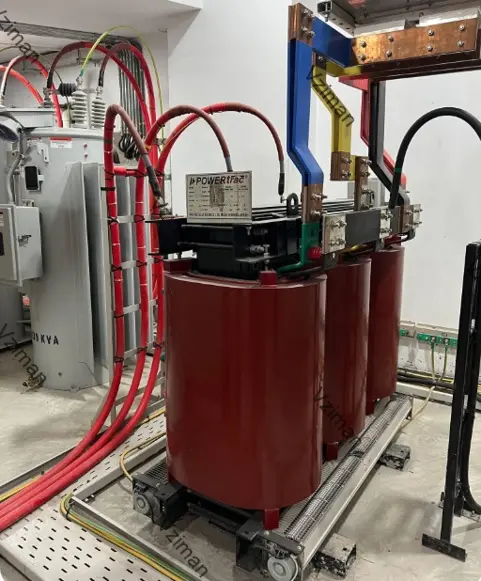
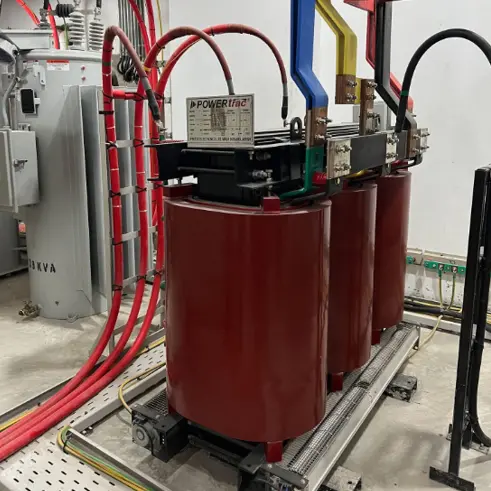
Figure 2: High flame-retardant epoxy resin casting eliminates fire hazard; integrated intelligent temperature controller on top enables real-time monitoring.
III. System Configuration & Engineering Implementation
- Configuration: Epoxy resin cast dry-type transformer with base-frame rollers, intelligent temperature controller, and forced-air cooling system (specific capacity, voltage ratio, impedance, vector group per as-built documentation). Temperature control system provides real-time winding temperature display, staged fan start/stop control, over-temperature alarm & protection outputs, plus reserved remote communication interface for future integration with building energy management platform.
- Construction Highlights: Constrained by basement access conditions; hydraulic shifting tools and traction used with equipment base rollers for positioning — completed without damage to building structure; leveled, anchored, and grounding verified post-positioning.
3.2 LV Distribution System Configuration & Construction
- Configuration: Draw-out LV switchgear with circuit breakers, power monitoring & protection units; enclosures maintain protection class & safety clearances while incorporating observation windows and ventilation channels for operational patrol.
- Construction Highlights: Busbar and cable terminal connections tightened with torque tools; contact surfaces prepared and coated with conductive paste; pre-commissioning and early-operation IR thermography verified critical joint temperature rise within standards & manufacturer limits.
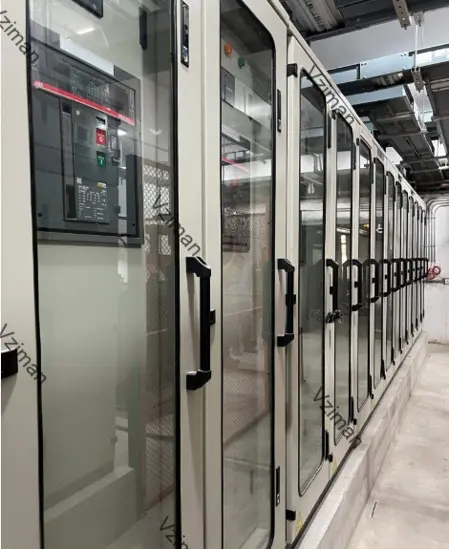
Figure 3: LV switchgear array. Large transparent viewing windows for patrol inspection; high-performance breakers; neat layout on moisture-proof bases; standardized workmanship.
3.3 Electrical Connections & Safety Protection
- Configuration: HV side via insulated jacketed cables; LV side via color-coded phase-sequence busbars to LV switchgear main bus; high-current joints coated with conductive paste and torqued to standard. Transformer zone enclosed by reliably grounded metal mesh fencing — maintains safety clearances while ensuring ventilation; base fitted with rubber anti-vibration pads to reduce structure-borne noise.
- Temperature Control & Protection Commissioning: Temperature controller implements staged control per manufacturer & design requirements — fan start/stop, over-temperature alarm & protection outputs; interlock verification with forced-air cooling and protection circuits completed; specific setpoints per commissioning records.
- Acceptance Testing & Labeling: In high-humidity environment completed: insulation resistance test, power-frequency withstand voltage test, ratio / DC resistance / vector group checks, and temperature control functional testing — all results met standards & manufacturer requirements, passed first time. Transformer fencing reliably grounded & locked; warning signs posted; phase sequence, grounding, cable circuit labels standardized for future O&M.
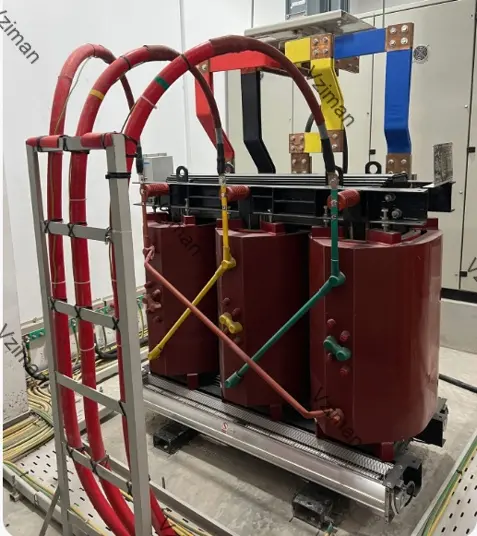
Figure 4: Transformer electrical connection details. HV side red flexible connections properly routed; LV side busbars color-coded, securely connected; standardized workmanship.
3.4 Cable Routing & Ventilation Design
- Configuration: Hot-dip galvanized cable trays; power/control separation; cables elevated to avoid ground water; bend radius, support spacing, grounding continuity per code. Integrated with basement mechanical ventilation system to ensure equipment cooling and reduce condensation risk.
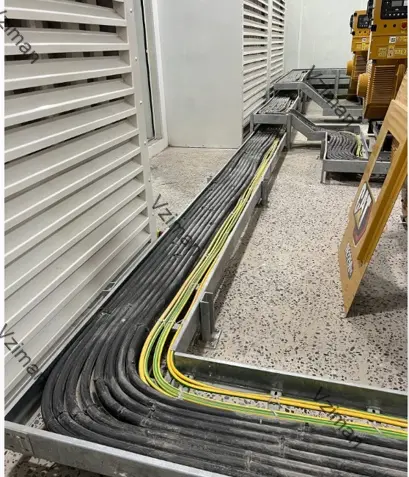
Figure 5: Cable routing & ventilation system. Organized cable trench layout; wall-mounted intake louvers ensure dry, well-ventilated equipment operating environment.
| Aspect |
Verification Result |
| Hot-Humid Adaptability |
Full-year high temperature/humidity & monsoon season endured; epoxy cast winding insulation stable; no condensation flashover or insulation anomaly alarms. |
| Load & Thermal Performance |
Evening peak load rate reached ~85%, ~40 percentage points above daytime average (estimated); significant load fluctuation. Forced-air cooling auto-engaged per logic; winding temperatures within design & manufacturer limits; no overload protection tripping. |
| Noise Control |
With anti-vibration measures, measured operating noise <55 dB at ~1 m distance; meets residential auxiliary equipment environmental requirements; zero property management complaints. |
| Operational Continuity |
First commissioning year tracking: zero unplanned outages related to transformer body; system running stably. |
Note: Above operational data based on site tracking records; actual performance subject to load growth, environmental control, and maintenance quality.
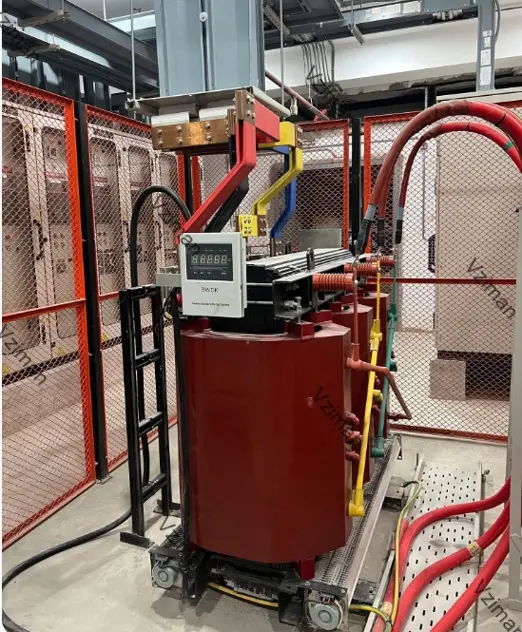
Figure 6: Transformer temperature monitoring & safety protection. Intelligent controller monitors winding temperature in real time; combined with fencing protection, ensures safe stable operation under high temperature & high load.
V. Lifecycle Cost Advantage Analysis
Compared to oil-immersed solution, dry-type solution offers advantages in the following dimensions (qualitative analysis; specific amounts subject to local quotations):
| Cost Dimension |
Dry-Type Advantage |
| Civil & Fire Protection Investment |
No accident oil pit or drainage facilities required; reduces associated civil, fire, and environmental protection costs |
| Annual O&M Cost |
Focus on cleaning, tightening, IR/electrical checks; no oil supervision or oil handling; maintenance cost significantly reduced |
| Operating Energy Consumption |
Transformer loss levels improved vs. conventional; electricity cost savings potential |
| Indirect Fault Losses |
Reduced risk of indirect losses from equipment failures & unplanned outages; this dimension influenced by property management, grid side, load management — recommend scenario analysis |
Synthesis: While dry-type solution carries a procurement premium, this premium is recoverable over the lifecycle via elimination of accident oil pit civil works, simplified O&M processes, and reduced indirect fault losses — yielding lifecycle total cost advantage (specific savings magnitude varies with local electricity tariffs, maintenance rates, and load profiles).
VI. Project Summary & Replication Value
Technical Level: This project validates that in tropical high-humidity, high-density residential basement scenarios, a comprehensive approach employing SCB epoxy resin cast dry-type transformers, standardized LV switchgear, intelligent temperature control, code-compliant cable tray routing, and vibration isolation effectively balances fire safety, space utilization, hot-humid adaptability, and operational reliability.
Economic Level: Despite equipment procurement premium, dry-type solution achieves lifecycle total cost optimization through accident oil pit elimination, O&M simplification, and indirect fault loss reduction.
Replication Value: Successful implementation provides a standardized reference template for subsequent Phase 2, Phase 3 project distribution designs. Applicable to basement distribution projects in high-rise residences, commercial complexes, and public buildings across tropical/humid regions of Southeast Asia, South Asia, and similar climates. When replicating, key attention areas include:
- Local climate impact on ventilation design requirements
- Equipment protection class matching
- O&M team competency in dry-type transformer maintenance standards
- Critical: In extremely humid environments where condensation risk exceeds natural ventilation capacity, supplementary dehumidification measures must be provided to ensure long-term reliable operation.

 Login